PocketBook Verse Pro vs PocketBook Era: Is the Bigger Screen and Speaker Worth It

Kenji Arai
October 15, 2026
PocketBook has quietly become the e-reader brand for people who want a dedicated reading device without signing up to a bookstore. Its devices open nearly any file format, work without an account, and never nudge you towards a store. Once you have decided that is what you want, the next question is which PocketBook, and two models come up most often for people who read mainly novels and non-fiction: the compact Verse Pro and the larger, button-equipped Era.
On paper they look like small and large versions of the same thing. In daily use they feel different enough that the choice comes down to where and how you read. I have read on both, through commutes, flights and the kind of long evening reading sessions that show up every hardware compromise.
What you get with either one
Start with what the two share, because it is most of the reason to buy a PocketBook at all. Both run PocketBook’s software, which opens EPUB, PDF, MOBI, FB2, DjVu, comic archives, Word documents and more without conversion. Both handle Adobe-protected EPUBs from stores and libraries directly on the device. Both offer Dropbox sync, PocketBook’s own cloud, and an email address that delivers files straight to the reader. Both support text-to-speech and audiobooks over Bluetooth. Both are waterproof, with sharp 300 ppi black-and-white screens and an adjustable front light with warm and cool tones.
If you already know you want those things, and especially if your books come from many places, either device will serve you well. How PocketBook compares with a mainstream brand on these points is covered in PocketBook InkPad vs Kobo Libra Colour. Here the question is narrower: compact, or larger with more physical controls?
| PocketBook Verse Pro | PocketBook Era | |
|---|---|---|
| Screen | 6-inch, 300 ppi | 7-inch, 300 ppi |
| Page-turn buttons | Physical buttons along the bottom edge | Physical buttons on a side grip |
| Audio | Bluetooth headphones and speakers | Bluetooth, plus a built-in speaker |
| Storage | 16 GB | 16 GB or 64 GB, depending on version |
| Waterproofing | Yes | Yes |
| Size in the hand | Pocketable, light | Larger, asymmetric grip |
| Price | Lower | Noticeably higher |
Line-ups and specifications vary between regions and production runs, and PocketBook also sells a colour version of the Era. Check the exact model’s specifications before buying, especially storage and audio features.
Six inches or seven: more than it sounds
The screen difference is one inch on the diagonal, but it changes how much text fits on a page more than that suggests. At the same font size, the Era shows noticeably more words per page, so you turn pages less often, and long paragraphs feel less chopped up. If you read at a larger font size, perhaps because your eyes appreciate it or you read late at night, the Era’s extra space matters even more. At large sizes, a 6-inch screen can feel like it shows only a few lines.
The Verse Pro’s advantage is the other side of the same coin. It slips into a jacket pocket or a small bag, it is light enough to hold in one hand for hours, and you are more likely to have it with you when you have ten unexpected minutes. Many people end up reading more on a smaller device simply because it is always there.
Buttons and how you hold it
Physical page-turn buttons are one of the main reasons people choose PocketBook over touch-only readers, and both devices have them, placed differently.
The Era’s buttons sit on a thicker grip along one side, like a book’s spine. You hold the device by the grip and turn pages with your thumb without moving your hand, which is the most comfortable way to read for long periods. A built-in sensor rotates the display, so you can hold it in either hand with the grip on the side you prefer.
The Verse Pro keeps its buttons along the bottom edge, in PocketBook’s traditional layout. They work well, and are welcome when your hands are cold or the screen is wet, but you reach down to them rather than resting a thumb on them, and some readers find that less natural for one-handed reading. If you mainly read with the device propped up, or alternate between hands, this matters less.
Both also support turning pages by tapping or swiping the screen, so you are never forced to use the buttons. But if buttons are the reason you are buying a PocketBook, try to hold both before deciding, because grip is personal.
Listening as well as reading
Both readers can read books aloud with text-to-speech and play audiobooks. The difference is how you listen. The Verse Pro needs Bluetooth headphones or a speaker. The Era adds a built-in speaker, so you can listen to a chapter while cooking or let text-to-speech read to you in bed without pairing anything.
Text-to-speech on e-readers is functional rather than beautiful, but for people who switch between reading and listening, or who use it for accessibility, the speaker is a real convenience. If you never listen, it is irrelevant.
Storage and the size of your library
Sixteen gigabytes holds thousands of ordinary ebooks, so for novels and non-fiction, storage is rarely the limit. It becomes one if you keep comics, large PDFs, or audiobooks on the device, all of which take up far more space. The Era’s larger storage version is worth it for those cases; for a text-only library it is not.
If you manage a large library on your computer, a tool such as Calibre makes moving books on and off either device simple, and Calibre vs Calibre-Web covers how to keep that library organised and available to your e-reader over Wi-Fi.
PDFs, comics and anything with a fixed layout
The size difference matters most for files that cannot reflow. A novel adapts to any screen, but a PDF, a comic or a scanned document is laid out for a page, and on a small screen it has to shrink.
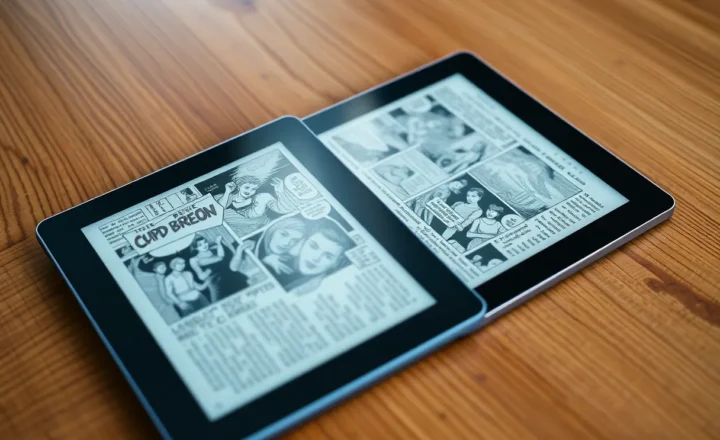
PocketBook’s software helps on both devices. It can reflow text-based PDFs into a readable single column, crop away wide margins, and step through two-column papers one column at a time. Comics can be read panel by panel. Even so, there is only so much a 6-inch screen can do. On the Verse Pro, PDFs are readable with these tools but rarely comfortable, and comics feel cramped. On the Era, the extra inch makes reflowed PDFs and comic pages noticeably more usable, especially in landscape mode, where the screen’s width works in its favour.
Neither is a real PDF device. For papers and manuals, a larger reader such as PocketBook’s 7.8-inch InkPad, or an even bigger e-ink tablet, is the better tool. But if the occasional PDF or comic is part of your reading, it is one more point in the Era’s favour.
Three readers, three answers
It helps to think in terms of who is reading and where.
The commuter. Reads in short bursts on trains and buses, often standing, and wants the device always in a pocket. The Verse Pro is the better fit: light, small, and quick to pull out. The bottom buttons work fine for short sessions, and you will carry it more often.
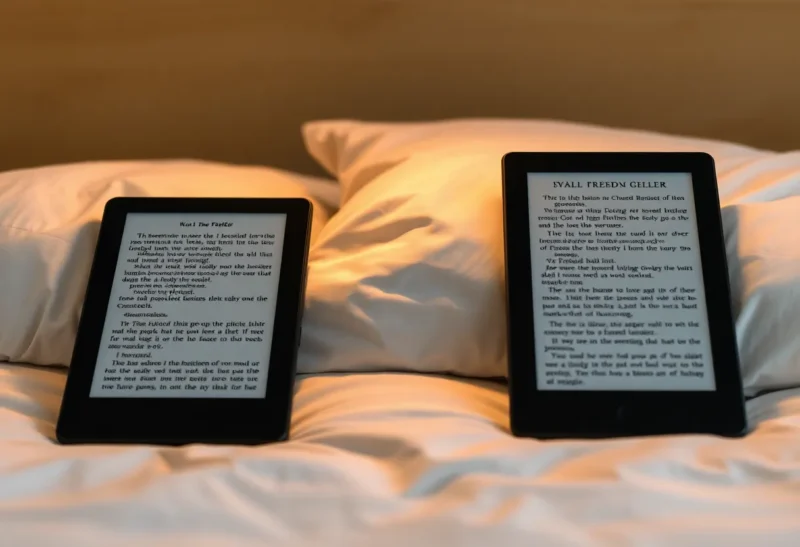
The long-session reader. Reads for an hour or more at a time, in an armchair or in bed, often with a larger font. The Era is clearly better: more text per page, a grip that makes one-handed reading effortless, and side buttons that keep your hand still. The higher price buys comfort over hundreds of hours.
The reader-and-listener. Switches between reading and audiobooks, or uses text-to-speech regularly. The Era’s built-in speaker removes a step every time, and its larger storage option suits audiobook files.
Battery, light and screen quality
Both last weeks on a charge with normal reading, more if you keep the front light low and Wi-Fi off. Audio use, especially through the Era’s speaker, drains the battery faster than reading, so listeners should expect to charge more often.
The screens are both sharp at 300 ppi, and both front lights adjust colour temperature, warmer for evenings and cooler for daytime. On a side-by-side test, differences in evenness and contrast between individual units can be larger than differences between the models, so do not choose based on screen quality alone.
Is the bigger screen and speaker worth it?
The Era costs noticeably more, so the question in the title deserves a direct answer. The bigger screen is worth it if you read for long stretches, read at large font sizes, or read mostly at home. The speaker is worth it if you listen often. The side grip is worth it if you value effortless one-handed reading. If two or more of those describe you, the Era earns its price every week.
If none of them do, and you mainly want a light, pocketable reader for commutes and travel, the Verse Pro gives you PocketBook’s best qualities, its format support, sideloading and freedom from a store, for considerably less money. Either way, you end up with a reader that treats your books as yours, which is the real reason to choose PocketBook in the first place.