The Hidden Labor Behind Content Moderation for AI Training Data

Futurion Editorial
July 9, 2026

When a chatbot politely declines to describe how to make a weapon, or a text-to-image model refuses to generate a certain kind of harmful content, most users experience that refusal as a clean, automatic boundary — a rule the model simply “knows.” What almost nobody sees is the person who taught it that boundary: a contract worker, often thousands of miles from the company whose logo is on the product, who spent eight hours a day reading or viewing the material the model needed to learn to refuse.
This is the least discussed part of the modern AI supply chain. Every major language model and image generator released in the last five years has passed through a data labeling and moderation pipeline staffed overwhelmingly by outsourced contract workers, frequently in Kenya, the Philippines, India, and other countries where English-language labor is available at a fraction of US or European wages. Their job, in large part, is to look at the worst material the internet has produced — violent imagery, graphic descriptions, hate speech, material involving child exploitation — and label it so a model can learn what to avoid producing or amplifying. The work is essential to making AI systems safe to deploy. It is also some of the most psychologically corrosive labor in the modern tech economy, and it has been built, almost from the start, to stay invisible.
How the Pipeline Actually Works
Training a large language model to refuse harmful requests, or a content moderation classifier to flag abusive material, requires a dataset of labeled examples: content marked as harmful alongside content marked as acceptable, often with fine-grained categories describing exactly why. Someone has to create those labels, and for the categories that matter most — the genuinely disturbing material, not the easy edge cases — that someone is a human reviewer, because automated pre-filtering systems are not yet reliable enough to handle the ambiguous and severe cases without human judgment in the loop.
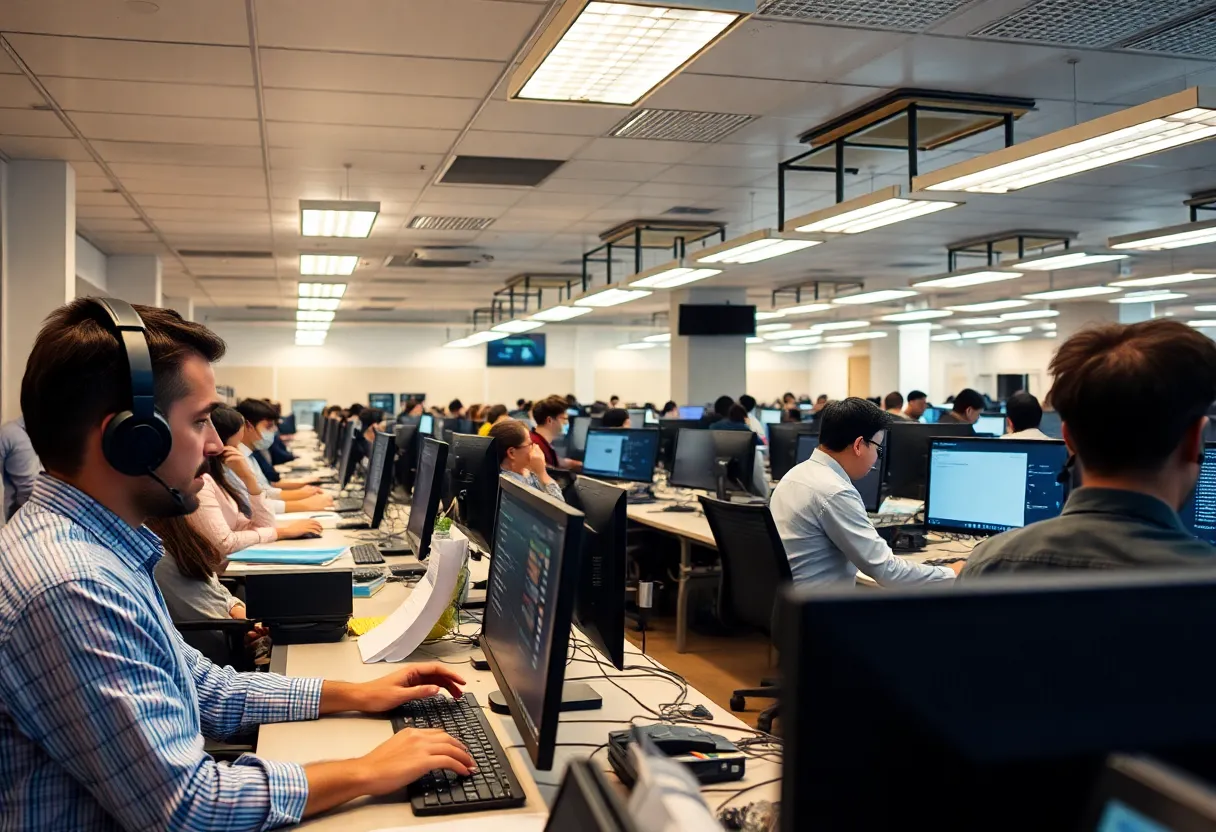
Major AI labs rarely do this labeling in-house. Instead, they contract with data annotation and business-process-outsourcing firms — companies like Sama, Teleperformance, Majorel, and a long tail of smaller outfits — who in turn hire and manage the actual workforce. This layered structure is not incidental. It creates legal and reputational distance between the AI lab whose name appears on the product and the working conditions of the people who made key parts of that product possible. When investigative reporting in 2023 revealed that workers in Kenya were being paid as little as $1.32 to $2 an hour to label graphic content for a major AI company’s safety systems, the company in question was able to point to the outsourcing firm as the direct employer, even though the contractual relationship and the specifications for the work originated entirely with the AI lab.
The categories of content workers are asked to review are, by design, the material a functioning safety system most needs to recognize: sexual abuse imagery, graphic violence, detailed self-harm content, extremist material, and hate speech in its most explicit forms. There is no way to train a model to reliably refuse to produce or amplify this content without some human, somewhere, having looked at enough real examples to label them accurately. The alternative — not building that training data at all — would leave AI systems considerably less safe for the billions of people who will never see the raw material behind the safeguard.
The Psychological Cost, Documented Repeatedly
This is not a new problem invented by generative AI — it is a direct continuation of the content moderation labor model that social media platforms built over the previous decade, and the psychological research on that earlier wave is unambiguous. Studies and journalistic investigations of Facebook’s and YouTube’s moderation contractors found rates of post-traumatic stress symptoms among reviewers comparable to those found in combat veterans and first responders, driven by sustained, repeated exposure to graphic and disturbing material with little psychological support and enormous throughput pressure.
Interviews with AI data-labeling workers describe strikingly similar patterns: intrusive thoughts, difficulty sleeping, and a persistent sense of alienation from the material’s afterlife — a Nairobi-based worker knowing exactly what a phrase in a chatbot’s refusal script was built to prevent, having sat with the raw examples that trained it, while the people asking the chatbot mundane questions have no idea that specific safeguard exists because someone absorbed a version of the underlying harm on their behalf. Some outsourcing contracts include access to counseling services; workers and labor advocates who have reviewed these programs describe them, in many documented cases, as underfunded, understaffed relative to caseload, or offered in ways that make workers reluctant to use them for fear of being flagged as unable to handle the work and losing shifts.
Quotas compound the problem. Workers in several documented contracts were expected to review and label a fixed volume of items per shift — sometimes several hundred pieces of content across an eight-hour day — with the throughput pressure structurally at odds with taking the kind of mental break that would let a worker recover between disturbing pieces of material. The economics of outsourced data labor are built around cost-per-label efficiency, and slowing down to protect a worker’s mental state is, in that framework, a cost rather than a feature.
Why This Stays Hidden
Part of why this labor is invisible is structural: outsourcing contracts frequently include non-disclosure provisions that prevent workers from naming which AI company’s data they are labeling, which makes it functionally impossible for the public to connect a specific chatbot’s safety behavior to the specific workforce that trained it. Part of it is simply that AI companies have strong incentives — reputational, legal, and competitive — not to draw attention to this layer of their supply chain, especially as public discourse around AI increasingly frames these companies as building toward beneficial, even utopian, futures.
And part of it is that the finished product genuinely erases the trace of the labor. A refusal message like “I can’t help with that request” gives no indication of the specific example, or the ten thousand specific examples, that taught the underlying classifier where the line was. This is not unique to AI — plenty of physical manufacturing supply chains obscure difficult labor behind a finished consumer product — but it is a particularly stark version of the pattern, because AI products are frequently marketed on the premise of near-magical automation, when a meaningful portion of what makes them safe to use at all was manual, human, and often traumatic.
What Accountability Efforts Have Actually Achieved
There has been real, if limited, progress. Investigative journalism from outlets covering the labor conditions behind major AI labs has forced at least some public acknowledgment and, in a few documented cases, contract renegotiation with outsourcing partners. Worker organizing efforts, including a unionization drive among content moderators in Kenya that led to the formation of the Data Labelers Association in 2023, have started to create collective bargaining leverage that individual contract workers never had. Some AI labs have published more detailed wellness and support commitments for annotation contractors following public pressure, though independent verification of how consistently those commitments are honored across every subcontracted worksite remains difficult for outside observers to confirm.
Regulatory attention is beginning to catch up as well. The EU’s proposed rules on platform work and elements of the AI Act’s supply-chain transparency requirements have started to create pressure for AI companies to disclose more about the human labor embedded in their systems, though enforcement mechanisms specific to overseas subcontracted annotation labor remain underdeveloped relative to the scale of the industry.

What Would Actually Change This
People who study this labor market consistently point to a small set of concrete changes that would matter more than any amount of public awareness alone: enforceable caps on daily exposure to the most severe content categories, mandatory and genuinely accessible mental health support built into outsourcing contracts rather than left optional, transparent disclosure requirements so the public and researchers can actually trace which labor pipelines fed which deployed models, and wage structures that reflect the psychological difficulty of the work rather than treating it as generic low-skill data entry.
None of these changes are technically difficult to implement. They are primarily a matter of AI labs choosing to absorb higher costs and more scrutiny in a part of their supply chain that has, until recently, been almost entirely shielded from public attention. As AI systems become more capable and more widely deployed, the volume of training and safety-labeling work is not going to shrink — if anything, more capable and more widely used models require more, not less, of this human judgment applied to edge cases automated systems still cannot reliably handle. The question the industry has not yet answered honestly is whether the people doing that work will finally be treated as a visible, valued part of building AI safely, rather than a cost to be outsourced, obscured, and forgotten the moment the product ships.