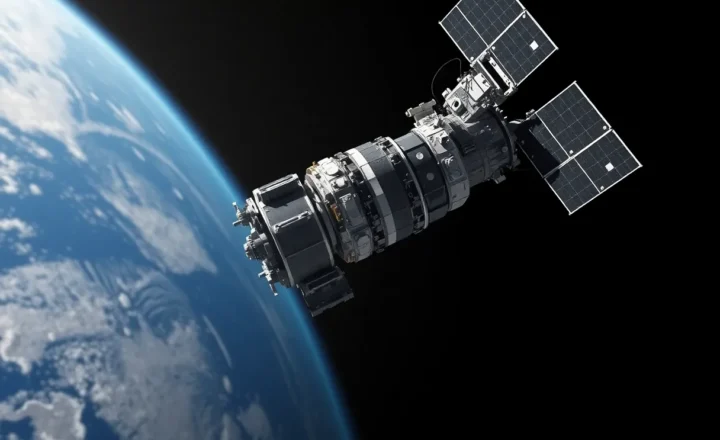
What Actually Happens When a Satellite Deorbits and Burns Up

Robin Hayes
July 9, 2026
Every satellite launched into low Earth orbit eventually has to come back down, one way or another. With SpaceX alone deorbiting Starlink satellites on a near-continuous basis as it replaces aging units, and roughly a few dozen intact rocket bodies and defunct satellites reentering the atmosphere uncontrolled every month across the industry, satellite reentry has quietly become one of the more routine — and more consequential — events happening in the sky above us, even though almost none of it is visible from the ground in daylight and most of it goes completely unnoticed by the public.
Why Satellites Come Down at All
Low Earth orbit, roughly the region between 160 and 2,000 kilometers altitude where the vast majority of active satellites operate, isn’t actually a vacuum in the way people often picture space — there’s a thin but real residual atmosphere at these altitudes that creates continuous drag on any object moving through it. This drag very gradually slows a satellite down, which causes its orbit to decay, meaning its altitude drops slightly with every orbit, a process that compounds over months or years until the satellite drops low enough for atmospheric drag to increase sharply and pull it down for good.
Satellites at very low altitudes, like SpaceX’s Starlink constellation which operates at roughly 550 kilometers specifically in part to ensure any failed satellite deorbits naturally within just a few years rather than lingering as space debris for decades, experience this decay relatively quickly. Satellites at higher altitudes, including many older defunct satellites left in higher orbits before deorbit planning became a standard part of mission design, can take decades or even centuries to naturally decay and reenter, which is precisely why orbital debris accumulation at higher altitudes has become such a persistent long-term problem that atmospheric drag alone won’t solve within any practically relevant timeframe.
What Physically Happens During Reentry
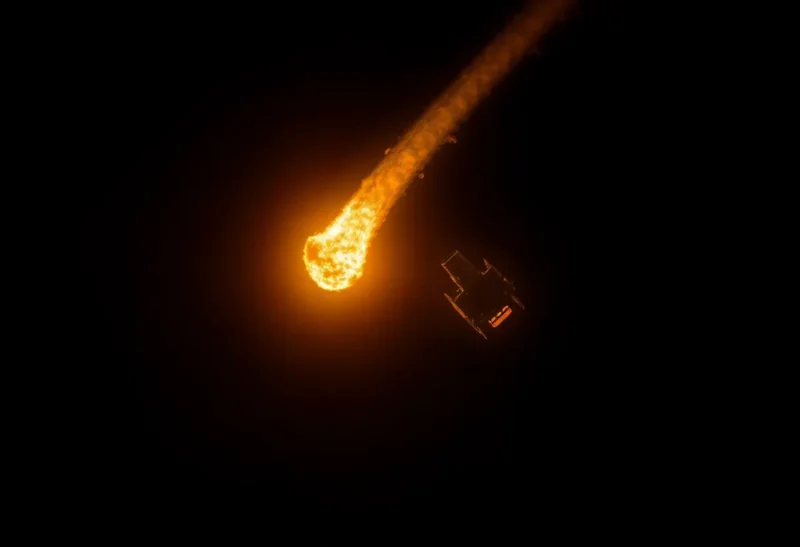
As a satellite’s orbit decays into the denser upper atmosphere, typically starting to experience significant heating and structural stress around 100 kilometers altitude — the informally recognized edge of space — atmospheric friction begins converting the satellite’s enormous kinetic energy into heat at a rate that increases extremely rapidly as altitude drops and atmospheric density increases. Surface temperatures on the leading edges of a reentering object can exceed 1,500 to 3,000 degrees Celsius depending on the object’s speed, mass, and reentry angle, temperatures well beyond the melting point of aluminum (which most satellite structures and components are substantially built from) and many other common satellite construction materials.
This is why the large majority of a typical satellite’s mass genuinely does burn up completely during reentry — most satellites are built primarily from aluminum and similar low-melting-point materials specifically because engineers have, for decades, treated “will this burn up completely on reentry” as an actual design consideration rather than an afterthought, a practice formalized under debris mitigation guidelines that most major satellite operators and space agencies now follow. The process typically takes somewhere between 30 seconds and a few minutes from the point significant heating begins to complete disintegration for a satellite-sized object, occurring at altitudes typically between 50 and 80 kilometers where atmospheric density becomes high enough to fully consume the structure.

Why Some Components Actually Survive
Not everything burns up completely, and this is the part of reentry physics that actually matters for ground safety risk assessment. Components made from higher-melting-point materials — certain titanium and stainless steel parts, dense metal components like fuel tanks, reaction wheels, and certain sensor housings — can survive reentry heating in whole or partial form and reach the ground as physical debris, a well-documented phenomenon that space agencies and satellite operators explicitly account for in mission planning through what’s called a “casualty risk” or “human casualty expectation” calculation required by most national regulatory frameworks before a satellite mission is approved for launch.
Real surviving debris has been recovered on the ground on multiple occasions — fragments from Chinese Long March rocket stages, remnants of a SpaceX Crew Dragon trunk section that washed up on a farm in Australia in 2022, and various other satellite and rocket body fragments have all been documented reaching the surface intact enough to identify. These events, while genuinely rare in terms of any individual piece of debris actually hitting a populated area or causing harm (the vast majority of Earth’s surface is ocean or sparsely populated land, and no confirmed human injury from reentry debris has been recorded to date), have become a growing focus of regulatory attention precisely because the raw number of reentry events has increased dramatically alongside the growth of mega-constellations like Starlink and Amazon’s Kuiper.
Who Actually Tracks and Predicts These Reentries
Predicting exactly when and where an object will reenter is a genuinely difficult forecasting problem, not a precise science, because atmospheric density fluctuates based on solar activity and other variables that are hard to model with complete precision days or weeks in advance — this is why reentry predictions from organizations like the U.S. Space Force’s 18th Space Defense Squadron, which maintains the primary catalog of tracked orbital objects, typically express reentry timing as a window spanning several hours or even a day or two, narrowing only in the final hours before reentry actually occurs, rather than a precise predicted moment.
The Aerospace Corporation’s Center for Orbital and Reentry Debris Studies (CORDS) and the European Space Agency’s Space Debris Office both maintain independent reentry prediction and risk assessment capabilities, and for genuinely large or notable reentry events — such as China’s Long March 5B core stages, which drew international attention for reentering uncontrolled on several missions rather than being deliberately guided to an unpopulated ocean area as most major space agencies now practice as standard procedure — these organizations issue public risk assessments and tracking updates as reentry approaches.

The Difference Between Controlled and Uncontrolled Reentry
The distinction between a controlled and uncontrolled deorbit is one of the more important but under-explained aspects of this topic in general coverage. A controlled deorbit uses a satellite’s remaining propellant to precisely target its final reentry trajectory toward a specific, typically unpopulated, ocean region — the South Pacific Ocean Uninhabited Area, sometimes informally called the “spacecraft cemetery,” is the standard target for controlled reentries of larger objects including the eventual planned deorbit of the International Space Station. This requires the satellite or spacecraft to retain enough functional propulsion and guidance capability at end of life to execute the maneuver, which is now standard practice built into mission planning for most major satellites and rocket stages, but which older spacecraft, or objects that suffer critical failures before planned deorbit, simply can’t execute.
Uncontrolled reentry, by contrast, means the object’s final trajectory and reentry location are determined purely by orbital mechanics and atmospheric drag rather than any deliberate targeting, which is why the exact reentry location for uncontrolled events (like the Long March 5B incidents) can’t be precisely predicted or controlled, and why regulatory pressure has increasingly pushed toward requiring controlled deorbit capability as a standard mission design requirement, specifically to eliminate the uncertainty and small but real ground risk that uncontrolled reentry of large objects carries.
Why This Is Becoming a Bigger Deal, Not a Smaller One
The sheer scale of active mega-constellations has made reentry frequency and management a genuinely more significant operational and regulatory issue than it was even a decade ago, when far fewer satellites were being launched and deorbited on any regular basis. Starlink’s constant satellite replacement cycle alone means the company is now responsible for a meaningful share of all uncontrolled but low-risk reentries happening globally, and as Amazon’s Kuiper constellation and other planned mega-constellations reach full deployment, the total volume of satellite reentry events is set to increase substantially further over the coming decade.
This growing volume is precisely why regulatory bodies including the U.S. Federal Communications Commission have moved to formalize stricter deorbit timeline requirements (the FCC’s “5-year rule,” adopted in 2022, requires most low Earth orbit satellites to deorbit within five years of mission completion, down from a previous 25-year guideline) and why casualty risk thresholds and debris mitigation design standards have become an increasingly binding, actively enforced part of the satellite licensing process rather than a voluntary best practice — a regulatory tightening that reflects just how routine, and how consequential in aggregate, satellite reentry has become as an ordinary part of how the modern space industry actually operates.