What Competitive Debate Tech Reveals About Real-Time Fact-Checking Tools

Futurion Editorial
July 9, 2026
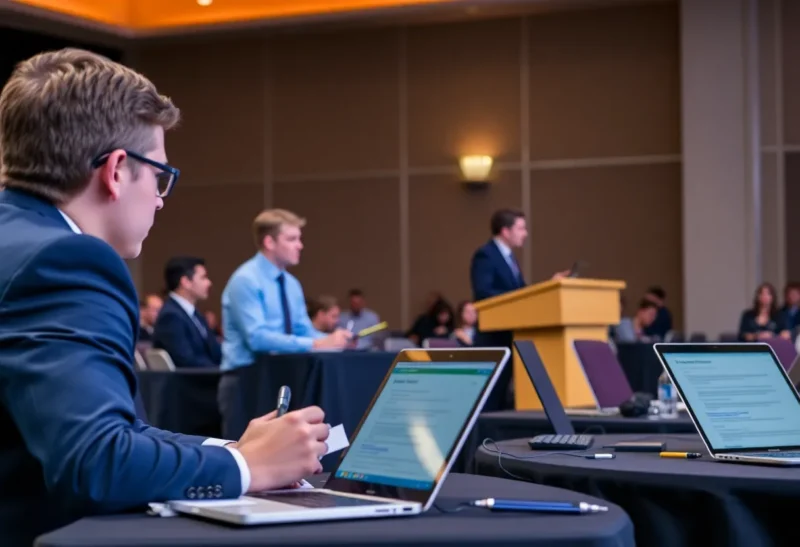
Competitive academic debate has always been an unusually information-dense sport, built around participants making rapid, evidence-heavy arguments while opponents scramble to find contradicting evidence and logical weaknesses in real time. That specific, high-pressure need — verify or refute a specific claim within seconds, while a speaker is still talking, using whatever evidence is at hand — turns out to be a genuinely useful preview of a much broader technical challenge that real-time fact-checking and misinformation-detection tools are now trying to solve for journalism, live broadcast, and public discourse more generally. Looking at how competitive debate participants and coaches have adapted technology to support this exact skill offers a useful, if unusual, window into what building genuinely fast, accurate real-time fact-checking actually requires.
Why Debate Culture Developed Sophisticated Research Tools Early
Competitive policy and parliamentary debate formats have long depended on participants building extensive, well-organized evidence files covering anticipated arguments and counterarguments before a tournament, and then rapidly retrieving and deploying the right piece of evidence at the right moment during an actual fast-paced round. This need drove debate programs, well before “real-time fact-checking” became a mainstream media technology topic, to develop specialized digital evidence organization and retrieval systems, moving from physical card catalogs of evidence in the pre-digital era to increasingly sophisticated searchable digital databases that let a debater or their teammates pull up a specific piece of supporting or contradicting evidence within seconds during an actual round, often while continuing to listen to and process an opponent’s ongoing argument simultaneously.
The specific technical and cognitive challenge this created — rapid, accurate information retrieval under severe time pressure, while an argument is actively unfolding rather than after it has concluded — is structurally very similar to what live fact-checking tools built for cable news broadcasts, political debates, and social media misinformation detection are trying to solve today, which is why several researchers and technologists working on real-time fact-checking automation have specifically cited or drawn inspiration from established competitive debate research and evidence-retrieval practices when designing these newer systems.
The Core Technical Problem Both Domains Actually Share
The genuinely hard part of real-time fact-checking, whether in a debate round or during a live televised political debate, isn’t running a single fact-check — it’s the pipeline of steps that has to happen fast enough, repeatedly, to keep pace with continuous live speech: first identifying which specific statements within a stream of ongoing speech are actual factual claims worth checking at all, as opposed to opinion, rhetorical framing, or reasoning that doesn’t reduce to a checkable factual claim; then matching each identified claim against relevant evidence or a knowledge base quickly enough to be useful before the moment has passed; and finally presenting that verification or contradiction in a format usable within the specific context, whether that’s a debater glancing at a laptop screen or a broadcast graphic appearing on a viewer’s television within a reasonable window of the original claim being made.
Academic research into automated real-time fact-checking systems has consistently identified claim detection — the first step of that pipeline, separating genuine checkable factual assertions from the much larger volume of ordinary speech that doesn’t constitute a specific, verifiable claim — as one of the more persistently difficult technical bottlenecks, because natural human speech mixes factual claims, opinion, rhetorical questions, and hedged or qualified statements together in ways that are often genuinely ambiguous even for human listeners to classify consistently, let alone an automated system trying to make that determination fast enough to be useful in a live setting.
Why Speed and Accuracy Trade Off Against Each Other Here More Than Usual
Both debate-oriented evidence retrieval tools and broadcast-oriented fact-checking systems have had to confront a genuine, hard trade-off between response speed and verification confidence that’s more acute in a live setting than in most other applied AI or information-retrieval contexts. A fact-check that takes thirty seconds to complete with high confidence is often close to useless in a live debate or broadcast setting, where the moment for the check to matter to the audience or opposing debater has already passed by the time it’s ready, but a fact-check generated in two seconds using a shallow, less rigorous verification process risks being wrong, which in a live, high-visibility setting carries a much higher reputational and informational cost than an ordinary, non-time-pressured fact-check error would.
Organizations building live fact-checking tools for broadcast journalism, including several academic and nonprofit initiatives that have piloted real-time fact-checking overlays during actual televised political debates and events, have generally converged on a middle-ground approach: automated systems flag and pre-surface likely factual claims and relevant background evidence extremely quickly, but a human fact-checker or editorial team still makes the final call on what gets published or displayed to the audience, treating the automated system as a speed-multiplying research assistant rather than a fully autonomous fact-checking authority — a division of labor that echoes almost exactly how debate teams have long used their own evidence-retrieval technology, where the software surfaces candidate evidence fast, but the debater themselves still makes the actual judgment call about which piece of evidence to use and how to frame it in the moment.

What Debate’s Longer Track Record Reveals About Failure Modes
Because competitive debate’s research and evidence-retrieval technology has been developing and stress-testing itself in actual high-pressure live competition for considerably longer than most broadcast-oriented fact-checking tools have existed, debate coaches and program directors have accumulated real, practical knowledge about specific failure modes that newer real-time fact-checking systems are now encountering for the first time. A frequently cited lesson from debate practice is that evidence retrieval speed alone doesn’t help if the underlying evidence organization and tagging is poor, since a debater or system that can search quickly but is searching against a badly organized or poorly indexed evidence base still won’t reliably surface the right result in time — a lesson that maps fairly directly onto why broadcast fact-checking tools invest so heavily in building and continuously maintaining well-structured underlying claim and evidence databases, rather than treating the retrieval algorithm alone as the primary bottleneck to solve.
Debate practice has also long grappled with the problem of evidence quality and source reliability under time pressure — the risk that a fast, superficially relevant piece of evidence gets deployed in the heat of a round despite being weaker or less directly applicable than a slower, more careful search would have found — which is precisely the tension that automated fact-checking tools face when balancing genuine real-time speed against the deeper verification that higher-confidence fact-checking would ideally involve, and it’s a tension that neither domain has fully solved so much as learned to manage through exactly the kind of human-in-the-loop final judgment layer both fields have converged on independently.
An Unlikely but Genuinely Useful Source of Institutional Knowledge
None of this means competitive debate technology directly transfers wholesale into broadcast fact-checking systems — the specific tools, scale, and audience are obviously quite different. What debate’s much longer operational history with exactly this kind of rapid, high-stakes, live evidence retrieval offers is a genuinely useful, underappreciated body of practical, battle-tested institutional knowledge about where these systems actually break down in real use, knowledge that newer fact-checking technology efforts, often built by teams without deep prior exposure to this specific problem space, have sometimes had to rediscover the hard way rather than learning from a field that had already worked through many of the same fundamental tensions years earlier, under considerably higher-pressure and lower-stakes conditions where failures were more forgiving to learn from.