Why Vinyl Record Pressing Plants Can’t Keep Up With Demand

Soren Bell
July 9, 2026
Vinyl has now outsold CDs in annual US revenue every year since 2020, and by a widening margin, according to RIAA sales data — a genuinely remarkable reversal for a format that industry analysts were confidently writing obituaries for as recently as the mid-2000s. But the format’s revival has run headlong into a manufacturing bottleneck that has nothing to do with demand and everything to do with the physical machines required to actually press a record, which turn out to be one of the more constrained and poorly understood pieces of industrial equipment still in active production anywhere in consumer manufacturing. I’ve spent years working as an audio engineer around the production side of the music industry, and the vinyl supply crunch is a genuinely interesting case study in what happens when consumer demand for an analog format outpaces an industrial base that was mostly dismantled decades ago.
The Machine Shortage at the Heart of This
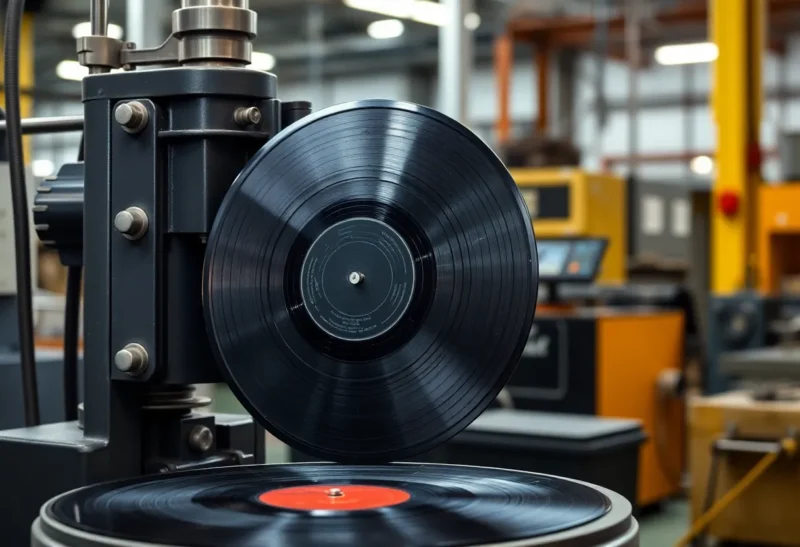
Vinyl records are stamped using hydraulic presses that apply heat and pressure to a “biscuit” of PVC compound, pressing it between two metal stampers (negative-image molds derived from a master lacquer disc) to physically imprint the audio grooves into the record. The overwhelming majority of these presses currently in operation worldwide are decades-old machines, many originally manufactured in the 1970s by companies like Toolex Alpha and continuously refurbished and kept running long after their original manufacturers stopped producing new units entirely, because vinyl’s near-total commercial collapse through the 1990s and 2000s eliminated essentially all commercial incentive to manufacture new pressing equipment for over two decades.
This means the entire global vinyl pressing capacity has, until relatively recently, been fundamentally capped by the finite number of surviving vintage presses still capable of running, a hard physical constraint that no amount of demand growth could simply expand around, since you can’t press more records than you have functioning presses to run, and building genuinely new presses from scratch required rebuilding manufacturing and engineering expertise that had largely atrophied industry-wide during vinyl’s commercial dark years.
Why New Presses Took So Long to Actually Arrive
Newbilt Machinery and Viryl Technologies are the two companies that have led the effort to actually manufacture new vinyl presses from the ground up rather than relying on refurbished vintage equipment, and both only began meaningful production in the mid-to-late 2010s, roughly a decade after vinyl’s commercial revival had already clearly begun — a genuinely long lag driven by how much precision engineering and specialized manufacturing knowledge had to be effectively reconstructed from scratch, since detailed manufacturing documentation and supplier relationships for pressing equipment components had mostly disappeared along with the original manufacturers decades earlier.
Viryl’s WarmTone press, one of the more widely adopted new-generation machines, represented a genuinely significant re-engineering effort rather than a simple reproduction of vintage designs, incorporating modern automation and consistency improvements that vintage presses (which typically require more manual operator skill to maintain consistent pressing quality) don’t offer. But even with these newer presses now in production, manufacturing capacity for the presses themselves remains genuinely limited — these are complex, expensive, relatively low-volume industrial machines, and scaling their own production has faced exactly the kind of slow, capital-intensive ramp-up that’s typical for specialized industrial equipment without an existing mass-market supply chain to draw on.
The PVC Supply Problem Layered on Top
Machine capacity isn’t the only constraint — the specific PVC compound formulations used for vinyl record pressing come from a small number of specialized chemical suppliers, and this supply chain took a significant, well-documented hit when a major raw material supplier’s production facility was damaged in a 2020 fire, an event that genuinely disrupted PVC compound availability across the pressing industry for an extended period and pushed several plants to work through alternate, sometimes less consistent, material sources while the primary supply chain recovered.
This PVC bottleneck illustrates a broader structural fragility in vinyl’s revived supply chain: unlike digital music distribution, which scales essentially without physical manufacturing constraints, vinyl’s entire production chain — from raw PVC compound, through mastering and lacquer cutting, to the actual pressing and packaging — runs through a genuinely small number of specialized suppliers and facilities worldwide, meaning any single point of failure in that chain (a fire, a major plant’s mechanical breakdown, a key supplier exiting the market) creates ripple effects across the entire industry’s production capacity in a way that more distributed, redundant supply chains for other product categories generally don’t experience to the same degree.
How Pressing Plants Have Actually Coped
Independent pressing plants have generally responded to demand outpacing capacity by extending lead times rather than trying to force more throughput through existing equipment — turnaround times that were once measured in a few weeks during the pre-revival era have, at peak demand periods, stretched to six months or more for new orders at some plants, particularly around major release windows like Record Store Day when demand spikes sharply against fixed capacity. This lead time extension has become such a routine part of the industry that record labels, especially larger ones planning major releases, now build vinyl production lead times into release scheduling many months in advance, treating pressing plant capacity as a genuinely binding planning constraint rather than an assumption that manufacturing can flex to match whenever demand requires it.
Some larger labels and artists have responded by investing directly in pressing capacity — several major labels have either acquired stakes in existing pressing plants or funded new plant construction specifically to secure guaranteed capacity for their own release slates, a vertical integration strategy that mirrors, in miniature, how supply-constrained industries in other sectors have historically responded to bottlenecks that pure market demand signals alone weren’t resolving quickly enough through existing independent suppliers.
Whether Capacity Will Actually Catch Up
New pressing plant construction and new press manufacturing have both continued expanding steadily since the mid-2010s, and total global pressing capacity has grown measurably as a result — this isn’t a static crisis with no improvement trajectory, and turnaround times at many plants have moderated somewhat from their most extreme pandemic-era peaks as more capacity has come online. But capacity expansion in an industry that requires this much specialized machinery, chemical supply, and technical expertise to rebuild from a near-total historical collapse doesn’t happen quickly even under strong demand incentives, and most industry analysts don’t expect pressing capacity to fully catch up to demand in a way that restores pre-revival turnaround times within the next several years.
The more durable lesson from vinyl’s supply squeeze is really about how thin the margin for error becomes when an entire product category’s manufacturing base gets dismantled and then has to be substantially rebuilt from scratch decades later — a genuinely different and harder problem than simply scaling up an existing, continuously operating supply chain to meet growing demand, and one that explains why “vinyl demand is booming” and “vinyl availability is still genuinely constrained” have both remained true simultaneously for years longer than casual observers of the format’s revival might expect.