What Reforestation Tech Actually Delivers at Scale (And What’s Just Marketing)

Isabel Morgan
July 7, 2026

Reforestation has become one of the most commercially appealing climate solutions—accessible to consumers through carbon offset purchases, attractive to corporations seeking to offset emissions, and easy to market with images of saplings and drones. Several companies have raised substantial funding on the promise of restoring forests at scales that would make a meaningful dent in atmospheric carbon. The technology that enables this—seed-firing drones, AI-driven site analysis, satellite monitoring, mobile nursery networks—is real and advancing.
But the reforestation technology sector has a growing credibility problem. Some of the most widely marketed programmes have been revealed to be far less effective than claimed. Others are effective in the narrow technical sense—trees are planted—but fail to deliver on the carbon capture promises attached to them. Understanding what reforestation tech actually delivers requires separating genuine innovation from optimistic accounting.
Where the Technology Is Genuinely Effective
The most defensible technological contribution to reforestation is in site identification and scale. Manual reforestation—planting trees by hand, location by location—is expensive and slow. At $0.50–$1.50 per tree for hand planting, restoring a million hectares of forest would cost billions before a single tree survives its first year. Technology has genuinely changed this calculation in a few important ways.
Satellite and LiDAR-based site analysis. Identifying degraded land that could support forest recovery, distinguishing it from agricultural land or areas with poor soil conditions, and mapping optimal planting zones—these are tasks that satellite data and machine learning have made dramatically faster and more accurate. Companies like Pachama and South Pole use remote sensing to identify and verify potential reforestation sites in ways that would take years of ground surveys to match manually. This is a genuine improvement.
Native species selection algorithms. Reforestation that plants the wrong tree species for the local ecology fails—trees that can’t survive local conditions, that don’t support local biodiversity, or that represent monocultures vulnerable to disease die at much higher rates than mixed native-species plantings. AI tools that cross-reference soil data, rainfall patterns, local species distribution, and climate projections to identify optimal species mixes are a real improvement over the old model of planting whatever seeds were available in large quantities.
Drone seeding for inaccessible terrain. BioCarbon Engineering (now Dendra Systems) pioneered drone-based seed firing that can cover terrain too steep, remote, or waterlogged for human crews to access. The drones map the terrain first, then fire seed pods pre-loaded with germination media into the soil at rates of thousands of seeds per hour. For the specific use case of replanting steep hillsides after erosion or wildfire, this is a genuine capability that didn’t exist before.
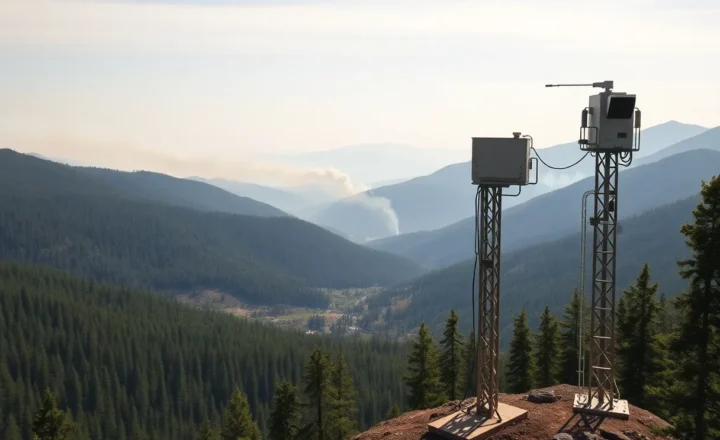
Monitoring and verification. Satellite-based monitoring of planted areas has improved significantly, allowing reforestation programmes to track survival rates, tree canopy growth, and carbon sequestration estimates with greater accuracy than annual ground audits. This addresses one of the fundamental problems with carbon offsets—the ability to verify that trees actually survived and are sequestering the carbon claimed.

Where the Marketing Runs Ahead of Reality
The credibility problems in reforestation tech fall into several categories, some related to technology limitations and others to how carbon accounting is done.
The tree mortality problem. Planting a tree is not the same as establishing a tree. Survival rates in large-scale reforestation programmes vary enormously—from under 20% in poorly managed projects to over 80% in well-managed ones with appropriate site selection, species choice, and maintenance. Many marketed “trees planted” figures count seeds or seedlings deployed, not established trees. A programme that fires 100,000 seed pods from drones and establishes 18,000 trees is not a 100,000-tree reforestation programme by any honest metric.
The 2023 investigation by Bloomberg and The Guardian into carbon offset programmes found multiple large-scale projects where satellite analysis of supposed reforestation areas revealed far less canopy cover than the carbon credit counts implied. Verra, the world’s largest carbon credit certification body, suspended issuance of some reforestation credits pending review of their methodologies after these investigations.
The additionality question. Additionality asks: would this carbon have been sequestered anyway, without the intervention? Some reforestation programmes have been caught claiming carbon credits for forests that were growing naturally in areas already protected from logging—forests that were never actually at risk. A protected wilderness recovering naturally from historic logging earns no additionality credit; it was already recovering.
Permanence and wildfire risk. A tree planted today takes decades to reach its carbon sequestration potential, and that carbon is released immediately if the tree dies. Reforestation programmes in fire-prone regions—much of the American West, Australia, Mediterranean Europe—carry significant permanence risk. A programme that plants 100,000 trees in California chaparral terrain and claims 40 years of carbon sequestration may see that sequestration reversed in a single fire season, as happened in multiple certified programmes during recent California wildfire years.
Some certification bodies now require “buffer pools”—setting aside additional carbon credits as insurance against losses. But the size of those buffers is often based on historical fire frequency, which is systematically underestimated in a world of changing fire conditions. The buffer approach assumes mean reversion in a climate that isn’t reverting.
The Monoculture Trap
Speed and scale incentives in reforestation have historically favoured monocultures—planting one or a few fast-growing species at high density. Eucalyptus plantations in Africa and South America, pine plantations in Europe, and similar large-scale single-species plantings can be established quickly, grow fast, and are easy to manage. They also provide poor habitat for local biodiversity, alter local hydrology (eucalyptus is notorious for water consumption), and are far more vulnerable to disease and pest outbreaks than diverse native forest.
A eucalyptus plantation that sequesters carbon is not ecologically equivalent to a restored native forest, and increasingly the scientific community has pushed back on claiming full ecosystem restoration credit for these plantings. The distinction matters for biodiversity credits, which are becoming an increasingly important part of the nature-based solutions market, and it matters for long-term carbon permanence—a disease that kills a eucalyptus monoculture releases that sequestered carbon immediately.
The companies doing this right have shifted to native mixed-species approaches with longer establishment timelines and higher per-tree costs. Terraformation, for example, focuses on native Hawaiian species restoration with careful soil preparation and extended monitoring periods. This produces better ecological outcomes but is slower and more expensive than monoculture alternatives—which creates pressure to cut corners when cost competition matters.

What the Best Reforestation Programmes Look Like
The programmes with the strongest evidence base share several characteristics that distinguish them from marketing-heavy alternatives:
They measure and publish survival rates—not seeds fired or seedlings planted, but established trees at one year and five years. The difference between deployment and establishment is enormous and honest programmes track it.
They use native species selected for the specific site conditions and climate projections, not a single fast-growing species optimised for carbon accounting metrics.
They work with local communities as long-term stewards. Reforestation that doesn’t create local economic value—jobs for community members in planting and monitoring, long-term land tenure for communities, benefits from restored ecosystem services—is more likely to be cleared again when the external funding ends. The projects with the best long-term survival records are those where local people have a vested interest in the forest’s continued existence.
They publish their carbon sequestration methodology transparently, including their assumptions about mortality rates, growth rates, and permanence risk. Programmes that produce clean, round carbon sequestration numbers without published methodology are a red flag.
They account for non-CO2 ecological costs and benefits. Young forests can briefly increase local albedo (reflectivity) effects that counteract carbon sequestration benefits in some climates. Conversely, restored forests reduce erosion, improve local watershed function, and restore habitat that has its own value beyond carbon. Honest programmes model the full suite of effects.
The Carbon Credit Market’s Accountability Problem
Much of reforestation technology’s scale has been funded by voluntary carbon markets—companies and individuals purchasing credits to offset emissions. The market for nature-based carbon offsets grew rapidly in the early 2020s, driven partly by net-zero corporate commitments and partly by loose verification standards.
The investigative journalism that found systematic overestimation in verified carbon programmes has significantly damaged the voluntary market’s credibility. The Science Based Targets initiative (SBTi) and other corporate net-zero standard bodies have progressively tightened their guidance on what kinds of offsets can be counted toward corporate net-zero claims. Nature-based solutions, including reforestation, face increasing scrutiny about whether they represent genuine, permanent, additional carbon removal or accounting manoeuvres that defer rather than address the underlying emissions.
This scrutiny is healthy and the reforestation sector should welcome it. Programmes that survive real verification are the ones that will be worth funding at scale. The technology that enables rigorous monitoring—satellite observation, ground-truth sampling, longitudinal tracking—is exactly what needs to get better and cheaper to make the entire sector more credible.
Where Reforestation Tech Is Worth Betting On
The honest assessment is that reforestation technology has genuine value in specific applications: accelerating natural forest recovery in areas where ecological conditions are right, improving the economics of restoration in terrain that was previously inaccessible, and providing monitoring tools that make verification credible rather than performative.
The applications where it’s more marketing than substance: drone seeding programmes that measure impact in seeds fired rather than established trees, carbon credit products attached to areas that weren’t under meaningful threat, and any programme that claims to restore “forest” by planting fast-growing monocultures designed for carbon accounting rather than ecological function.
The best analogy is to pharmaceutical development: the technology platform is real, the applications are genuinely promising in some cases, and the regulatory and verification frameworks are still catching up to the marketing. The programmes worth funding are those that will survive when rigorous verification becomes standard—not because regulation makes them the only option, but because they’re built on practices that actually work over the 50-year timescales that forests require to mature.
Planting trees is not a climate solution by itself. Restoring functioning forests over decades, with the right species in the right places with community stewardship and honest accounting, is something closer to one. The technology can help with the scale problem; it can’t substitute for getting the fundamentals right.