What CRISPR Livestock Trials Are Quietly Changing About Food Production

Dr. Lena Marsh
July 9, 2026
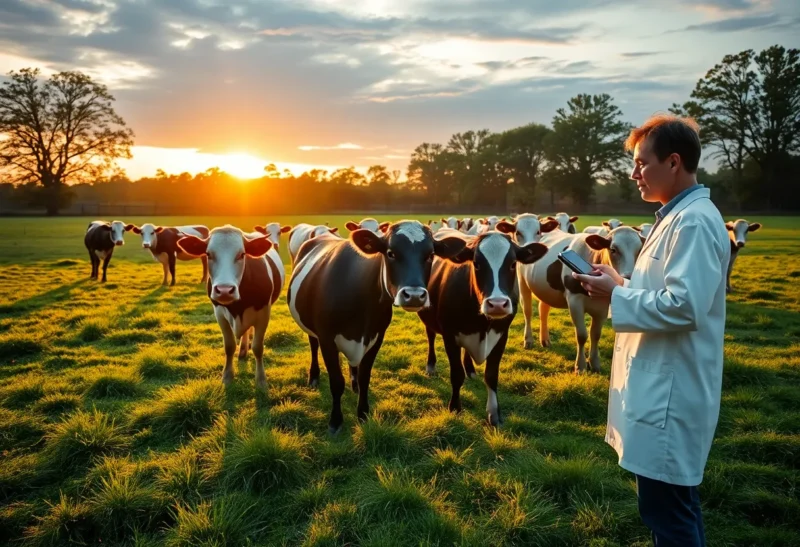
Most public conversation about CRISPR still orbits human medicine — sickle cell trials, cancer therapies, the occasional ethics panic about embryo editing. Meanwhile, in barns and research farms that get almost no press coverage, gene-edited pigs, cattle, and chickens have been quietly moving from lab curiosity to actual commercial pipeline. It’s not science fiction anymore, and it’s not really a future story either. Some of it is already on shelves, and more of it clears regulatory review every year.
I spent nine years running livestock breeding research before moving into writing about this field, and the thing that strikes me most about the last five years isn’t the headline-grabbing edits — it’s how mundane the actual deployment has become. This piece is about what’s real, what’s still stuck, and why the practical impact looks different from what most coverage suggests.
What’s Actually Been Approved
The clearest commercial success story so far is PRLR-SLICK cattle — a gene edit that gives cows a naturally short, slick hair coat, mimicking a trait that already occurs in some tropical cattle breeds through conventional mutation. Short coats mean better heat tolerance, which means less heat stress, which translates directly into better milk yield and weight gain in hot climates. The U.S. FDA cleared this edit for market in 2022 under a low-risk determination specifically because the edited trait already exists naturally in cattle populations — the edit just gets there faster and more precisely than decades of selective breeding would.
Pigs have seen the most significant single approval: PRRS-resistant pigs, edited to remove a receptor (CD163) that porcine reproductive and respiratory syndrome virus needs to infect cells. PRRS is one of the costliest diseases in global pork production, estimated to cost the U.S. industry alone over half a billion dollars annually in losses. Genus, the UK-based animal genetics company behind this work, received regulatory clearance in the United States in 2023 and has been pursuing approvals in other major pork-producing countries since, including a notable green light in Colombia in 2024 — one of the first approvals of a disease-resistant gene-edited animal outside the U.S.
Why Disease Resistance Is the Real Story, Not Novelty Traits
It’s tempting to think of gene editing in livestock as a tool for flashy traits — more muscle, faster growth, unusual coloring. Some of that research exists (hornless dairy cattle to eliminate the need for painful dehorning is a notable welfare-motivated example), but the trials with actual commercial momentum are almost all about disease resistance, and that’s not a coincidence. Disease outbreaks are where the economics of gene editing make the most sense: a single edit that confers resistance to a costly, recurring disease pays for its own development many times over across a population, in a way that’s harder to argue for cosmetic or productivity traits alone.
African swine fever, a disease with no effective vaccine and near-total lethality in infected pig herds, has been a major driver of research funding into resistance editing, particularly after outbreaks devastated pig populations across China and parts of Europe starting in 2018. Researchers at the Roslin Institute in Scotland — the same institution behind Dolly the sheep — have been working on edits targeting the RELA gene, associated with resistance in warthogs and bushpigs that carry the virus without symptoms, trying to transfer a version of that resilience into domestic pigs. Avian influenza resistance research in poultry has picked up urgency for similar reasons, especially given the scale of culling that recent H5N1 outbreaks have forced across commercial flocks.

The Regulatory Patchwork That’s Actually Slowing Things Down
The technology has outpaced regulatory clarity almost everywhere, and the resulting patchwork is arguably the biggest practical barrier to wider deployment — more than any remaining scientific hurdle. The U.S. approach, treating edits that could theoretically have arisen through conventional breeding as lower-risk and eligible for a streamlined review, has worked reasonably well for cases like SLICK cattle. But it creates ambiguity for edits that introduce genuinely novel genetic changes with no natural analog, which face the same lengthy, case-by-case review process as a transgenic animal.
The European Union has been considerably more conservative, historically classifying gene-edited organisms under the same strict framework as older-generation GMOs, which has effectively frozen most commercial livestock gene editing out of the EU market. That began shifting in 2023 and 2024 as EU policymakers debated new rules that would treat certain categories of gene-edited plants more permissively — livestock policy has lagged behind the plant-focused reforms, leaving animal applications in a longer holding pattern. Meanwhile, countries like Japan, Argentina, and increasingly China have moved to establish clearer, faster review pathways specifically because they see gene-edited livestock as a competitive advantage in disease-prone or resource-constrained agricultural sectors, and don’t want their producers left behind while other markets figure out an approval framework.
The upshot is that a technology which is, in engineering terms, largely mature for several specific traits is being deployed unevenly across the globe based almost entirely on regulatory posture rather than remaining scientific uncertainty.
What Consumers Actually Encounter
Here’s the part that surprises people: if you’ve eaten pork or beef in a market where these approvals have gone through, you may have already eaten meat from a gene-edited animal without any labeling requirement specifically flagging it, because in most approving jurisdictions, an edit that mimics a naturally occurring trait or removes a disease susceptibility gene isn’t treated as requiring different labeling than conventional meat. This is a genuinely contested point — advocacy groups favoring mandatory labeling argue consumers deserve to know regardless of the edit’s nature, while regulators and much of the scientific community argue that labeling based on production method rather than any measurable difference in the product itself sets an inconsistent precedent, especially since selective breeding, which produces comparable genetic changes over generations, has never been labeled either.
Consumer acceptance research on this topic (Pew and various university surveys) consistently shows a split that depends heavily on framing: support rises substantially when the edit is framed around disease resistance or animal welfare (like hornless cattle avoiding painful dehorning), and falls when framed around productivity or cosmetic traits, even when the underlying editing technique is identical. That framing sensitivity is likely to shape which traits companies prioritize for near-term commercial rollout, regardless of what’s technically easiest to edit.

The Limits That Aren’t Going Away Soon
It’s worth being honest about what gene editing in livestock hasn’t solved and probably won’t solve quickly. Complex, multi-gene traits — the kind that drive most economically important characteristics like overall feed efficiency or fertility — remain far harder to edit reliably than single-gene disease-resistance traits, because they involve dozens or hundreds of genes interacting in ways researchers don’t fully map yet. Off-target effects, where the editing tool alters unintended parts of the genome, have become much rarer with improved CRISPR variants and better guide RNA design, but verification remains expensive and is a real cost driver in bringing an edited line to commercial scale, particularly for smaller producers who can’t absorb that verification cost the way large integrated operations can.
There’s also a structural concentration risk worth naming plainly: the companies capable of doing this work well — Genus, Recombinetics, a handful of well-funded university spinouts — are relatively few, and the intellectual property around specific edits and delivery methods is tightly held. That raises real questions about whether the benefits of disease-resistant, more welfare-friendly livestock end up broadly distributed to producers of all sizes, or concentrated among the large operations that can afford licensing fees and premium breeding stock, potentially widening an already significant gap between industrial-scale and smallholder agriculture.
Where This Actually Goes
The realistic trajectory over the next five to ten years looks less like a dramatic transformation and more like a slow, uneven accumulation of narrow wins: a disease-resistant pig line here, a heat-tolerant cattle breed there, adopted first in the markets with the clearest regulatory pathways and the most acute disease pressure. African swine fever resistance, if it clears the remaining research and regulatory hurdles, could be the single highest-impact application given the disease’s devastating economic toll, particularly across Asian pork production.
What won’t happen, at least not soon, is a wholesale redesign of livestock genetics. The traits that matter most economically are too complex, the regulatory landscape too fragmented, and the public trust question too unresolved for anything faster than the incremental path already underway. That’s a less exciting story than the one usually told about gene editing, but it’s the one actually playing out in barns right now — mostly out of view, mostly uncontroversial in practice, and mostly measured in disease outbreaks that quietly didn’t happen rather than headlines that did.