The NISQ Era of Quantum Computing: What Today’s Machines Can and Can’t Do

Vikram Rao
July 7, 2026
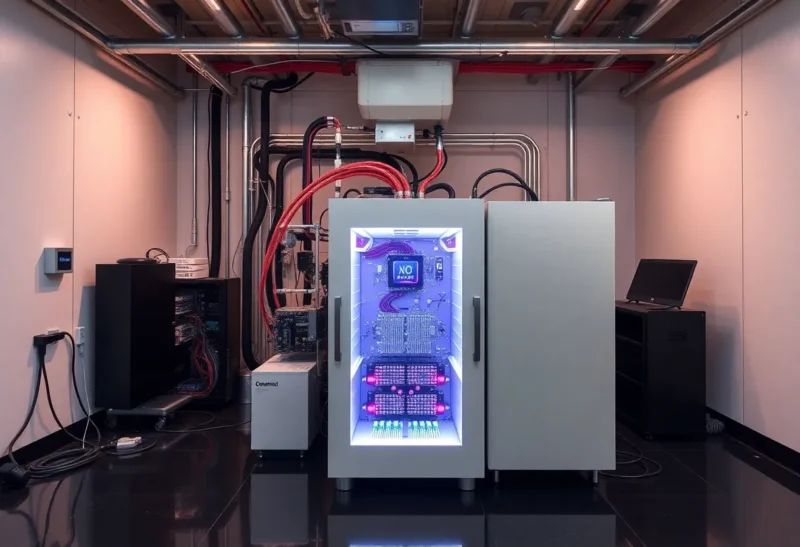
The phrase “quantum supremacy” entered the public vocabulary in 2019, when Google announced that its Sycamore processor completed a specific calculation in 200 seconds that would take a classical supercomputer approximately 10,000 years. The announcement was immediately qualified, disputed, and contextualised—IBM contested the 10,000-year figure, and the specific calculation had no practical application—but the media coverage conveyed a simpler message: quantum computers have arrived and will soon do things classical computers cannot.
That message was misleading in a specific, technical way that continues to generate confusion. The quantum computers that exist today are NISQ devices: Noisy Intermediate-Scale Quantum computers. Understanding what NISQ means, and what it implies about what today’s quantum machines can and cannot actually do, is essential for anyone trying to make sense of the quantum computing landscape in 2026.
What NISQ Means
The term NISQ was coined by physicist John Preskill in 2018 to describe the quantum processors available and anticipated in the near term. It encapsulates two key limitations:
Intermediate-Scale: NISQ devices have tens to hundreds of qubits. IBM’s Eagle processor (2021) had 127 qubits; their Osprey (2022) had 433; IBM’s Heron processors in 2024 scaled into the hundreds with improved connectivity. Google, IonQ, Quantinuum, and other players have similarly progressed. These qubit counts sound large, but the effective scale for useful computation is far smaller than the headline numbers suggest.
Noisy: The “noisy” in NISQ is the critical constraint. Qubits are extraordinarily sensitive to environmental disturbances—electromagnetic interference, temperature fluctuations, even cosmic rays can cause a qubit to lose its quantum state, a process called decoherence. Physical qubits in current systems have error rates on the order of 0.1–1% per gate operation. This sounds low until you consider that a useful quantum computation requires many thousands or millions of gate operations, at which point the errors accumulate to the point where the computation produces unreliable output.
The theoretical solution to qubit errors is quantum error correction (QEC): using many physical qubits to encode a single logical qubit, with the redundancy allowing errors to be detected and corrected before they corrupt the computation. Current estimates suggest that fault-tolerant logical qubits require on the order of 1,000–10,000+ physical qubits each, depending on the error rate of the physical qubits. A fault-tolerant quantum computer capable of running Shor’s algorithm (the famous algorithm that can break RSA encryption) at cryptographically meaningful scales would require millions of physical qubits—orders of magnitude beyond current hardware.
What NISQ Devices Can Do
NISQ machines are not useless—but they’re useful in a specific and limited way. Several genuine applications have been demonstrated:
Quantum simulation: Simulating the behaviour of quantum systems (molecules, materials, condensed matter physics) is inherently well-suited to quantum computers, because quantum systems are naturally described in the same mathematical framework that quantum computers operate in. NISQ devices have been used to simulate small molecules relevant to chemistry and materials science—though for systems small enough that classical computers can also simulate them, albeit less efficiently. The practical utility of quantum simulation for real-world drug discovery or materials design remains prospective rather than demonstrated at commercially relevant scale.
Quantum machine learning experiments: A variety of quantum machine learning algorithms have been proposed and tested on NISQ hardware. The results have been mixed: it’s difficult to demonstrate quantum advantage (performance that definitively beats classical methods) for machine learning tasks, partly because classical machine learning hardware and software has also improved enormously, and partly because noise limits the circuit depth where quantum advantage might theoretically emerge.
Optimisation problems: Algorithms like QAOA (Quantum Approximate Optimisation Algorithm) and VQE (Variational Quantum Eigensolver) are designed to run on NISQ hardware and address combinatorial optimisation problems (scheduling, routing, logistics). Results have been published showing these algorithms running on current hardware, but demonstrating practical advantage over the best classical optimisation methods for real-world problems has proven difficult. The “quantum optimisation” that a company might legitimately be doing in 2026 is almost certainly research-grade, not production-critical computation.
The Quantum Advantage Question
The honest accounting of quantum advantage for real-world, practically useful tasks in 2026 is that it remains elusive. Google’s 2019 demonstration proved quantum supremacy for a contrived task (random circuit sampling) with no practical application. Subsequent claims of quantum advantage have typically involved similarly narrow demonstrations or have been contested by improved classical algorithms.
This isn’t a criticism of quantum computing’s potential—it reflects the genuine difficulty of the engineering challenge. The noise in NISQ devices limits circuit depth, and circuit depth is typically required to achieve meaningful quantum speedup for interesting problems. The algorithms that offer provable quantum advantage (Shor’s, Grover’s) either require fault-tolerant hardware that doesn’t exist yet or offer speedups that are polynomial rather than exponential—useful, but not transformative at current noise levels.

The phrase “quantum advantage” is used loosely in industry communications. A company claiming to use quantum computing for optimisation should be pressed on whether they mean they’re demonstrating advantage over classical methods, running NISQ experiments to gather data, exploring future potential, or—less charitably—using quantum language for marketing purposes. All four are possible, and distinguishing them requires specifics that press releases and product announcements rarely provide.
The Path Beyond NISQ
The transition from NISQ to fault-tolerant quantum computing is the central engineering challenge of the field. Several physical qubit architectures are in active development, each with different noise characteristics and scaling challenges:
Superconducting qubits (used by IBM and Google) operate at temperatures near absolute zero (around 15 millikelvin—colder than outer space) using Josephson junctions. They have relatively fast gate times (nanoseconds) but currently limited coherence times and require complex cryogenic infrastructure.
Trapped ion qubits (used by IonQ and Quantinuum) use individual charged atoms suspended in electromagnetic traps. They have higher gate fidelity and longer coherence times than superconducting qubits but slower gate speeds and face scaling challenges. Quantinuum’s H-series processors, using trapped ions, have demonstrated some of the highest-fidelity two-qubit gates available.
Photonic qubits, neutral atoms, and topological qubits (Microsoft’s long-pursued approach, recently showing promising results with Majorana zero modes) represent alternative approaches with different trade-off profiles. The field has not converged on a single winning architecture, which is both a sign of genuine scientific uncertainty and an indicator that the hardware challenge remains open.
The 2026 Reality Check
In 2026, quantum computing is in a position roughly analogous to where classical computing was in the early 1960s: the theoretical foundations are sound, early hardware exists and works in limited ways, and the engineering challenges required to scale to practically useful computation are substantial and largely unsolved. The comparison is imperfect—quantum computing faces physical challenges (decoherence, error rates) that classical computing didn’t—but the developmental stage is similar.
What this means practically: organisations monitoring quantum computing for potential future impact are being prudent; organisations claiming to extract commercial value from current NISQ hardware for real production workloads should be viewed sceptically unless they’re providing specific, technical evidence of advantage; and the timeline to fault-tolerant, practically transformative quantum computers remains genuinely uncertain, with credible estimates ranging from 5 to 20+ years depending on which engineering obstacles prove hardest to overcome.
Quantum computing is real, the progress is real, and the eventual impact on specific fields—cryptography, materials science, optimisation—could be significant. The NISQ era we’re in tells us what we’re working toward, not what we’ve achieved.