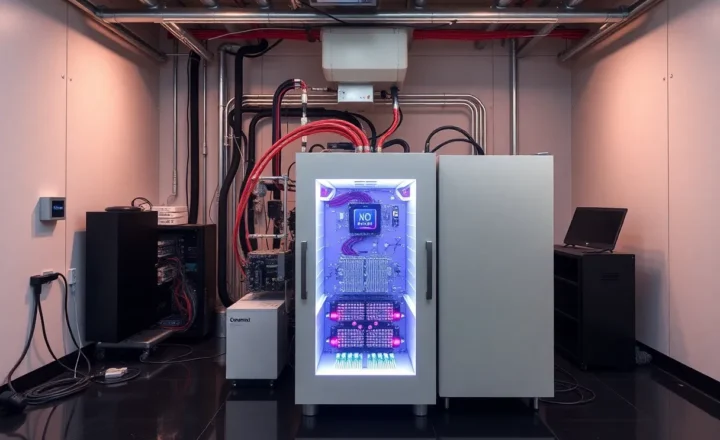
Quantum Computing Isn’t Science Fiction Anymore—Here’s What’s Real

Vikram Rao
February 24, 2026
Quantum computing has spent decades in the “almost here” bucket. Headlines promised it would break encryption, design drugs, and optimize logistics—any year now. For a long time, the reality was a handful of qubits in a lab and a lot of theory. That’s no longer the case. Quantum machines with hundreds of qubits are running in the cloud; researchers and companies are solving problems that would take classical supercomputers years; and the gap between hype and what’s actually running is finally narrowing. Here’s what’s real in 2026 and what’s still ahead.
What Actually Exists Today
Major vendors—IBM, Google, IonQ, Quantinuum, and others—operate quantum processors that you can access via the cloud. You don’t need a lab; you submit jobs through an API or a web console. The machines range from a few dozen to over a thousand qubits (depending on how you count and which architecture). They’re noisy: qubits lose coherence quickly, and error rates are high. So today’s “utility-scale” or “error-mitigated” systems don’t replace classical computers for most tasks. They’re good for a narrow set of problems where quantum algorithms have a proven advantage and where the noise can be modeled or mitigated enough to get a useful result.
Those problems include: certain types of optimization (e.g. portfolio or logistics), quantum chemistry (simulating molecules for materials and drug discovery), and specialized cryptography research. Researchers have demonstrated quantum advantage—a quantum machine solving something faster than a classical one—in controlled experiments. The next step is making that advantage practical for real workloads, not just benchmarks.

Why Quantum Is Hard (and Why It Still Matters)
Qubits are fragile. They need to be isolated from the environment (often cooled to near absolute zero) and kept coherent long enough to run a circuit. Any interaction with heat, vibration, or electromagnetic noise can cause errors. Building a large, fault-tolerant quantum computer—one that corrects its own errors and can run arbitrarily long algorithms—requires many physical qubits per “logical” qubit and is still a long-term goal. What we have now are noisy intermediate-scale quantum (NISQ) devices: not fault-tolerant, but big enough to run meaningful experiments and a growing set of applications.
Despite the noise, progress is real. Error mitigation techniques (running the same circuit many times, post-processing to reduce error) are improving. Hybrid algorithms combine classical and quantum steps so that the quantum part does only what it’s good at. And hardware is scaling: more qubits, better connectivity, and longer coherence times are coming from multiple approaches (superconducting, trapped ions, neutrals, photonics). The field is no longer “will it ever work?” but “when and for what?”

What’s Still Science Fiction (For Now)
Quantum computers are not general-purpose replacements for your laptop or the cloud. They won’t run your app faster. “Quantum supremacy” or “quantum advantage” demonstrations are narrow: a specific task, often designed to favor the quantum machine. Breaking RSA or today’s public-key crypto with a quantum computer is theoretically possible (Shor’s algorithm), but it would require a large, fault-tolerant machine that doesn’t exist yet. Post-quantum cryptography—classical algorithms designed to resist quantum attacks—is the response, and it’s being standardized and deployed now so that when large quantum computers arrive, we’re ready.
Similarly, “quantum AI” or “quantum machine learning” is an active research area, but practical advantages over classical ML are still limited and domain-specific. The hype often runs ahead of the results. The honest picture: quantum computing is real, it’s progressing, and it will matter for a slice of problems—but that slice is growing, and the rest is still on the horizon.
Who’s Using It and How to Dip a Toe In
Banks, pharma companies, and national labs are already running quantum experiments. Use cases include risk optimization, molecular simulation for drug discovery, and materials design. You don’t need to own a quantum computer: IBM Quantum, AWS Braket, Google Quantum AI, and others offer cloud access. Developers can write circuits in Qiskit, Cirq, or similar frameworks and submit jobs to real hardware or simulators. Starting with a simulator lets you learn the programming model without burning queue time; when you’re ready, you can target a real device and see how your algorithm behaves under noise. The barrier to entry is lower than it’s ever been—and the best way to separate hype from reality is to run something yourself and see what comes back.
The Bottom Line
Quantum computing has moved from lab curiosity to a deployable resource. You can run circuits on real hardware today. The machines are noisy and the set of useful applications is still small, but it’s expanding. If you’re in optimization, chemistry, or security, it’s worth paying attention—and maybe running an experiment. If you’re waiting for a quantum laptop, that’s still science fiction. What’s real is the middle: serious machines, serious research, and a path from here to the next decade of breakthroughs.