Starlink vs 5G Home Internet: When the Cell Tower Beats the Dish

Dana Robles
September 18, 2026
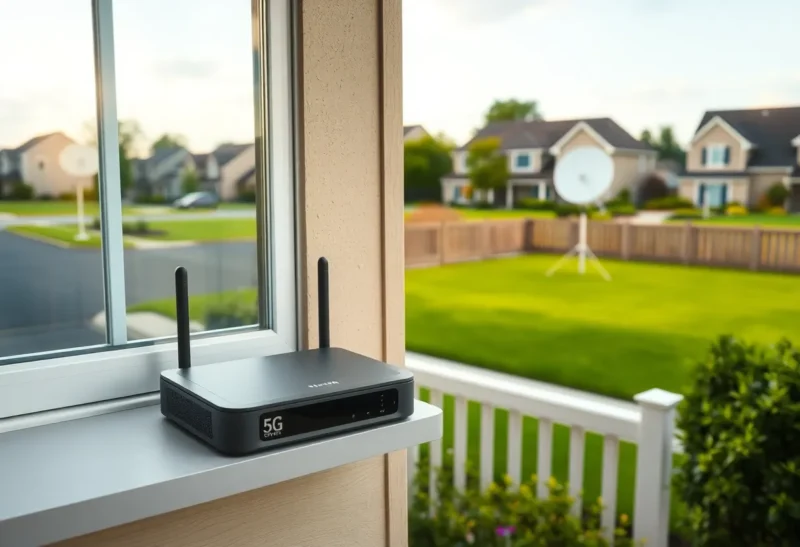
A 5G home gateway in a window can beat a Starlink kit on a pole. I have said that in yards where the dish had a beautiful dome and the tower was two miles of honest line. I have also said the opposite in a hollow where the only 5G was a marketing map. The search is not “which brand is the future.” It is when the cell tower is the less stupid radio.
I walk rural and edge-suburban houses through both. T-Mobile Home Internet, Verizon 5G Home, a regional fixed-wireless WISP that still says LTE — I treat them as the same class: a modem that marries a sector. Starlink is a modem that marries a moving mesh. The winner is the path that is less busy, less wet, and closer to a face you cannot reschedule.
What 5G home actually is
It is not your phone hotspot with a nicer plastic. It is a fixed plan on a gateway that the carrier expects to sit still. Priority is not phone-priority. Evening congestion is real. A “coverage map” is a sales layer. I ask for a gateway trial and I leave it where they would actually live with it — not on the roof for a heroic screenshot, on the windowsill they will tolerate.
When it works, latency looks like a decent cable. Uploads can be the weak knee. Video calls live. CGNAT is common. Port forwards are a fantasy. That last sentence is a tie with Starlink, not a win.
When it fails, it fails like a phone: one sector melts at 7 p.m., a tree full of water between you and the panel, a gateway that wants to roam a weaker tower because someone walked it to the other room. The dish does not roam a tower. It roams a sky. Different enemy, same evening.

When the tower wins
You can see a tower or a site that is not a rumor. The gateway stays above 2–3 bars of the band it actually uses — not a 5G icon that is a sticker. Evenings stay usable for a call. Rain does not take the session away for twenty minutes. You rent, and a landlord will not allow a mast. You already pay the carrier and the trial is free enough to be honest.
I have put a Verizon or T-Mobile box in a ranch house at the edge of a town and watched it hold Zoom while a Mini on the picnic table dropped a maple. The tower was the shorter path through weather. Ka-band and LEO fade are physics. Mid-band 5G through a wet tree is also physics. Sometimes the tree is kinder than the whole sky going milk.
Install time wins too. A gateway is an afternoon. A honest Starlink install is a mast, a run, a marriage conversation. If the tower is good, I do not make them drill. If the tower is a maybe, I do not let a two-day trial stand in for a January evening.
When the dish wins
No tower, a loaded sector, a “5G Home” that is LTE in a tuxedo, a gateway that only works in one window that the household will not live in. A job that uploads all afternoon. A cell that dies when the high school lets out. Starlink’s bad day is weather and a busy hex. 5G home’s bad day is every phone in town plus your “home” plan at the back of the queue.
Rural hexes can be kind to Starlink and cruel to a carrier that never built the site. Do not use a suburban YouTube as your tower. Walk the road. Look for the actual panel. If you cannot find it, you are buying a map.
A clear Starlink Standard on a pole will embarrass a weak indoor gateway almost always. That is not a philosophy. That is radio. The interesting cases are the good gateway versus a compromised dish. Compromised dishes are common. People buy Mini, they fear height, they have oaks. Then they ask why space lost to a window. Space did not lose. The install lost.
Latency, uploads, and the work you actually do
5G home, on a good sector, often feels snappier for SSH and a SIP client than Starlink. Starlink can still dump a huge file faster at 10 a.m. in a quiet hex. People mix those jobs. I ask them to name the job that pays. If it is a call, I weight latency and holes. If it is a nightly backup, I weight the worst upload hour. If it is both, I want a trial of both or I want fiber. Two radios as a thought experiment is cheaper than a pole you hate.
Starlink as fiber failover we already know can break a house PBX. 5G home as failover has the same CGNAT soul. Neither is a public IP product. If inbound is the product, neither “beats” the other. A tunnel beats both.
Caps, deprioritization, and the honest bill
Carrier home plans love a priority bucket and a shrug after it. Starlink residential loves a service address and a soggy guest mode when you leave. Both have fine print that is a queue. I do not pick from the brochure unlimited. I pick from the Tuesday after you have used it like a house.
Price flips. Promos make 5G look free. Starlink looks like a hardware hit. After twelve months the promo dies and the dish is paid for. Run the year, not the unboxing. I have seen people “save” with 5G and then buy Starlink in March when the sector filled. I have seen the reverse when a tower went up. Neither brand is loyal to you. Be loyal to the radio that worked in the dark month.
Mobility and the lie of the same modem
A 5G gateway is not a travel kit. Some people move it to a cabin and discover the plan is an address too. Starlink at least sells a roaming SKU. If your life is two houses, do not assume the cheaper 5G box is the portable one. It is often the more territorial one.
Phones as a backup still matter. A household with 5G home and no Starlink should keep a real phone bucket. A household with Starlink and no tower should do the same. Single-path righteousness is how you miss a telehealth slot.
Indoor antennas and the lie of the 5G sticker
Carriers ship indoor gateways because trucks are expensive. Indoor is a bet that the window sees the sector. A metal roof, low-E glass, a basement office — those are Faraday moods. People then buy an “outdoor antenna” kit or they start talking Starlink. I would rather an outdoor 5G antenna on a cheap mast than a Starlink Mini under oaks, if the sector is truly there. I would rather Starlink on a real pole than an indoor gateway in a faraday ranch, if the sector is a hope. Match the antenna to the radio you already won. Do not stack accessories to rescue a map.
External antennas for 5G home are a different Saturday than a Starlink mast, but they are still a Saturday. If the household will not do Saturday, they get the window or they get nothing. I do not design around a hero install they will not perform.
How I test a week
Same laptop. Same hours. Evening call. Morning upload. One rainy day if the calendar allows. I write “held” or “died,” not Mbps. I note whether the gateway wanted a different window than the marriage will allow. I note whether the dish wanted a pole the marriage will allow. The constraint that the household will not change is the real RF plan.
If both hold, I pick the one they will not resent: no mast, or no carrier app, or the bill they already understand. If only one holds, the essay is over. If neither holds, I look at WISP, GEO leftovers, or a move. I do not stack two bad radios and call it resilience. Two bad radios are a hobby.
Homelab notes without the romance
Neither path loves inbound. Both are fine behind a firewall you own if you only need outbound and a tunnel. 5G home gateways vary in how ugly their LAN is; some fight bridge mode the way an ISP gateway fights it. Starlink at least has a bypass story. If you already know you want your own firewall, ask whether the 5G box will be a modem. If it will not, the dish may be the less annoying WAN even when the tower is faster in a speed test.
The decision
The cell tower beats the dish when the sector is real, the gateway can live where the household lives, and evenings still carry a face — especially when the Starlink sky is trees, a Mini, or a wet hex. The dish beats the tower when the map is a lie, the sector is a parking lot, or you can actually mount a Standard into open sky. Trial the window and the yard in the same week. Keep the radio that held the call. Return the other. I have returned both brands. I have also kept a 5G box and told a pole salesman to go home. That is allowed.