SpaceX IPO (SPCX): What $85B and Quarterly Earnings Change for Starship Cadence

Walter Pryce
September 18, 2026
SpaceX closed the IPO in June 2026 with about $85.7 billion of proceeds after the overallotment, ticker SPCX, a Class A print that turned a private cadence argument into a public one. Cash does not catch a ship. Quarterly earnings do change who gets to ask, every thirteen weeks, why Super Heavy can be caught and Starship still cannot, and why the Space segment still loses money while Connectivity prints and AI eats capex. I used to read Starship timelines as an engineering calendar. I now read them as a capital-allocation slide that has to survive a 10-Q.
I have planned missions on spreadsheets that assumed reuse math the hardware had not earned. The $85 billion does not earn it either. It buys time, steel, and a balance sheet that can absorb a flight that ends in the Pacific on purpose. What it changes is the cost of a quiet quarter. Private SpaceX could slip a catch and tell a story. Public SpaceX files the slip.
What the raise actually bought
The June 12 debut and the June 15 close were a liquidity event, not a Raptor event. SpaceX ended the second quarter with on the order of $100 billion in cash and marketable securities and a backlog the company put at $47.5 billion. It also issued a large investment-grade bond. That is dry powder. Dry powder is how you keep Massey and the pads working when a heat shield still argues with orbital energy.
It is also how you fund a second factory of a different kind. Q2 capex landed around $18.4 billion, with something like $15.8 billion pointed at AI infrastructure. That number is larger than the quarter’s revenue. Starship cadence now shares a cash pile with Colossus. Anyone who bought SPCX as a pure launch multiple bought a conglomerate that will say the word vertical whenever the questions get rude.
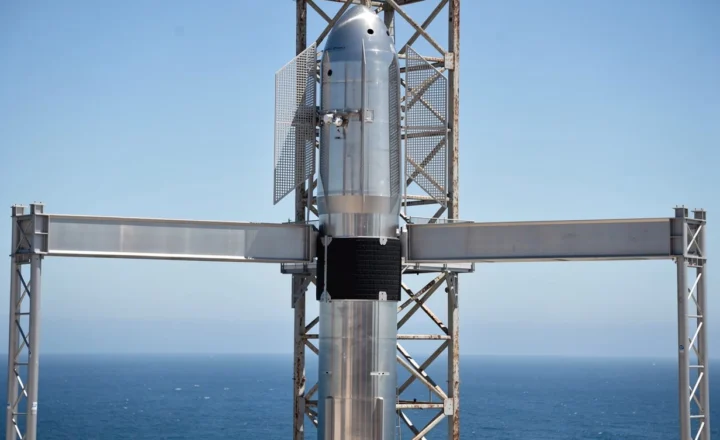
Shotwell told the debut audience to watch Starship. The first public print watched AI contracts and a Connectivity engine. Both can be true. Only one of them flies a 124-meter stack.
The Space line versus the story
In that first earnings print, Space — Falcon, Dragon, Starship — was the small segment: on the order of $962 million of revenue and a wider operating loss as R&D stayed loud. Connectivity did the adult revenue. Two Starship V3 flight tests in ninety days is a real sentence. It is not a cadence. Cadence is a week that repeats. Two tests is a campaign. Campaigns slip. Earnings do not like slip that cannot be footnoted as “learning.”
Reuse math only starts when the same booster and the same ship fly again without a new vehicle eating the learning. Super Heavy has been caught. The ship has not. Ocean splashdowns are still the honest plan for the next orbital attempt. You cannot put “fully reusable” in a shareholder letter and then splash both stages without someone asking when the letter becomes a schedule.
I do not treat a successful suborbital V3 drop of a handful of satellites as an operational constellation factory. That is a payload demo on a trajectory that was still allowed to fall. The IPO does not change the physics of the first sustained orbit. It changes the audience for the delay if that orbit slips past a guidepost the street invented.
Quarterly earnings are a new failure mode
Private companies miss windows and tweet. Public companies miss windows and get a multiple. Analysts will model flights per year because they can. Hardware will refuse. The dangerous outcome is not a tough question on a call. It is a cadence target that exists to defend a slide: fly before the tower is ready, catch before the heat shield is boring, stack V3 mass before the ship can come home.
The healthy outcome is the opposite: use the $85 billion so you can say no. No, we will not catch the ship on the first orbital flight. No, Pad 2 rehearsals are not a press kit for next week. No, Falcon 9 still flies the constellation while Starship learns to be a truck. Earnings pressure makes “no” expensive. That is the new constraint. It is not in the S-1 risk factors as “we might become impatient.” It should be.

How launch economics used to hide
When I ran mission plans for a living, the expensive lie was always the same: assume the next vehicle is cheaper because the last one taught you something. Teaching is not a unit cost. A destroyed ship is a full ship. A caught booster that needs a tear-down is not a same-day turn. Falcon 9 made that lie smaller by flying the same cores until the story was boring. Starship is still in the era where each flight is a press conference. The IPO invites people to price Falcon-like learning curves onto a vehicle that has not yet come home from orbit.
Lunar logistics punish LEO assumptions. I have written that sentence about landers. It applies to a cadence model that treats Starbase like a 737 line. A 737 line has certified parts and a regulator who has seen the movie. Starship has a regulator who is still writing the movie, and a heat shield that has to survive a different energy than a booster hop. Cash shortens the line at the machine shop. It does not certify the movie.
If SPCX holders want a number, give them cost per successful orbital attempt and time between attempts that ended as planned. Do not give them “flights per year” until splashdowns are a choice, not the plan. A year of water landings can still be a good year. A year of forced tower dates will be a filmed accident.
Cadence is pads, engines, and a ship that returns
Starbase is not a ticker. OLP-2 can hold a rehearsal with an unflown ship in the chopsticks and still have Flight 14 targeted at an ocean. I care about static fires, flight-proven heat-shield tiles after orbital energy, and a booster that can be caught at the pad that will actually launch the next one. Pad 1 catch heritage does not teleport to Pad 2. Public markets will blur that. Engineers should not.
Raptor production and ship production only become cadence when the return is routine. Until then, every flight is a prototype with a live payload if they choose to hang V3s under it. That is brave. It is also how a constellation schedule becomes a test-article schedule. Falcon 9’s boring truck is still the factory. The IPO does not retire Falcon. If anything, earnings will punish a fantasy that Starship already replaced it.
What I watch on the next few 10-Qs
Not the adjective “successful.” I watch: flights attempted versus flights that reached the intended trajectory; whether a ship returns to a tower or to water; capex split between AI halls and South Texas steel; whether Space-segment losses widen because they are building a factory or because they are replacing vehicles; whether Starlink subscriber growth still funds the story when V3 is a slide and not a weekly stack.
I also watch guidance language. The first time they publish a flight-count that looks like a 2021 meme, I assume the multiple asked for it. The first time they refuse to publish one, I assume someone in production still has a veto. The veto is the valuable part of the $85 billion. Spend the cash to keep the veto.
AI capex is not a footnote on the rocket
A segment that can turn EBITDA-positive on $15 billion of quarterly compute spend is a different company than the one that sold Falcon manifests. I am not here to litigate Grok. I am here to say Starship cadence now competes, inside one 10-Q, with halls in Memphis and Southaven. If the street rewards the halls, South Texas will feel it as a slower crane. If the street rewards the crane, the halls will still have already spent. The $85 billion was supposed to prevent that fight. The first print showed the fight anyway.
Related-party gravity — Tesla, xAI history, a Cursor-sized headline — will keep the call noisy. Cadence needs quiet. The useful discipline of being public is a cash footnote you cannot hide. The useless discipline is a narrative that Starship must accelerate because the AI slide was expensive. Those are inverse incentives. I would rather they keep losing money on Space on purpose than “win” a quarter by flying a ship that was not ready to come home.
The decision
$85 billion and a quarterly clock change the politics of Starship cadence. They do not change orbital energy, tile bonds, or the difference between catching a booster and catching a ship that has been around the Earth. Use the raise to stay boring: Falcon for the constellation, splashdowns until the catch is earned, and a Space segment that is allowed to lose money on purpose. If earnings start flying the stack, the IPO will have bought a faster way to write off steel. I would rather a slow truck that exists than a public cadence that does not.