How Robotic Pollinators Are Being Tested as Emergency Backup for Bees

Dr. Helena Cortez
July 9, 2026
Commercial pollination services have become a genuinely significant, fragile piece of agricultural infrastructure — beekeepers truck millions of honeybee colonies across the US every year specifically to pollinate California’s almond crop and various other pollination-dependent agriculture, an industry that colony collapse disorder, varroa mite infestation, and other bee health pressures have made increasingly expensive and less reliable over the past two decades. This fragility has motivated a genuine, if still mostly experimental, research push into robotic and mechanical pollination technology, not as a wholesale replacement for bees, but as a targeted backup and supplement for the specific situations where natural pollination has become unreliable enough to threaten crop yields. I’m an entomologist who studies pollinator ecology, and this research area is a useful case study in how narrowly and realistically most serious researchers in this space actually frame robotic pollination’s role, in contrast to some of the more sweeping “robots will replace bees” framing that shows up in less careful coverage.
Why Pollination Is a Genuinely Hard Problem for Robots
Pollination requires precisely transferring pollen from a flower’s male anther to another flower’s female stigma, timed to each specific crop’s flowering biology, at a physical scale (individual flower structures) that demands real precision, across an enormous number of individual flowers per acre that would need to be visited for meaningful commercial-scale pollination coverage. Honeybees and other natural pollinators solve this problem through millions of years of evolved specialization — their bodies are physically shaped to collect and transfer pollen efficiently, and their foraging behavior naturally covers enormous numbers of flowers per day across large areas without any need for external navigation or control systems.
Replicating this with robotics means solving a genuinely difficult combination of problems simultaneously: precise micro-manipulation to actually transfer pollen without damaging delicate flower structures, computer vision and navigation sophisticated enough to identify and approach individual flowers reliably across varied crop types and growth stages, and a scale of deployment — enough individual robotic units covering enough flowers per day — that can approach anything close to what a natural pollinator population accomplishes essentially for free as a byproduct of its normal foraging behavior.
What Current Robotic Pollination Research Has Actually Achieved
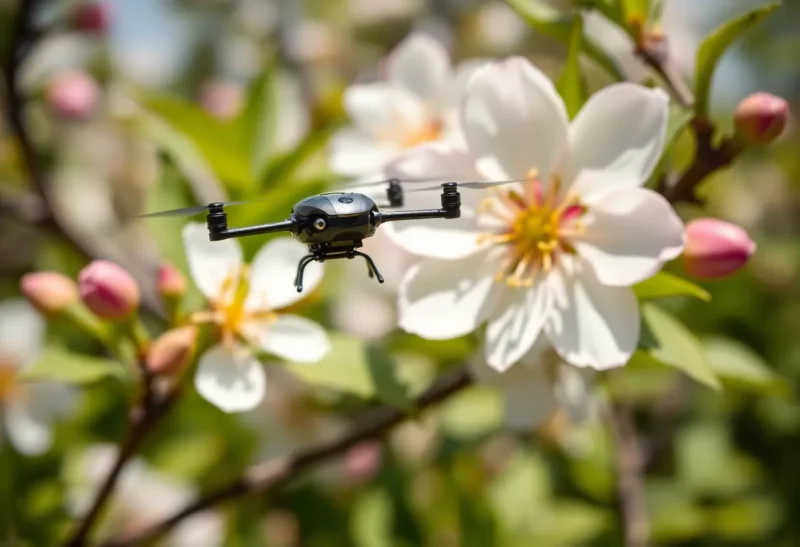
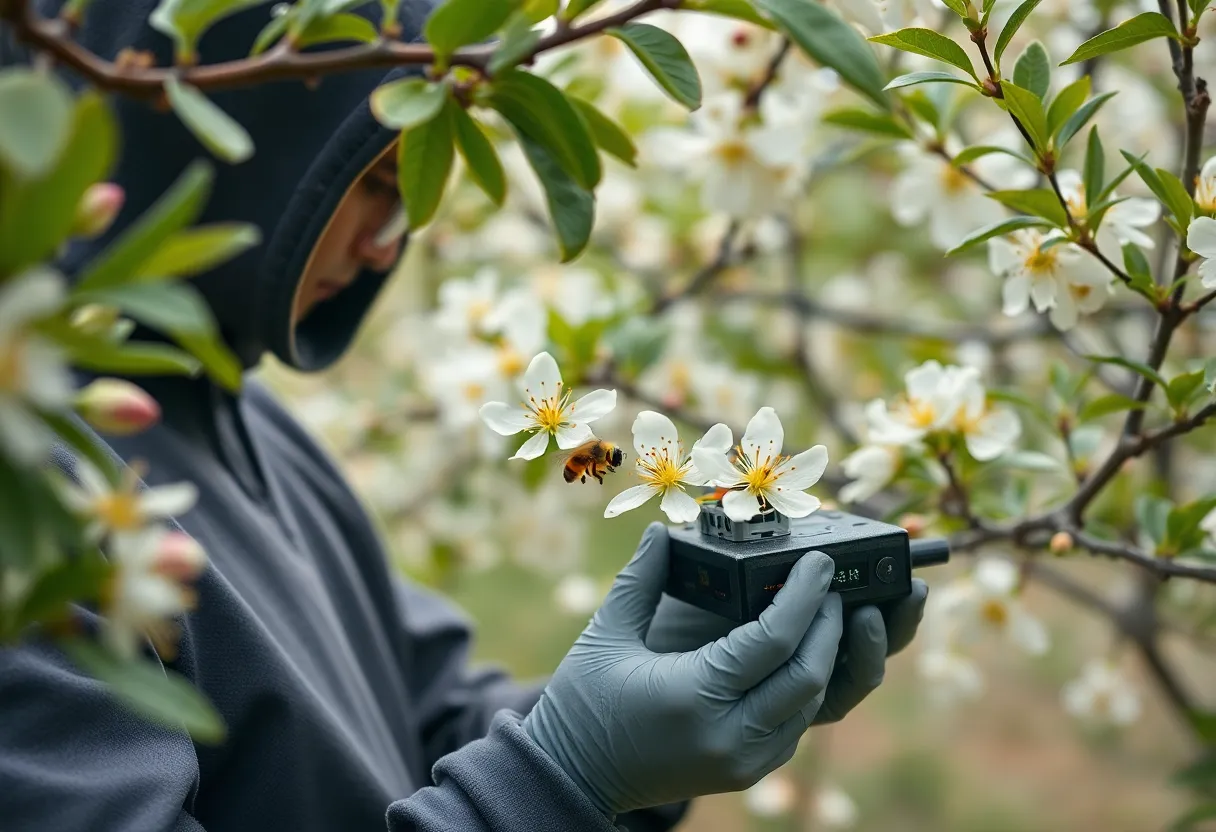
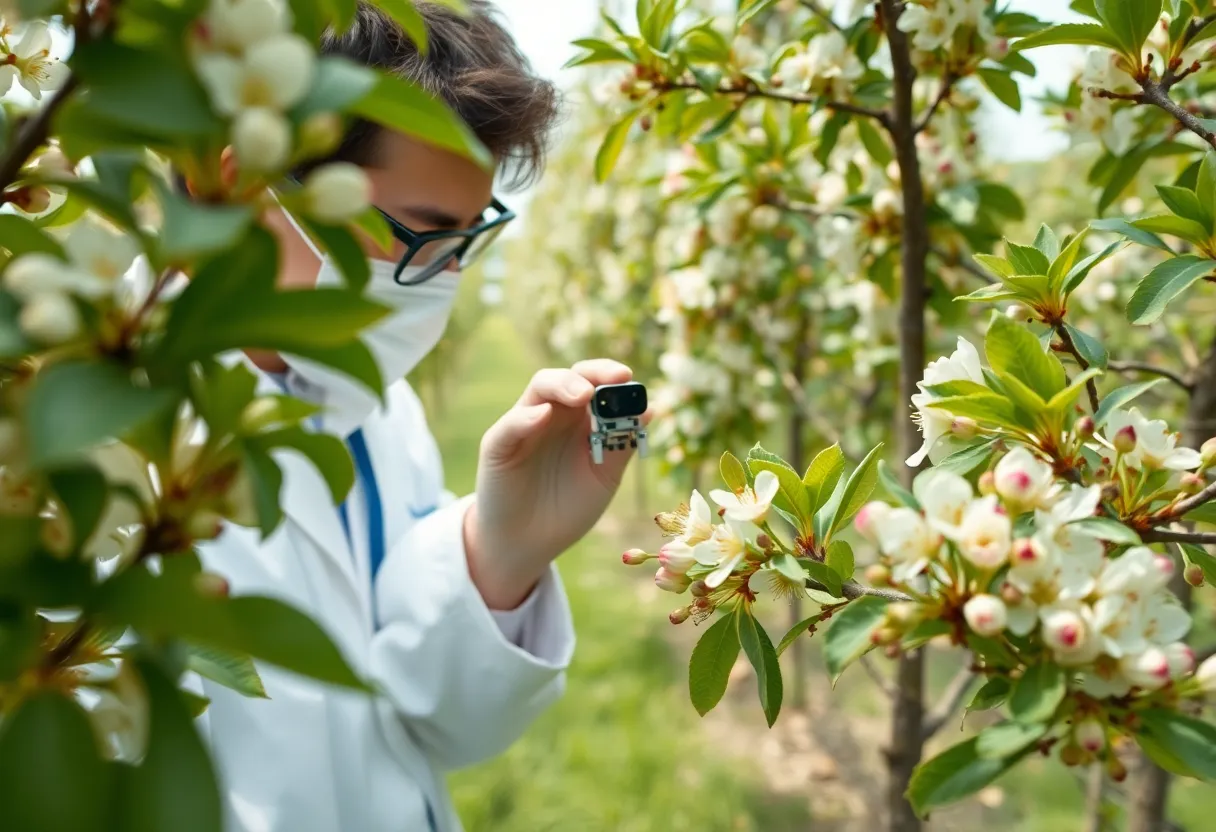
Most serious robotic pollination research has focused on small drone-based or robotic arm systems designed for specific, high-value crops rather than attempting broad-acre field crop pollination, since the economics and technical feasibility are considerably more favorable for crops where individual flowers or trees are valuable enough to justify more intensive, precision-focused robotic intervention. Research groups, including work at Harvard’s Wyss Institute on small-scale robotic pollination concepts and various university agricultural engineering programs working on drone-based pollen dispersal systems for orchard crops, have demonstrated genuine proof-of-concept capability for targeted pollination assistance in controlled research settings.
Some approaches have taken a notably lower-tech route than fully autonomous robots — mechanical pollen dispersal systems, including drone-mounted pollen spraying or dusting mechanisms that distribute collected pollen across a flowering orchard rather than attempting individual flower-level precision manipulation, have shown practical promise specifically for tree fruit and nut crops where broader pollen distribution across a flowering canopy, rather than exact individual flower targeting, is what actually matters for effective fertilization at commercial scale.
Why This Is Framed as Backup, Not Bee Replacement
It’s worth being direct about scale here, because the economics genuinely don’t favor wholesale robotic replacement of natural pollination at anything like current agricultural scale: a single almond orchard requires an enormous number of individual flower visits during a narrow flowering window each year, a scale of coverage that natural bee colonies achieve through millions of individual foraging bees operating in parallel essentially for free, and that would require an enormous number of individual robotic units, with all the associated manufacturing, deployment, power, and maintenance costs that scale implies, to even approach comparable coverage using current robotic pollination technology.
This is exactly why the most serious researchers and companies working in this space have generally framed robotic pollination as a targeted supplement for specific high-value crop situations, or as genuine emergency backup capability for scenarios where natural pollinator populations have been severely disrupted by disease, pesticide exposure, or colony collapse events specifically threatening a critical pollination window, rather than positioning robotic systems as a broad economic alternative to maintaining healthy natural pollinator populations across agriculture generally. The pitch isn’t “replace bees,” it’s “have some capability available for the specific, high-stakes situations where bee-based pollination has already failed or become unreliable enough to threaten a harvest.”
The Genuine Ecological Argument Against Over-Relying on This Technology
Beyond the current cost and scale limitations, there’s a more fundamental ecological argument for why robotic pollination shouldn’t be viewed as reducing the urgency of addressing actual bee health and pollinator conservation challenges directly: natural pollinators provide ecosystem services well beyond commercial crop pollination alone, including pollination of wild plant populations that support broader biodiversity and ecosystem function in ways that narrowly targeted robotic crop pollination systems have no capacity to replicate or substitute for at any meaningful scale.
This means even in a hypothetical future where robotic pollination technology matured considerably beyond its current experimental state, it would still only address the narrow commercial crop pollination piece of what natural pollinators actually provide, leaving the broader ecological argument for pollinator conservation — habitat preservation, pesticide reduction, and disease management for wild and managed bee populations — just as important as it is today, a point that responsible researchers in this space have generally been careful to emphasize precisely because “robots can back up bee pollination” risks being misread as “bee conservation matters less than it used to,” which isn’t an accurate or responsible takeaway from this research.
Where This Technology Is Actually Headed
The realistic trajectory for robotic pollination is continued narrow, targeted development for specific high-value crop applications and genuine emergency-backup scenarios, rather than broad commercial displacement of natural pollination services, given how favorably natural pollinators’ evolved efficiency and effectively free-to-deploy scale compares to the cost and technical complexity of robotic alternatives for most agricultural pollination needs. Continued advances in drone technology, computer vision, and precision agriculture more broadly are likely to keep improving what’s technically achievable in this space, but the fundamental cost and scale mismatch between robotic systems and natural pollinator populations means this is likely to remain a genuinely useful supplementary and emergency-backup technology for specific situations rather than a wholesale solution to the broader pollinator health crisis that continues to make this kind of backup capability worth developing in the first place.