Why Modern Ships Are Surprisingly High-Tech—And What Makes Them So Efficient

David Shaw
July 7, 2026
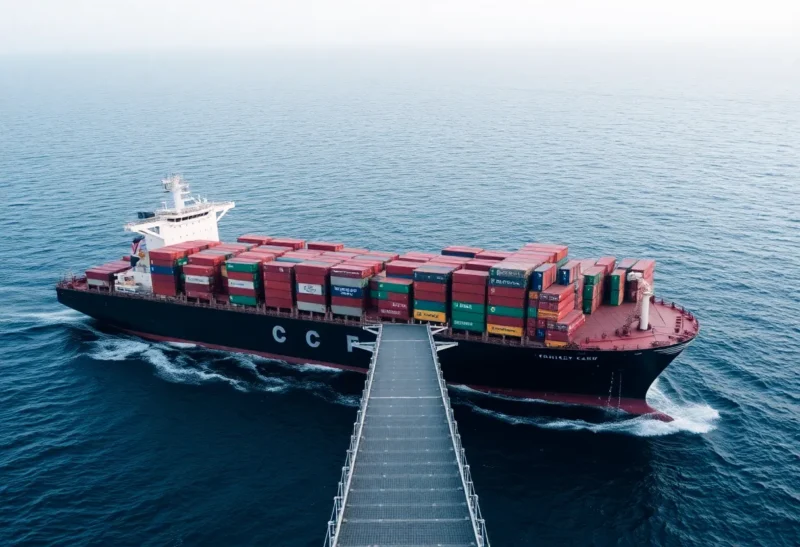
Ships don’t get much attention from technology media. They’re slow, they’re enormous, they spend most of their time out of sight in open water, and they don’t generate the kind of consumer excitement that drives coverage of smartphones, electric vehicles, or AI. But the world’s cargo and tanker fleet is responsible for moving roughly 90% of global trade by volume, and modern commercial ships are genuinely sophisticated engineering systems—in some ways more technically advanced than they appear and more fuel-efficient per ton-mile than any other mode of bulk transport.
Here’s what’s actually interesting about modern maritime engineering, and why the economics and physics of large ships lead to design decisions that seem counterintuitive until you understand the constraints.
Scale as the Foundation of Efficiency
The most fundamental advantage of shipping is scale. A large container ship—say, a 24,000 TEU (twenty-foot equivalent unit) ultra-large container vessel—can carry 24,000 standard shipping containers in a single voyage. At the kind of fuel efficiency modern large ships achieve, the carbon intensity per container-kilometer can be lower than any other form of cargo transport.
This is basic physics. The resistance a ship experiences moving through water scales roughly with the square of its length and proportionally to speed squared, while cargo capacity scales roughly with the cube of linear dimensions. Larger ships carry disproportionately more cargo per unit of hull resistance. The economies of scale in ship size are real and have driven a steady trend toward larger and larger vessels over the past fifty years—from the 2,000 TEU ships of the 1970s to vessels that are currently as large as 24,000 TEU.
The Suez Canal, the Panama Canal (after its expansion), and port infrastructure are the practical limits on ship size. Ultra-large container vessels can’t fit through the old Panama Canal locks at all, and routing decisions around these constraints are a significant factor in global shipping economics.
The Slow Steaming Revolution
One of the least obvious facts about modern commercial shipping is that ships deliberately steam far slower than they could. A large container ship capable of 25 knots typically operates at 14–18 knots. This is not a technical limitation—it’s an economic and environmental optimization.
Ship propulsion power requirements increase roughly with the cube of speed. Traveling at 18 knots instead of 24 knots requires less than half the engine power. Since fuel is typically the largest operating cost for a ship (often 50–70% of total voyage costs), the fuel savings from reduced speed are enormous. The trade-off is longer voyage times, which increases the capital cost per voyage and requires more ships to maintain the same schedule frequency—but at the fuel prices that have prevailed since the mid-2000s, slow steaming is almost always the economically optimal choice.
After the 2008 financial crisis, when shipping demand dropped sharply and fuel prices rose, slow steaming became industry standard practice. What was once an emergency measure during overcapacity became a permanent operational strategy and a meaningful contributor to the carbon efficiency of maritime transport.
The Two-Stroke Engine That Runs Almost Anything
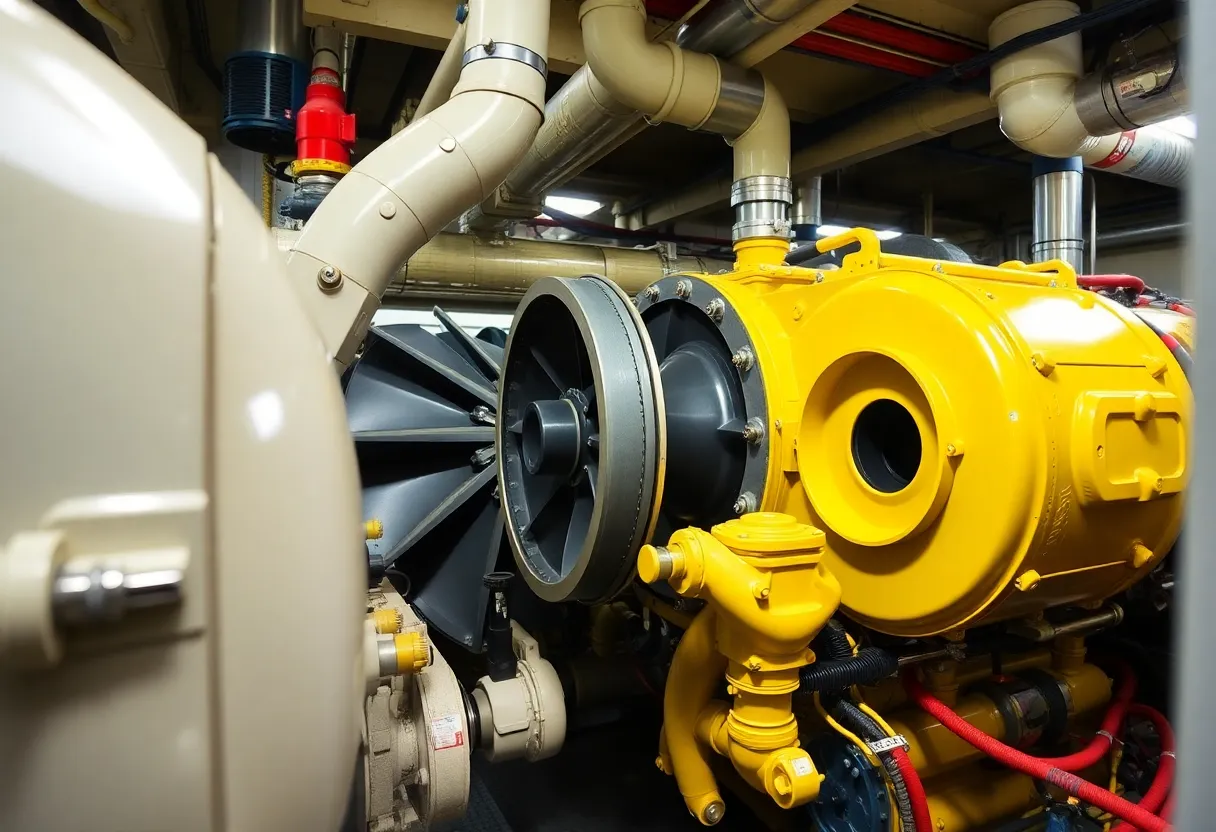
Most large commercial ships are propelled by massive two-stroke diesel engines—some of the largest reciprocating engines in existence. The Wärtsilä RT-flex96C, used in some of the world’s largest container ships, has cylinders with a bore of 960mm (about 38 inches), a stroke of 2,500mm, and at full power produces around 80 MW from 14 cylinders. Each piston moves through a stroke longer than a car is wide.
Two-stroke ship engines are remarkable for their thermal efficiency. Modern large low-speed two-stroke marine diesels achieve thermal efficiencies of 50–55%, meaning they convert more than half of the fuel’s energy into useful shaft work. For reference, automotive gasoline engines typically achieve 30–40% thermal efficiency, and aircraft turbines in cruise achieve similar or somewhat lower efficiencies when including the propulsive efficiency of the fan. For a heat engine burning fossil fuel, 50%+ thermal efficiency is exceptional.
The efficiency comes from several factors: large cylinder size (which reduces surface-area-to-volume ratio and heat losses), very high compression ratios, waste heat recovery, and optimized combustion design. Modern engines are also “electronically controlled”—fuel injection timing and amount are controlled by computer rather than mechanical cams, allowing precise optimization across the full operating range.
Waste Heat Recovery
Because the thermodynamics of combustion mean that a significant fraction of fuel energy leaves the engine as hot exhaust, modern ships invest heavily in recovering this waste heat. A typical waste heat recovery system includes:
Exhaust gas economizers: Heat exchangers in the exhaust stack that use exhaust heat to produce steam. This steam powers steam turbines to generate electricity, reducing or eliminating the need to run auxiliary diesel generators while underway. On a modern well-optimized ship, waste heat recovery can meet most or all of the ship’s electrical needs during normal ocean transit.
Turbochargers: Large radial or axial turbochargers use exhaust energy to compress intake air, improving combustion density and engine output without additional fuel consumption. Marine two-stroke engines typically use large turbines that recover a significant fraction of exhaust energy.
Power turbines: Some modern installations add power turbines downstream of the turbocharger, extracting further energy from exhaust gas that would otherwise be wasted.
When all waste heat recovery is counted, modern large ships achieve overall energy efficiencies that are genuinely impressive—in terms of cargo moved per unit of fuel burned, ships are among the most efficient freight transport systems ever built.
Navigation and Bridge Technology
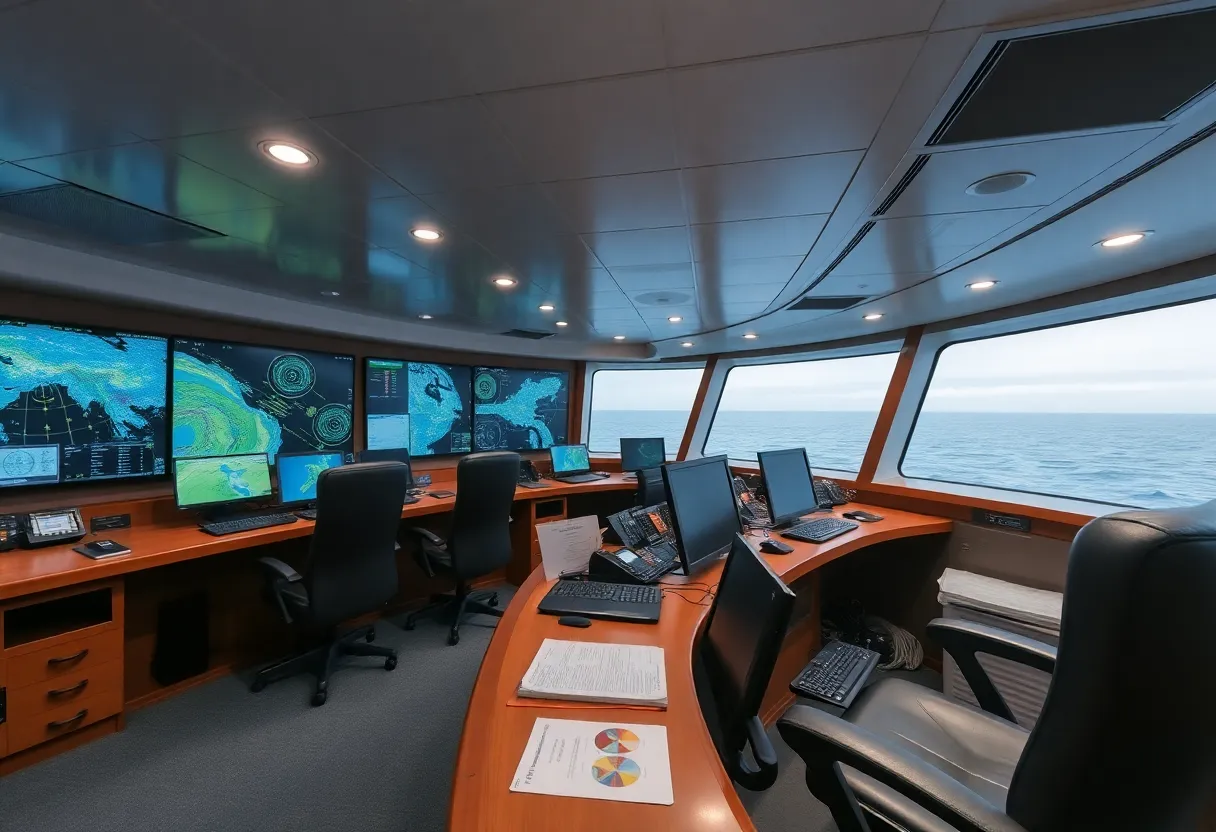
The bridge of a modern large ship looks more like an aircraft flight deck than the wheel-and-compass setup of old maritime imagination. Electronic chart display and information systems (ECDIS) have replaced paper charts on most commercial vessels, displaying real-time vessel position from GPS over high-resolution electronic nautical charts that include depth soundings, hazard markers, shipping lane boundaries, and traffic separation schemes.
Automatic Identification System (AIS) transponders transmit and receive vessel identification, position, course, speed, and other data from all nearby vessels. On a busy shipping lane or in a port approach, the ECDIS display shows dozens of vessels simultaneously with their predicted tracks, allowing the officer of the watch to assess collision risk proactively rather than reactively.
Radar, once the primary collision-avoidance tool, now works in conjunction with AIS and ECDIS. Modern X-band and S-band radars with ARPA (automatic radar plotting aid) can track multiple targets simultaneously, automatically calculating closest point of approach and time to closest point of approach for each tracked vessel.
Integrated bridge systems increasingly pull navigation, engine monitoring, and cargo management data onto common displays. A watch officer can see engine status, fuel consumption, weather overlay, traffic, and chart data without leaving the bridge console.
Autopilot systems on modern ships are sophisticated. Over open ocean, a ship typically runs on autopilot for most of the voyage—the officer of the watch monitors but doesn’t steer manually. The autopilot accounts for wind, current, and sea state, making constant small heading adjustments to maintain the track. Fuel-optimizing autopilots analyze the trade-off between different headings and speeds to find the most economical route given actual ocean conditions.
Ballast Water and Environmental Systems
Ships take on seawater ballast to maintain stability and trim when not fully loaded. When a container ship unloads in a port, it takes on seawater in ballast tanks to compensate for the removed cargo weight. When loading in the next port, it pumps out ballast. Over the course of a voyage, a large ship might handle thousands of cubic meters of ballast water.
This creates an environmental problem: ballast water from one ocean region, full of local microorganisms and small marine creatures, is discharged in a different region. Invasive species transport via ballast water has caused serious ecological damage globally. The IMO Ballast Water Management Convention, in force since 2017, requires ships to treat ballast water before discharge—killing organisms through UV treatment, filtration, or chemical treatment. Most large ships now carry ballast water treatment systems that were retrofitted or included in newbuilds.
Exhaust scrubbers—systems that wash sulfur and particulates from ship exhaust using seawater or caustic solutions—have been installed on many ships in response to IMO sulfur emission limits that took effect globally in 2020. Ships without scrubbers switched to low-sulfur fuel; those with scrubbers can continue using cheaper high-sulfur bunker fuel. The scrubber investment economics depend on the fuel price differential, which has fluctuated significantly.
Autonomous and Semi-Autonomous Systems
The maritime industry is investing in autonomous vessel technology, though full autonomy faces steeper regulatory and practical challenges at sea than in other transport domains. Existing autonomous or remote-control operations are mostly limited to short-range ferries, harbor tugs, and research vessels in controlled environments.
Rolls-Royce (now Kongsberg Maritime’s ship autonomy technology division) and several other companies have developed remote operation and autonomous navigation systems. Yara Birkeland, a Norwegian autonomous electric container ship, completed its first fully autonomous voyage in 2022—a short coastal route—as a proof of concept. Commercial autonomous deep-sea voyages remain ahead, but the underlying sensor, navigation, and decision-making technology is advancing.
The Quiet Giant
Shipping’s technological sophistication goes largely unnoticed because its outputs are invisible—the products it moves show up in stores and warehouses without the transport that brought them being evident. But the engineering that allows a single vessel to move 24,000 containers across an ocean in about two weeks, burning less fuel per ton-mile than any road or air alternative, using engines that are half a century in their basic concept but continuously refined to remarkable efficiency, managed by navigation systems that coordinate traffic across global sea lanes—that engineering deserves more attention than it typically gets.
The world’s cargo fleet is not glamorous. It is, however, quietly essential and more technologically interesting than its low profile suggests.