The Engineering of Modern Wind Turbine Blades: Bigger, Cheaper, Smarter

Erik Svensson
July 7, 2026
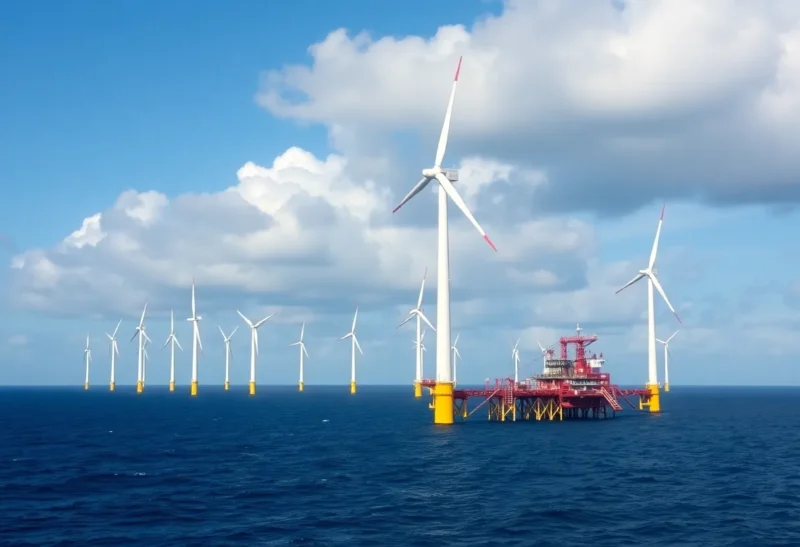
Wind turbine blades are among the most demanding engineering objects in mass production. A modern offshore wind turbine blade is longer than the wingspan of an Airbus A380, must survive wind loading cycles numbering in the hundreds of millions over its 25-year design life, operates through temperature ranges from -40°C to over 50°C, faces lightning strikes, ultraviolet degradation, and leading-edge erosion from rain and insects, and must be produced in large volumes at a cost that makes the resulting electricity economically competitive.
The fact that the industry has achieved all of this—while also roughly doubling blade lengths every fifteen years and reducing the cost of wind electricity by 70% in a decade—is a story of engineering progress that deserves more attention than it typically receives outside the energy industry.
Why Bigger Blades Produce Cheaper Electricity
The power output of a wind turbine scales with the area swept by the rotor—the circle described by the rotating blades. Because area scales with the square of the radius, doubling blade length produces four times the swept area and, in theory, four times the potential power output (at the same wind speed). In practice, the physics of wind energy conversion means the scaling is slightly less than ideal, but the fundamental relationship holds: larger rotor diameters mean more energy captured per unit of time and per unit of capital cost invested in the turbine itself.
The cost of a turbine does not scale linearly with blade length. The nacelle, tower, foundation, and grid connection have costs that grow with turbine size but not proportionally to the power increase. The blades themselves grow in cost, but the relationship between blade cost and blade length has improved substantially as manufacturing has scaled. The net result is that larger turbines—represented by falling Levelised Cost of Energy (LCOE)—produce electricity more cheaply than smaller ones, which has driven the consistent industry trend toward larger machines.
Onshore turbine blade lengths have reached approximately 80-100 metres on current-generation machines; offshore blades on the latest generation turbines (Siemens Gamesa’s 14-222 DD, Vestas’s V236-15.0) reach 107-115 metres, with prototypes and near-term designs approaching 130 metres. At these scales, blade tips travel at over 300 km/h when the turbine is operating at rated power.
Materials: Why Carbon Fibre and Glass Fibre Coexist
Wind turbine blades are composite structures—multiple materials combined to achieve properties that none achieves individually. The structural core is typically glass fibre-reinforced polymer (GFRP), with carbon fibre-reinforced polymer (CFRP) used in regions requiring higher stiffness or lower weight, primarily in the main spar (the structural beam running the blade’s length) and on very long blades where weight management becomes critical.
Glass fibre is cheap, widely available, and has adequate structural properties for much of the blade structure. Carbon fibre is significantly stiffer and lighter per unit of weight, but it costs approximately 10-15 times more than glass fibre. The engineering challenge is optimising the balance: using carbon where its superior properties justify the cost premium and glass where adequate performance can be achieved more cheaply.
At very long blade lengths, the blade’s own weight becomes a significant design driver—the blade must be stiff enough to avoid striking the tower under load (tower clearance is a critical constraint) and must survive the fatigue loading from gravity cycling as the blade rotates. Carbon fibre in the main spar is often the difference between a blade that achieves the required stiffness within an acceptable weight budget and one that doesn’t. For the largest current offshore blades, the carbon-glass hybrid approach has become standard.
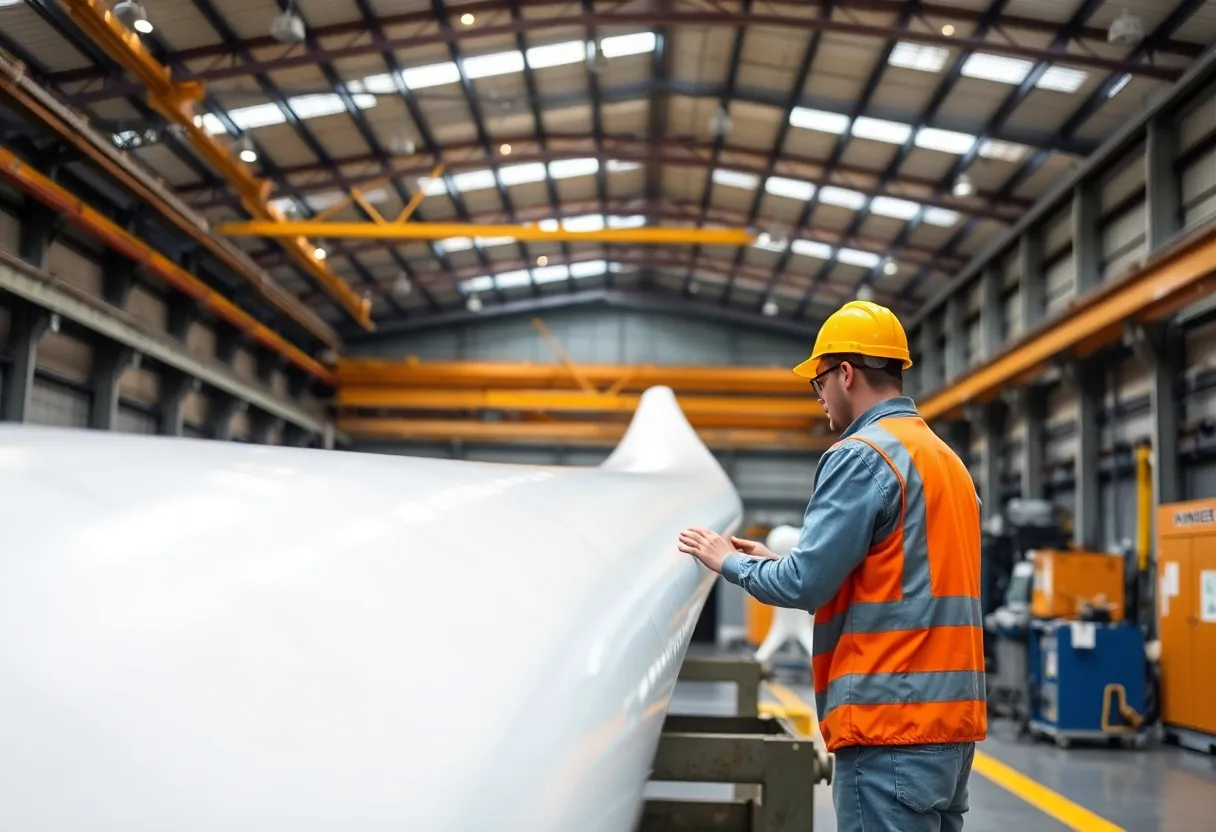
The blade shells (the aerodynamic surfaces) are typically made from multi-axial glass fibre laminates and sandwich structures, with foam or balsa wood core for bending stiffness without excessive weight. The trailing edge and leading edge have specific structural and aerodynamic requirements that influence their construction. The blade root (the end that connects to the hub) carries the highest structural loads and uses the thickest laminates.
Aerodynamic Design: Beyond the NACA Profiles
Wind turbine blade airfoil profiles have evolved substantially from the NACA profiles borrowed from aircraft wings in early designs. Wind turbine aerodynamic requirements differ from aircraft requirements in several important ways: the blade operates at lower Reynolds numbers (particularly near the root), must perform across a wide range of wind speeds, operates in turbulent and gusty inflow conditions rather than smooth cruise flight, and the outer portion of the blade moves much faster than the inner portion relative to the incoming wind.
Modern blade designs use families of airfoils specifically designed for wind energy applications, with different profiles at different radial positions: thicker, high-lift profiles near the root (where the section is structurally important and aerodynamic efficiency is lower due to slow relative velocity) transitioning to thinner, high-lift-to-drag profiles toward the tip (where aerodynamic efficiency dominates).
Computational aerodynamics has transformed blade design capability. High-fidelity CFD (Computational Fluid Dynamics) simulations can resolve the flow around complex three-dimensional blade geometries and predict aerodynamic performance with accuracy that was impossible with the panel codes and simplified strip theory methods used even fifteen years ago. The simulation tools have enabled exploration of design spaces—twisted and tapered blade geometries, winglet-style tip configurations, vortex generators, and serrated trailing edges—that experiment-driven design alone would have taken far longer to develop.
Structural Design and Fatigue Life
Wind turbine blades accumulate fatigue loading at a rate that puts them in a unique engineering category. Unlike aircraft, which accumulate flight cycles over decades at relatively low frequency, wind turbine blades rotate continuously, accumulating over 100 million load cycles over their design life. The material science and structural engineering required to ensure adequate fatigue life at this load count is demanding.
Fatigue testing of prototype blades is done at facilities that apply cyclic loads to full-scale blade sections, typically at frequencies of 0.5-1 Hz, running for months to simulate years of operational loading in accelerated form. These tests validate structural models and identify failure modes that simulation doesn’t predict.
The wind loading itself is complex: the blade sees a combination of flapwise bending (out of the rotor plane, driven by thrust force), edgewise bending (in the rotor plane, driven by gravity and torque), and torsional loading (twisting), all varying with wind turbulence, turbine operational states, and control actions. Modern structural design integrates finite element analysis, computational fluid dynamics, and loads simulations across the full operational envelope to ensure the blade meets its fatigue life requirement.
Manufacturing at Scale
Producing blades at the lengths now standard in offshore wind requires manufacturing facilities large enough to accommodate the complete blade in a single piece—modern blade factories are among the longest single-span buildings in existence. The blades are typically built in two shell halves in precision moulds (reusable glass fibre or carbon fibre infusion moulds that define the blade’s aerodynamic surface), infused with resin under vacuum, cured, and then bonded together with the internal structural components.
The labour intensity of this process has driven continuous investment in automation: robot-assisted laminate layup, automated bonding adhesive application, and machine-assisted inspection. Full automation of composite blade manufacturing remains a research challenge—the complex three-dimensional shapes and the need for precise fibre orientation are difficult for current robotic systems—but the degree of automation has increased substantially.
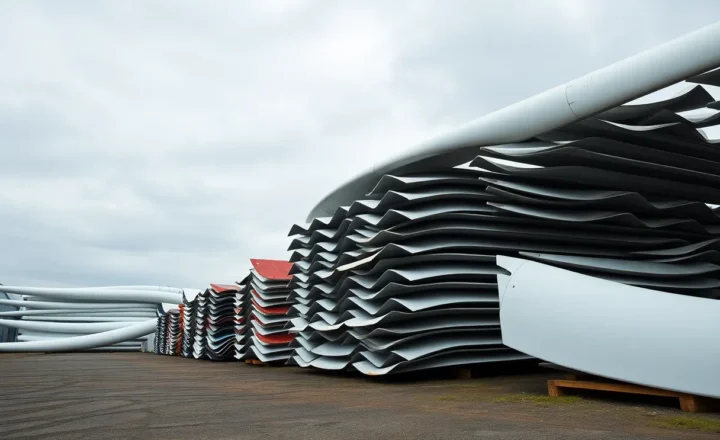
End-of-life blade recycling is an increasingly important engineering and sustainability challenge. The thermoset resin systems used in most current blades aren’t easily recyclable; decommissioned blades have historically been landfilled, cut up for secondary uses like noise barriers or playground equipment, or incinerated for energy recovery. Thermoplastic matrix systems that enable genuine recyclability are in development and have been demonstrated in prototype blades; scaling them to production represents one of the industry’s significant near-term engineering challenges.
Where the Technology Is Going
The trend toward longer, lighter, and smarter blades continues. Structural health monitoring—embedding sensors in the blade to track strain, temperature, and damage indicators in real time—is being integrated into commercial designs, enabling predictive maintenance and extending service life. Active flow control through trailing edge devices or morphing structures that adjust blade shape in response to wind conditions is a research topic with commercial potential for reducing fatigue loads while maintaining energy capture.
At the system level, the scaling of offshore turbines toward 20 MW and beyond will require solving the logistical as well as engineering challenges of transporting and installing blades that are longer than any current handling systems can manage—driving interest in segmented blade designs that can be assembled at the installation site. The engineering of wind turbine blades is far from a solved problem, and the pace of innovation in the field remains high enough that machines installed in a decade will look significantly different from those being installed today.