How Soil Microbiome Research Is Changing What We Know About Agriculture

Rosa Chen
July 7, 2026

For most of agricultural history, soil was understood primarily as a physical and chemical medium—a substrate that held plants in place and provided nutrients, water, and minerals for growth. The nutrients could be quantified, the chemistry could be managed, and crop yields could be optimised by adjusting the inputs: more nitrogen, more phosphorus, more potassium. This model produced the Green Revolution’s dramatic yield gains and now underpins global food production.
What this model missed—or rather, what it acknowledged but couldn’t fully account for—is that soil is not primarily a chemical system. It’s a biological system of extraordinary complexity. A teaspoon of healthy soil contains more microorganisms than there are humans on Earth: bacteria, fungi, archaea, protozoa, nematodes, arthropods, and their phages and viruses, interacting in networks whose influence on plant growth, nutrient cycling, disease resistance, and carbon storage is still being mapped.
Advances in metagenomic sequencing—reading the genetic material of entire microbial communities without culturing individual species—have transformed the ability to characterise these communities and are revealing that the microbiome of the soil is not incidental to agriculture but central to it.
The Mycorrhizal Network and Nutrient Exchange
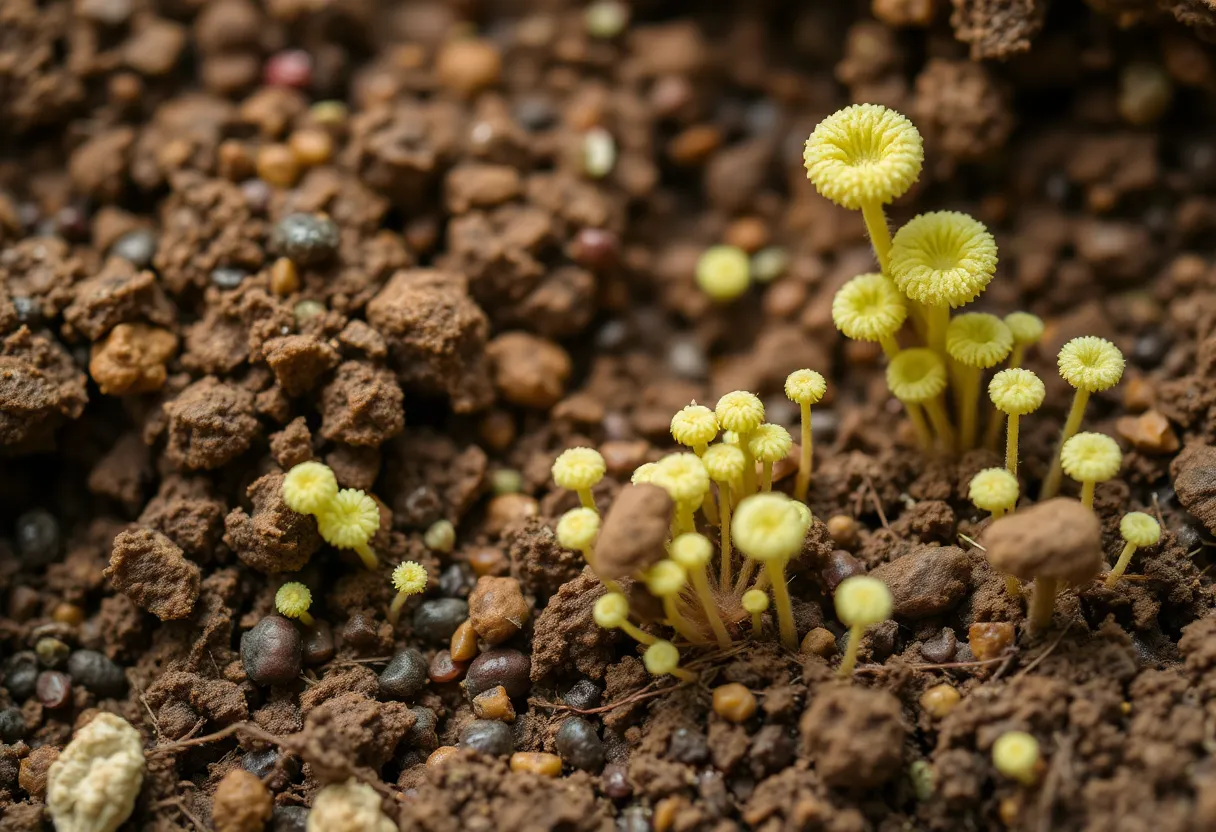
The relationship between plants and mycorrhizal fungi is one of the most well-studied and consequential in soil biology. The vast majority of terrestrial plant species form symbiotic associations with mycorrhizal fungi, which colonise plant roots and extend networks of hyphae (thread-like fungal structures) far beyond the root zone. Through these networks, plants and fungi exchange resources: the plant provides carbon (sugars from photosynthesis) to the fungus; the fungus provides phosphorus, nitrogen, water, and other minerals that the fungal network can access from a far larger soil volume than roots alone could reach.
The practical agricultural implication is significant. Many crops have evolved to rely substantially on mycorrhizal partnerships for phosphorus acquisition, particularly in phosphorus-limited soils. Applying synthetic phosphorus fertiliser satisfies the immediate nutrient demand but can also suppress mycorrhizal associations—the plant has no need to invest in the fungal partnership if phosphorus is available in excess. Repeated high-phosphorus fertilisation can systematically reduce the mycorrhizal community, leaving the soil more dependent on continued fertiliser inputs rather than building biological nutrient cycling capacity.
Modern agricultural practices including tillage, synthetic fertiliser application, and pesticide use have been shown to reduce mycorrhizal diversity and abundance across many cropping systems. The consequence isn’t always visible in short-term yield data—fertiliser compensates—but appears in reduced soil health indicators, higher fertiliser requirements over time, and reduced plant resilience to drought and disease stress.
The Nitrogen Cycle and Rhizosphere Bacteria
Nitrogen is the most limiting nutrient in most agricultural systems. The synthetic nitrogen fertiliser industry—which converts atmospheric nitrogen gas to ammonia through the Haber-Bosch process—is responsible for roughly half the nitrogen in the food system and is essential to feeding the current global population at current yields. It is also one of agriculture’s largest sources of greenhouse gas emissions (through nitrous oxide from soil denitrification) and water pollution (through nitrate leaching into groundwater and surface water).
The biological alternative to synthetic nitrogen is biological nitrogen fixation—the conversion of atmospheric nitrogen to plant-available forms by nitrogen-fixing bacteria. The most important of these are rhizobial bacteria that form symbiotic nodules on legume roots, which is why legume rotation has been a cornerstone of sustainable agriculture for millennia. Less well-recognised is the contribution of free-living nitrogen-fixing bacteria in bulk soil and in the rhizosphere (the zone of soil directly around roots), which can contribute meaningful amounts of nitrogen to non-legume crops.
Research on the nitrogen-fixing microbiome of cereals and other non-legume crops has found that some crop varieties host much more active nitrogen-fixing communities than others, and that agricultural management practices significantly affect the abundance of nitrogen-fixing bacteria. This opens the possibility of breeding crop varieties that are better hosts for nitrogen-fixing partnerships, reducing synthetic nitrogen requirements without sacrificing yield.
Microbially-produced nitrogen biostimulants—commercial products containing nitrogen-fixing bacteria—are now available and marketed to farmers. The evidence for their effectiveness is mixed and highly context-dependent: results vary significantly by soil type, existing microbial community composition, crop variety, and management practices. This is characteristic of microbiome-based agricultural interventions generally—the complexity of soil communities makes simple “add microbe X” solutions less reliable than adding a synthetic nutrient.
Soil Carbon Storage and Microbial Biomass
Soil is the largest terrestrial carbon reservoir, containing approximately three times more carbon than the atmosphere. Much of this carbon is held in organic forms—humus, fungal biomass, bacterial biomass, plant residues in various stages of decomposition. How long carbon persists in soil depends partly on the microbial community: some microbial communities actively process organic matter into more stable forms; others mineralise it quickly, releasing it as CO₂.
The connection between soil microbiome diversity and soil carbon storage is an active research area with significant implications for climate. Agricultural management practices that build soil organic matter—cover cropping, reduced tillage, compost application, diverse crop rotations—also tend to increase microbial biomass and diversity. The microbial community is both a product of healthy soil and a cause of it: microbial processes build stable soil aggregates, which protect organic matter from decomposition, which maintains the microbial community’s food supply.
Regenerative agriculture, which encompasses a set of practices aimed at restoring soil health through biological pathways rather than chemical inputs, derives much of its theoretical basis from soil microbiome science. The evidence for its yield and climate benefits is promising but more complex than advocates sometimes claim: outcomes depend heavily on local conditions, and yield comparisons with conventional agriculture during the transition period to regenerative practices are often unfavourable as the soil community adjusts.
Plant Disease Resistance Through the Microbiome
The rhizosphere microbiome is central to plant disease resistance in ways that weren’t well-understood until recently. Healthy soils with diverse microbial communities exhibit “suppressive” properties against certain plant pathogens—pathogens introduced to suppressive soils fail to cause disease at rates that would be expected given their concentrations. The mechanism involves competitive exclusion (beneficial bacteria and fungi occupying niches the pathogen needs), antibiotic production by beneficial microbes, and induction of plant immune responses through microbial signals.
The concept of induced systemic resistance (ISR)—where specific root-associated bacteria prime the plant’s immune system to respond faster and more strongly to pathogen attack—has moved from laboratory observation to commercial application. Biocontrol products based on Bacillus, Pseudomonas, and Trichoderma species are now significant agricultural markets, and understanding the specific mechanisms has improved product formulation and application protocols.
The practical takeaway for agriculture is that the microbiome is a functional component of the cropping system, not just an ecological curiosity. Management practices that damage the microbiome—deep tillage, broad-spectrum soil fumigation, continuous monoculture without rotation—remove services that the biological community provides and must compensate with synthetic inputs. Understanding this trade-off is now supported by enough evidence to inform management decisions, even if the full picture of soil microbial ecology remains complex and incompletely mapped.
What Changes in Practice
The shift in understanding from soil as chemistry to soil as biology is slowly translating into changed practice in some farming systems. Precision application of fertilisers, timed to match microbial nutrient cycling activity, reduces waste and leaching. Microbial inoculants—targeted applications of specific beneficial microorganisms—are improving in efficacy as the science of soil-microbe-plant interactions advances. DNA-based soil testing, which characterises the microbial community rather than just the chemical composition, is becoming commercially available and used by some progressive farmers to monitor soil health trajectories.
The transition from chemical to biological agriculture at scale faces real barriers: the biology is more complex and context-dependent than chemistry, making management recommendations harder to generalise; the economics favour conventional approaches in many markets; and the knowledge base for biology-forward farming is less developed than for conventional approaches. The research trajectory is clear, though: soil microbiome science is providing an increasingly detailed account of the biological processes that underlie soil fertility, opening pathways to more efficient, resilient, and sustainable cropping systems that the purely chemical model couldn’t fully access.