Why Vapor Chamber Cooling Is Replacing Heat Pipes in Thin Laptops

Futurion Editorial
July 9, 2026
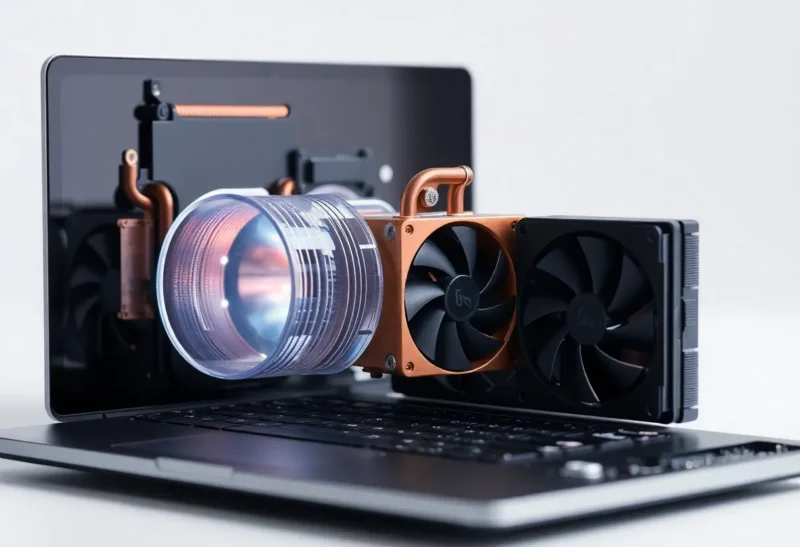
Laptop thinness and processor performance have been fighting each other for two decades, and the cooling system tucked inside a laptop’s chassis is where that fight actually gets settled. For most of that history, the standard solution was the heat pipe: a sealed copper tube containing a small amount of liquid that evaporates near the hot processor, carries heat toward a cooler section as vapor, condenses back to liquid, and cycles back, moving heat away from the chip far more efficiently than solid copper alone could manage. Over the past several years, a growing number of flagship thin-and-light laptops have quietly swapped heat pipes for a related but meaningfully different technology: vapor chambers, flat sealed enclosures that work on the same evaporation-condensation principle but spread heat across a wide, thin plane rather than funneling it through a narrow tube.
Why the Shape of the Cooling Solution Actually Matters
A heat pipe is fundamentally a one-dimensional heat transport solution — heat moves efficiently along the pipe’s length, from the hot end to the cool end, but the pipe itself only contacts a relatively small area of the processor package directly. In a modern laptop, this creates a real design constraint: processors and graphics chips have gotten physically larger and, more importantly, have increasingly concentrated their heat output into smaller, hotter regions of the chip package as transistor density has increased, and a heat pipe’s narrow contact footprint struggles to pull heat away from those concentrated hot spots fast enough, even when the pipe itself is doing an excellent job moving heat once it’s captured.
A vapor chamber solves this specific problem by essentially flattening the heat pipe concept into two dimensions. Instead of a narrow tube, it’s a thin, flat, sealed metal enclosure — typically copper — with the same internal working fluid and wick structure, but shaped to make direct, close contact across a much larger area of the chip package, and often across multiple heat-generating components simultaneously, like a CPU and a discrete GPU sitting near each other on a motherboard. This wider, more even heat capture is the entire value proposition: a vapor chamber can pull heat away from a concentrated hot spot and spread it across its full surface area almost instantly, at which point conventional heat pipes or direct fan contact can carry that now-diffused heat to the laptop’s exhaust vents far more efficiently than if the same total heat had remained concentrated in one small area.

Why This Became Necessary Rather Than Just Nice to Have
The shift toward vapor chambers tracks fairly directly with two converging trends in laptop design that have made heat pipes’ one-dimensional limitation increasingly costly. Laptops have gotten thinner over the past decade even as manufacturers pushed to include genuinely high-performance processors and discrete graphics chips that would previously have only appeared in bulkier gaming or workstation laptops, meaning cooling systems have had to do more work in less available internal volume, with less margin for an inefficient heat capture design to be compensated for simply by adding more metal or more fan capacity, since there’s often no physical room left to add either.
Modern chip packages have also increasingly integrated multiple distinct heat-generating components onto a single package or into very close proximity — combining CPU cores, integrated graphics, and sometimes dedicated AI accelerator silicon on the same chip die or package, as has become common with recent laptop processor generations from AMD, Intel, and Qualcomm’s ARM-based chips built specifically for thin, fanless-capable, or minimally-cooled designs. This kind of multi-component heat source is precisely the scenario where a heat pipe’s narrow, linear contact area struggles most, since different hot spots on the same package may be positioned in ways that don’t align well with where a traditional heat pipe would naturally be routed, while a vapor chamber’s broad surface contact can capture heat from multiple hot spots across the package more or less regardless of their specific position.
The Manufacturing Trade-off That Kept Vapor Chambers Out of Cheaper Laptops for Years
Vapor chambers aren’t a new invention — the underlying physics and even early commercial applications date back decades, and they’ve been standard in high-end desktop graphics card cooling for years before becoming common in laptops. Their slower adoption specifically within the laptop category came down to a genuinely difficult manufacturing trade-off: a vapor chamber thin enough to fit within an increasingly slim laptop chassis, while still maintaining the internal wick structure and vacuum-sealed integrity needed to actually function correctly as a two-phase cooling device, is considerably harder and more expensive to manufacture reliably than an equivalently sized heat pipe, which can be made thinner more easily without compromising its core function as dramatically.
Manufacturing advances in ultra-thin vapor chamber production — driven substantially by the smartphone industry, which had independently been pushing vapor chamber miniaturization hard for its own thermal challenges inside phones with essentially zero internal cooling volume to spare — have gradually brought costs down and reliability up over the past several years, to the point where laptop manufacturers can now justify including genuinely thin vapor chambers in mainstream flagship thin-and-light and gaming laptop lines, rather than reserving the technology exclusively for the most expensive workstation-class machines the way was more common a decade ago.
What This Actually Means for Real-World Performance
Independent thermal testing and reviews comparing otherwise similar laptop models with heat-pipe versus vapor-chamber cooling solutions have generally found the vapor chamber designs deliver measurably lower sustained peak temperatures under heavy, prolonged workloads — video editing exports, extended gaming sessions, or compilation-heavy development work — and, more importantly for real-world user experience, better sustained performance during those workloads, since modern processors dynamically reduce their clock speed to manage temperature, meaning a cooling system that keeps temperatures lower directly translates into a chip that can maintain higher performance for longer before thermal throttling kicks in.
The improvement is generally most noticeable specifically under sustained, heavy load rather than brief bursts of activity, which makes sense given what the technology actually addresses — a vapor chamber’s advantage is in more efficiently capturing and spreading concentrated heat over time, and that advantage compounds the longer a chip runs hot, while for brief, bursty tasks that never generate enough sustained heat to create a meaningful hot-spot problem in the first place, the practical difference between a well-designed heat pipe system and a vapor chamber system narrows considerably.
Where the Technology Is Headed Next
The trajectory in laptop thermal engineering points toward vapor chambers becoming standard across an increasingly wide range of laptop price points and form factors, following the same trickle-down pattern most laptop cooling innovations have historically followed as manufacturing costs decline with production scale and experience. Some manufacturers have already begun exploring hybrid designs that combine a central vapor chamber directly over the hottest components with traditional heat pipes handling the remaining heat transport to more distant exhaust vents, capturing the vapor chamber’s hot-spot-spreading advantage specifically where it matters most while keeping overall system cost and complexity more manageable than a full vapor-chamber-based design would require. As chip makers continue pushing more powerful, more thermally concentrated silicon into ever-thinner laptop designs, the pressure pushing this technology further down-market and into an even wider range of laptops shows no sign of easing up.