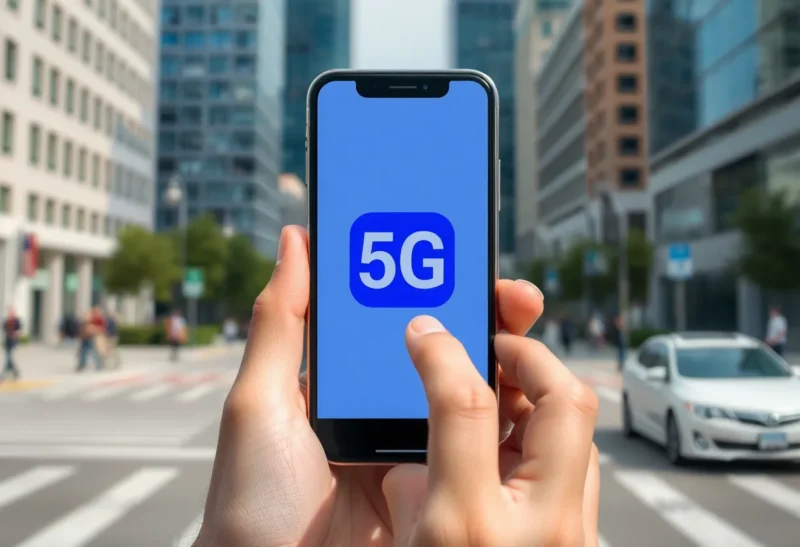
5G was supposed to change everything: gigabit speeds on your phone, lag-free gaming, a platform for connected cars and smart cities. Years into the rollout, most people’s experience is “sometimes it’s a bit faster than 4G, sometimes it’s not.” The gap between the promise and the daily reality is wide. Here’s why 5G still feels like a letdown—and what would have to change for that to shift.
The Marketing vs. the Physics
5G comes in different flavors. Millimeter-wave (mmWave) can deliver multi-gigabit speeds over short distances; it’s the “real” 5G that makes the demos look amazing. But mmWave doesn’t travel far and doesn’t penetrate walls or windows well. Carriers have deployed it in dense urban pockets—stadiums, airports, a few blocks in big cities. Most of the “5G” you see on your phone is actually mid-band or low-band: same spectrum family as 4G, with better encoding and more capacity, but not the order-of-magnitude jump that mmWave can provide. So when you’re on “5G” at home or on the move, you’re often getting a modest upgrade, not a revolution. The marketing said “5G”; the physics said “better 4G in most places.”
Coverage and Congestion
Even where 5G is deployed, coverage is patchy. Drop to 4G when you walk indoors or drive a few miles, and the experience feels inconsistent. Congestion matters too. 5G can handle more users in the same slice of spectrum, but when everyone on a tower is on 5G, you’re still sharing. In crowded venues or rush hour, speeds can tank. So the “letdown” isn’t just that 5G isn’t magic—it’s that it’s not reliably better where people actually use their phones. Until coverage is ubiquitous and backhaul (the link from the tower to the core network) is upgraded to match, 5G will keep underdelivering for the average user.
Device Support and Battery Tradeoffs
Not every phone is equal on 5G. Older or budget devices may support only certain bands or lack the antenna design to hold a solid 5G connection. When the phone keeps falling back to 4G or hunting for a 5G signal, battery life suffers—and the user gets no real speed benefit. Carriers have also been criticized for “5G” labels on networks that are barely different from 4G LTE-Advanced. So part of the letdown is that the “5G” badge doesn’t guarantee a better experience; it depends on your device, your location, and how the carrier has built out the network. For many people, turning off 5G and staying on 4G actually improves battery and stability. That’s not a good look for a “next generation” technology.
International Variance
5G experience varies wildly by country. In some markets, regulators freed up strong mid-band spectrum early and carriers invested heavily; in others, rollout has been slow or focused on the wrong bands. In the U.S., the mix of mmWave, C-band, and low-band has created a fragmented picture: great in a few places, mediocre in most. In parts of Europe and Asia, dense mid-band deployment has made 5G feel more consistently better than 4G. So “5G is a letdown” is partly a function of where you live and which carrier you use. The technology itself isn’t inherently disappointing—the deployment and positioning have been uneven.
What Would Make 5G Feel Worth It
For 5G to stop feeling like a letdown, a few things would need to happen. First, honest positioning: set expectations around “faster and more reliable in many places” rather than “everything changes.” Second, more mid-band deployment—the sweet spot between range and speed—so that “5G” isn’t just a label on a slightly improved 4G layer. Third, applications that actually need 5G: low-latency cloud gaming, AR that depends on edge compute, or industrial IoT that can’t run on Wi-Fi. Right now, most phone use—streaming, browsing, messaging—doesn’t need gigabit speeds. The apps and services that would demand 5G’s low latency or high bandwidth—cloud gaming, real-time AR, always-on high-quality video—are still emerging. So 5G is ahead of the demand curve: the network is being built for use cases that haven’t fully arrived. Until there’s a killer use case that only 5G can deliver, the upgrade will feel incremental. 5G isn’t a failure; it’s a foundation that’s still waiting for the rest of the stack to catch up. For most people, that’s why it still feels like a letdown.