The Real Problem With Smart Home Fragmentation—And Whether Matter Actually Fixed It

Caleb Whitmore
July 7, 2026
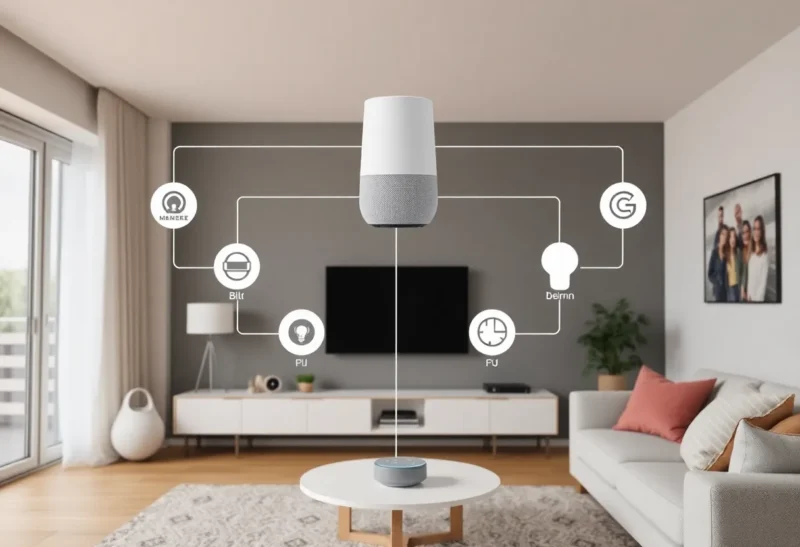
Smart home fragmentation has been a problem since the category existed. You buy a smart thermostat from one company, smart bulbs from another, a doorbell camera from a third, and a smart lock from a fourth. Each has its own app, its own account, its own firmware update cadence, and its own voice assistant compatibility matrix. Getting them all to work together, automate together, and talk to each other requires either living in one ecosystem’s walled garden (Amazon, Google, Apple) or becoming a hobbyist who runs Home Assistant on a spare server and writes YAML automations on weekends.
Matter, the smart home interoperability standard backed by Apple, Google, Amazon, Samsung, and the Connectivity Standards Alliance, was supposed to fix this. It launched in 2022 with significant industry fanfare. The question worth asking in 2026, after several years of deployed Matter devices and real-world use, is whether it actually did fix the problem — and where the limits of what a connectivity standard can address actually are.
What Matter Actually Is
Matter is an application-layer protocol and device certification standard. It defines how smart home devices communicate over IP networks (using Wi-Fi, Thread, or Ethernet), what commands they support, and what data they expose to controllers. A Matter-certified light bulb has a defined interface for on/off, dimming, and color, which any Matter controller (Apple Home, Google Home, Amazon Alexa, Samsung SmartThings, Home Assistant) can use without a manufacturer-specific integration.
This is genuinely meaningful. Before Matter, getting a Philips Hue bulb to work with Google Home required Philips to maintain a Google integration, and getting it to work with Apple Home required a Philips HomeKit integration. If Philips dropped one of those integrations, that ecosystem combination stopped working. Matter removes the bilateral integration requirement — a Matter-certified bulb works with any Matter controller, because the controller is talking to a standard interface rather than a proprietary one.
Thread, the underlying network protocol for many battery-powered Matter devices, is also a real improvement over Zigbee and Z-Wave for mesh networking. Thread is IP-based (making it more compatible with modern network infrastructure), self-healing mesh, and lower power than Wi-Fi. Thread-based devices don’t need per-brand hubs; they communicate via Thread Border Routers that multiple manufacturers’ devices can share.
What Matter Fixed
The clearest win for Matter is onboarding. Adding a Matter device to a controller is genuinely simpler than the pre-Matter process. Scan a QR code, the device connects to your network, and it appears in your chosen controller app. No brand account required (for the basic Matter functions), no manufacturer hub in most cases. The multi-admin feature means you can add the same device to both Apple Home and Google Home simultaneously — genuinely useful for households with mixed platforms.
Basic device control across controllers works reliably. Lights, plugs, thermostats, locks, and blinds — the core Matter device categories — work reasonably well across major controllers with basic commands. If you buy a Matter-certified bulb, it will almost certainly work with your existing controller without any special configuration beyond the QR code onboarding.
The longevity argument is real and underappreciated. When a smart home product company goes bankrupt or discontinues a product line, Matter-certified devices continue working with any Matter controller. The device isn’t dependent on the manufacturer’s cloud or their specific app integration. For people who’ve lost devices when companies like Wink, Insteon, or SmartThings scaled back their services, the architectural change to local standard protocols matters significantly for long-term reliability.
What Matter Didn’t Fix
Matter addresses the connection and control layer. It doesn’t address the rich feature layer, and that’s where most of the interesting smart home functionality lives.
Manufacturer-specific features — Philips Hue’s dynamic lighting scenes, Nest’s learning thermostat features, Ring’s event video feeds, Arlo’s AI detection categories — are not part of Matter. They’re exposed through manufacturer apps and cloud services, not through the Matter interface. A Matter controller can turn your Philips Hue bulbs on and off and set their color, but the Hue app’s curated lighting scenes and sync features require the Hue app and Hue ecosystem. Matter made the floor higher; it didn’t flatten the ceiling.
Automation sophistication varies wildly by controller and is not standardized by Matter. Apple Home’s automation capabilities are meaningfully less powerful than what Home Assistant can do. Google Home’s automation is different from Amazon’s. Matter means your devices can all be seen by all controllers; it doesn’t mean they’ll all automate equally well in all controllers. The controller you choose still determines your automation ceiling, and the best automations still often require the most capable controller (which tends to mean Home Assistant for power users).
Device category support in Matter is still growing. As of 2026, cameras with local streaming through Matter have rolled out slowly, and full camera feature parity with manufacturer apps through Matter controllers is still incomplete. Robot vacuums, some sensor types, and various niche device categories have limited or no Matter support. The standard is improving, but it’s still a snapshot of a developing specification rather than a comprehensive solution.
Cloud dependency isn’t eliminated — it’s reduced. Many Matter devices still require manufacturer cloud accounts for initial setup or for features beyond basic control. The local control promise of Matter is real for basic functions, but many devices still phone home for advanced features. True local-only operation often still requires Home Assistant with local integrations rather than cloud-dependent Matter implementations.
The Honest Assessment
Matter meaningfully improved the smart home experience for the typical consumer who buys a few devices from different brands and wants them to work together in a single app. Onboarding is genuinely better. Basic interoperability is genuinely better. The longevity story is genuinely better.
Matter did not and cannot fix the parts of smart home fragmentation that come from platform-level competition and manufacturer differentiation. Apple, Google, and Amazon are not going to converge their automation interfaces. Manufacturers are not going to expose their differentiating features through a standard protocol. Power users who want the most capable and most flexible smart home still need Home Assistant (or equivalent) to achieve it.
The practical implication for smart home buyers: Matter certification is now a baseline quality signal worth checking when buying new devices, because it improves compatibility, reduces hub requirements, and helps future-proof purchases. It doesn’t mean you can stop thinking about which ecosystem you’re building in — the controller platform choice still matters for what you can actually automate and how well it works. It just means the floor under you is higher than it was before 2022, and you’re less likely to get burned by a company closing down a cloud service that your whole setup depended on.