The Real Engineering Constraints Behind Building a Quiet Dishwasher

Futurion Editorial
July 9, 2026
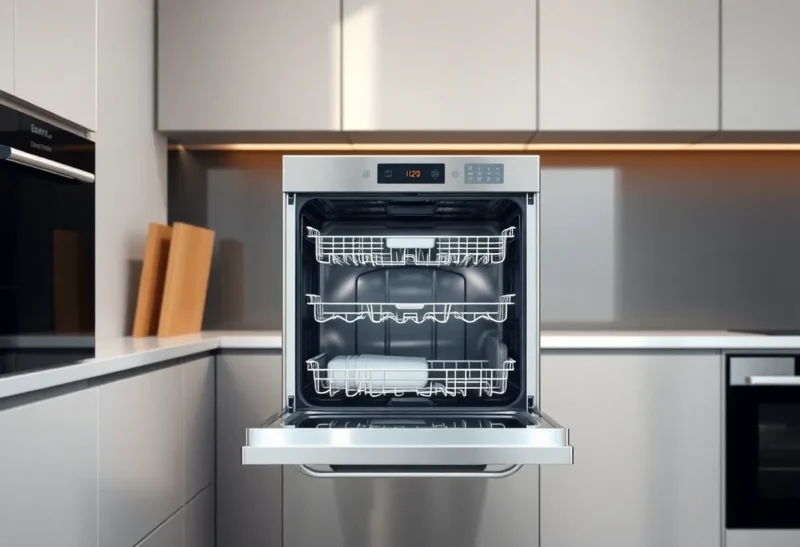
Dishwasher decibel ratings have become a genuine marketing battleground over the past fifteen years, with premium models now advertising noise levels quiet enough to run during a dinner party without disrupting conversation — a real shift from a generation of dishwashers loud enough to be a running joke about needing to leave the room. That improvement wasn’t a single breakthrough. It’s the result of manufacturers systematically attacking every individual noise source inside the machine, and understanding what those sources actually are explains both why quiet dishwashers cost more and why even expensive units still make some unavoidable sound.
Where Dishwasher Noise Actually Comes From
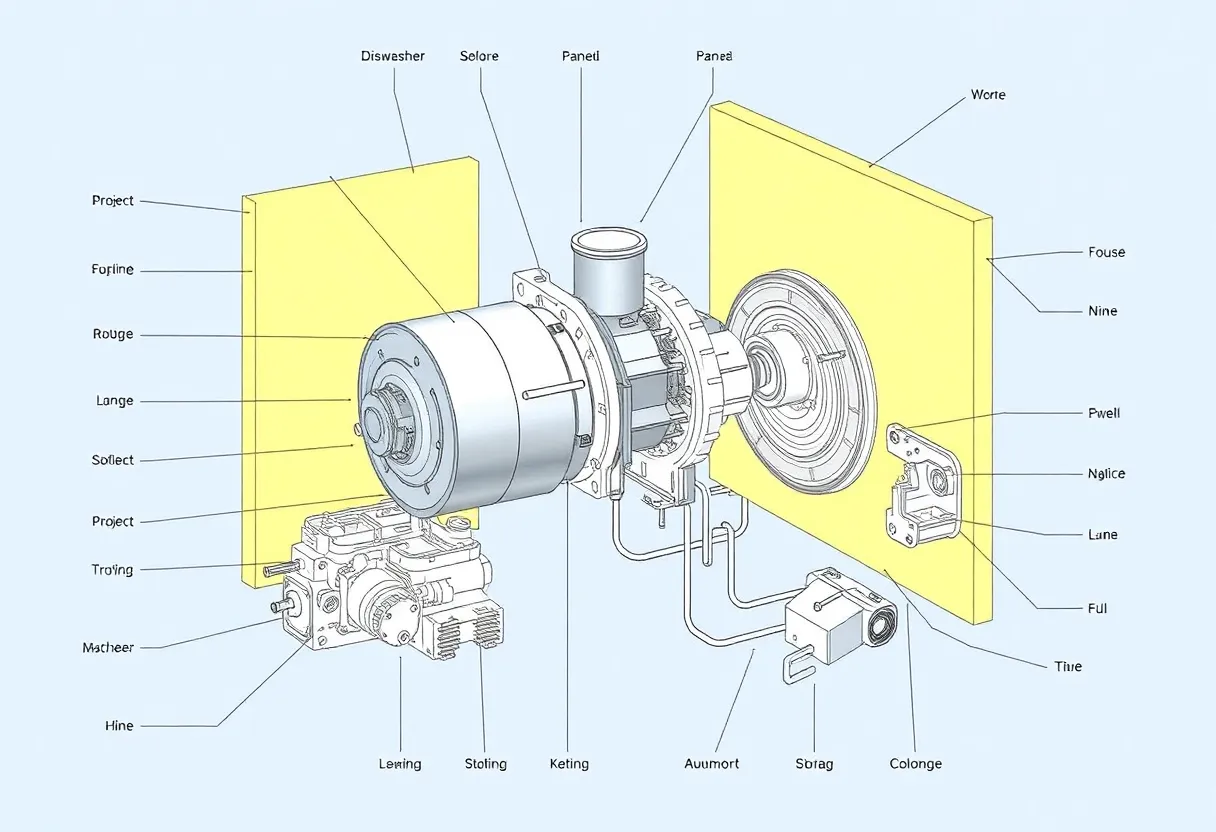
A running dishwasher generates noise from several genuinely distinct sources, each requiring a different engineering fix, which is exactly why quieting a dishwasher isn’t a single design change but a cumulative set of them. The circulation pump motor, which drives water through the spray arms at pressure, is usually the single loudest continuous noise source, generating both airborne noise (sound radiating directly from the motor housing) and structure-borne vibration that transmits through the machine’s frame and cabinet mounting into the surrounding cabinetry, which can amplify sound well beyond what the motor produces on its own in isolation.
Water impact noise — the sound of pressurized water actually striking dishes, the tub walls, and the spray arm housing — is a second, physically unavoidable source, since a dishwasher’s cleaning mechanism fundamentally depends on that impact to dislodge food residue. Drain pump operation during the drain cycle adds its own distinct noise signature, often higher-pitched than the circulation pump due to different motor characteristics and the sound of air being drawn through drain lines. And door latch mechanisms, cycle-stage solenoid valves switching, and the structural resonance of thin sheet-metal tub and door panels all contribute smaller but audible noise contributions that add up in an inexpensive unit that hasn’t specifically engineered around each one.
Insulation Does More Work Than People Assume, and Costs Accordingly
The most direct lever manufacturers have for reducing perceived noise is layered sound insulation wrapped around the tub and door — typically some combination of fiberglass batting, foam layers, and increasingly, specialized sound-deadening composite mats that combine mass with damping properties specifically tuned to absorb the frequency ranges dishwasher motors and water impact noise fall into rather than generic broadband soundproofing.
Budget dishwashers typically use a single, thinner insulation layer sufficient to meet minimum safety and basic noise standards but not much more, while premium quiet models stack multiple insulation layers of different densities specifically because different layer types are more effective against different frequency ranges — a dense layer helps block lower-frequency motor rumble, while a lighter, more absorptive layer helps with higher-frequency water and mechanical noise. This is a large part of why insulation packages account for a meaningful share of the cost difference between a base-model and premium-tier dishwasher from the same manufacturer, even when the actual washing performance and cycle options are similar — the customer is largely paying for the sound engineering, not additional cleaning capability.
Motor and Pump Redesign Solved a Problem Insulation Alone Couldn’t
Insulation reduces how much noise escapes the machine, but it does nothing to reduce how much noise the motor and pump generate in the first place, which is why the more fundamental long-term improvement in dishwasher noise has come from redesigning the pump motors themselves. Older dishwashers commonly used simpler induction motors that ran at a fixed speed regardless of load, generating consistent mechanical noise and vibration throughout the wash cycle. Modern premium dishwashers have shifted toward brushless DC (BLDC) motors, which run more quietly at a mechanical level due to smoother rotational characteristics and the absence of brush contact noise, and which can vary their speed electronically depending on the specific wash phase’s actual pressure and flow requirements, rather than running at a single fixed speed that’s louder than necessary during lower-intensity cycle phases.
This motor shift also enabled a secondary noise benefit: variable-speed control lets manufacturers deliberately slow the pump during specific cycle phases where high pressure isn’t needed, trading a small amount of cycle time for a meaningful noise reduction during those phases — an option that simply wasn’t available with older fixed-speed induction motors, which ran at the same speed and noise level whether the current phase needed that intensity or not.
Structural Damping Addresses the Noise Insulation Misses
Even a well-insulated tub with a quiet motor can still transmit noticeable vibration-borne noise if the machine isn’t structurally decoupled from the cabinetry it’s installed in, which is why quieter dishwasher models increasingly include specific vibration-damping mounting hardware — rubber or composite isolation mounts between the motor assembly and the chassis, and between the chassis and the surrounding cabinet mounting brackets — designed specifically to prevent motor vibration from transferring efficiently into the cabinetry, where it would otherwise resonate and radiate as audible noise well beyond what the machine itself produces directly.
This is also why identical dishwasher models can produce noticeably different real-world noise levels depending on installation quality — a poorly leveled unit, mismatched cabinet gaps that create resonant air spaces, or missing anti-tip and vibration-dampening brackets during installation can all undermine a manufacturer’s careful acoustic engineering in ways that have nothing to do with the appliance’s actual design.
Why Decibel Ratings Don’t Tell the Whole Story
Published dishwasher decibel ratings, while directionally useful for comparison shopping, measure sound pressure level under specific standardized test conditions that don’t fully capture how noise is subjectively perceived in an actual kitchen. A dishwasher’s noise profile isn’t just about total decibel level — the specific frequency content matters enormously for perceived annoyance, and a quieter-rated unit with a higher-pitched whine can feel more intrusive in an open-plan kitchen than a slightly louder unit with a lower, more consistent hum, because human hearing and annoyance perception aren’t linear with raw sound pressure across different frequencies. This is part of why some published “quietest dishwasher” rankings based purely on decibel specification sheets don’t always match independent reviewer or owner-reported real-world satisfaction with actual noise experience, and it’s a genuine limitation of decibel ratings as a single, simple shopping metric for a problem that’s actually multidimensional.