Nest vs Ecobee: Why the Smart Thermostat War Isn’t About Temperature

Ryan Collier
March 1, 2026
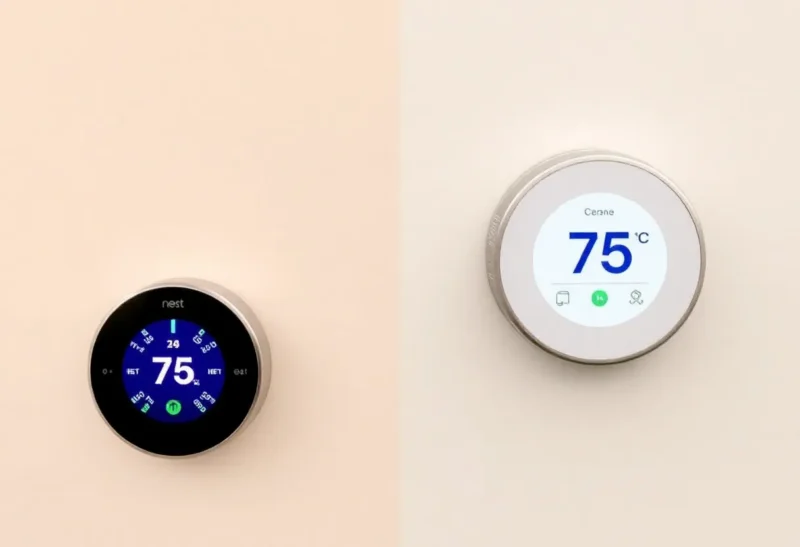
Nest vs Ecobee—the smart thermostat rivalry that never seems to end. Ask most people which one to buy, and you’ll get temperature specs, learning algorithms, and compatibility checklists. But the real battle isn’t about heating and cooling. It’s about ecosystems, data, and who controls your home. Here’s what’s actually at stake when you choose between the two.
The Surface-Level Comparison
Both Nest and Ecobee make excellent thermostats. They learn your schedule, adjust for occupancy, and save energy. Nest has the iconic circular design and Google integration. Ecobee has room sensors, better HomeKit support, and a more open approach to third-party integrations. Temperature accuracy is a wash—both do the job. The real differences lie beneath.
Nest is a Google product. It feeds into the Google Home ecosystem, uses Google’s AI for scheduling, and sends data to Google’s servers. Ecobee is independent—it works with Amazon Alexa, Apple HomeKit, and Google, but it doesn’t belong to any one tech giant. That distinction shapes everything: privacy, compatibility, and long-term support. The thermostat is just the front door. What matters is what’s behind it.
Data and Privacy
Thermostats know when you’re home. They know your wake-up time, your work schedule, when you go to bed. They infer occupancy from motion and temperature changes. That data is valuable—to you, for energy savings; to advertisers, for targeting; to insurers, for risk assessment. Who gets it?
Nest shares data with Google. Google’s privacy policy applies. Your thermostat data can be used to improve Google services, personalize ads, and train algorithms. You can limit some of that in settings—but the default is integration. Ecobee’s policy is more restrictive. It doesn’t sell your data to advertisers. It uses data to improve its products and may share anonymized aggregates, but it’s not feeding a broader ad empire. If privacy matters, Ecobee has the edge.
Neither is perfect. Both require cloud connectivity for full functionality. If you want climate and lights off that trade, start with home automation that actually runs locally. Both have had security scares—Nest cameras were famously hacked; Ecobee had a vulnerability that could expose home data. The difference is scale: Google’s data hunger is structural; Ecobee’s is more contained. It’s a matter of degree, not kind.
Ecosystem Lock-In
Nest works best with Google. Add a Nest thermostat to a Google Home setup, and everything flows. Voice control, routines, automations—it’s seamless. But if you want to use Apple HomeKit or Amazon Alexa as your primary assistant, Nest is awkward. Google has dragged its feet on Matter and Thread; Nest’s compatibility with non-Google ecosystems has been inconsistent. You’re buying into a walled garden.
Ecobee plays nicer with everyone. It supports HomeKit, Alexa, and Google. It was early to Matter and Thread. You can start with Alexa and switch to HomeKit later without replacing the thermostat. That flexibility matters if you’re building a smart home over time or if you’re not sure which ecosystem you’ll commit to. Ecobee is the Switzerland of smart thermostats—neutral, interoperable, future-proof.
Room Sensors and Comfort
Ecobee’s room sensors are a real differentiator. You can place sensors in bedrooms, living rooms, and offices—the thermostat adjusts based on where people actually are, not just the hallway where it’s mounted. That improves comfort and can reduce energy waste. Nest has relied more on its built-in occupancy detection; it’s gotten better, but it doesn’t offer the same granularity. If you have a multi-story home or rooms that heat and cool unevenly, Ecobee’s sensors matter.
Nest counters with design and simplicity. The circular interface is iconic. The learning algorithm is mature. If you want a thermostat that just works with minimal setup, Nest has appeal. But “just works” increasingly means “just works with Google.” The trade-off is real.
The Bottom Line
Nest vs Ecobee isn’t a temperature war. It’s an ecosystem and privacy war. Choose Nest if you’re all-in on Google, you value design and simplicity, and you’re comfortable with your data feeding the broader Google machine. Choose Ecobee if you want interoperability, better privacy controls, and room-level comfort. Both will keep your house the right temperature. The question is who else benefits—and how much control you keep.