Megaconstellations vs Dark Skies: What Amateur Astronomers Lose in 2026

Robin Hayes
April 7, 2026
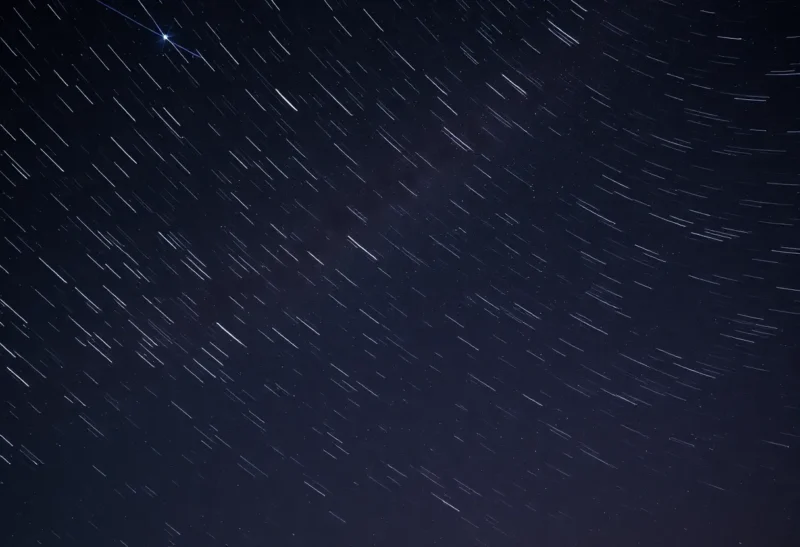
There is a moment every backyard astronomer knows: the sky finally steadies, tracking locks, and a faint target starts to accumulate photons in the sensor stack. Then a bright line scratches across the frame—too fast for a plane, too straight for a meteor train, too orderly to ignore. It is not science fiction. It is low Earth orbit, visiting your exposure one photon at a time.
By 2026, megaconstellations are not a rumor in astronomy forums. They are infrastructure—thousands of satellites designed to close digital divides, fund ambitious launch cadence, and keep the global internet humming. They are also a moving stencil laid over the night sky, changing what “dark” means for professionals, amateurs, and anyone who thought the stars were a quiet public commons.
The conversation is polarized enough already, so let us keep the physics and the feelings separate: connectivity can be vital and sky brightness can be a real constraint. Holding both truths is the only adult way to talk about trade-offs.
This article is not an anti-satellite screed. Connectivity saves lives and enables work. The point is narrower: there are real trade-offs for sky science and sky culture, and amateur astronomers pay them in ways that rarely show up in quarterly earnings calls.
What changes first: wide-field imaging and twilight windows
Satellite brightness depends on geometry: altitude, solar illumination, surface materials, and orientation. Many megaconstellation spacecraft are most visually intrusive during twilight passes—when observers on the ground are in darkness but the spacecraft still catches sunlight. That overlaps uncomfortably with popular observing windows for comets, conjunctions, and wide-field Milky Way photography.
For astrophotographers stacking long exposures, satellites do not merely annoy; they inject correlated artifacts that software must reject. Rejection algorithms improve. So do satellite counts. It becomes an arms race between cleaner pipelines and busier skies.
What amateur astronomers “lose” is not just pretty pictures
The losses are unevenly distributed:
- Time: more frames ruined, more re-shoots, more planning around passes.
- Signal-to-noise budgets: faint targets need long integrations; satellites waste photons and can saturate sensors.
- Educational experiences: public star parties rely on predictable awe; unpredictable bright trains reshape first impressions of the sky.
- Citizen science: projects that depend on clean light curves or asteroid searches can face higher false-positive rates and human fatigue.
None of this negates the social value of connectivity. It does mean the cost is not “invisible” just because it happens above the clouds.
Beyond pretty Milky Way shots: science that gets noisier
Optical astronomy is the most photogenic casualty, but it is not the only discipline watching orbit fill up. Radio-quiet zones and coordinated spectrum management matter for sensitive receivers; satellite downlinks and radar-like emissions can interfere with observations depending on frequency coordination and local enforcement. Amateurs may not run giant interferometers, but they participate in meteor monitoring, occultation timing, variable star photometry, and exoplanet follow-up—work where clean time series matter.
When a light curve wobbles, you want physics—not a specular glint from a solar panel briefly aimed wrong.
Specular flares and the “train” era
Early deployment phases produced memorable “trains” of satellites, bright enough to draw headlines. As constellations mature, spacing changes and some spacecraft dim—but brightness is not a single constant. Orientation adjustments, decaying orbits, and new generations of hardware keep the problem dynamic. Amateurs learn to treat the sky like weather: sometimes calm, sometimes streaky, always worth checking predictions.
Mitigation exists—and it is incomplete
Operators have experimented with darker coatings, sunshades, attitude rules, and deorbiting plans. Astronomers have built prediction tools, scheduling aids, and image-masking workflows. Regulators and international bodies debate coordination frameworks.
The honest summary in 2026 is mixed: mitigation reduces the worst-case brightness for some designs, but the aggregate number of objects and mission types continues to climb. Amateurs feel that aggregate in their histograms.
Equity framing: who gets sky silence?
Dark skies were never equally accessible. Light pollution from cities already stole the Milky Way from billions. Satellites add a second layer: even under a dark rural sky, exposures can carry mechanical glitter. The communities with resources—remote sites, better gear, software stacks—adapt faster. The communities without resources lose more than aesthetics; they lose access to a low-cost gateway into STEM identity.
That matters because astronomy is one of the few sciences where a modest telescope still feels like a time machine. If the first hour under the stars becomes a lesson in artifact rejection, you still learn engineering—but you might learn fewer constellations.
Policy is lagging physics, but it is not irrelevant
There is no global “sky HOA,” but there are national regulators, spectrum agencies, launch licensing conversations, and pressure from scientific unions. None of this moves at startup speed. Meanwhile launches do. The gap is itself a cost: observatories plan expensive mitigation while constellations iterate hardware on shorter cycles.
Constructive policy goals tend to converge on transparency (better ephemerides), brightness limits for certain phases, and deorbit accountability—without pretending space can be frozen in amber.
Cultural skies: more than a hobby budget line
For many cultures, the night sky is continuity—navigation, ceremony, seasonal markers. Industrializing low Earth orbit changes shared references in ways that spreadsheets struggle to capture. You do not have to romanticize the past to acknowledge that “more satellites” is also a cultural shift, not only a bandwidth upgrade.
The software stack arms race (and why it cannot solve everything)
Modern astrophotography pipelines already reject cosmic rays, satellite trails, airplane trails, and bad tracking frames. Each new contaminant class costs developer attention and CPU time. Stacking algorithms can statistically clip outliers—until trails overlap your target in too many subframes. Then you are not “cleaning data”; you are deciding whether tonight’s session is a loss.
This is where amateurs experience megaconstellations as a tax: not always fatal, but persistent. It shows up as fewer keepers per hour, longer integration requirements, and more nights that feel like work.
Professional observatories and amateurs: different pain, same sky
Giant surveys face their own scheduling and data-quality nightmares, but they also have institutional leverage: operator conversations, modeling teams, and sometimes dedicated mitigation agreements. Amateurs usually have enthusiasm and spreadsheets. The asymmetry matters because public enthusiasm is what funds planetariums, club telescopes, and school programs—exactly the ecosystem that produces future professionals.
Orbital debris and the confounding variable
Megaconstellations are not the same problem as space debris, but they share public confusion. A bright streak is not automatically “junk.” Still, the overall sense that low Earth orbit is crowded feeds anxiety about collisions and cascading breakups—anxiety that changes how people feel about launch cadence even when their complaint started as an aesthetic one.
What you can do without pretending you run NORAD
- Plan exposures around predicted passes when possible.
- Use satellite-aware scheduling tools where your software supports them.
- Advocate for dark-sky preservation locally—ground lighting still matters enormously, and it is something municipalities can actually change if residents show up.
- Support organizations that engage in constructive operator dialogue rather than pure doom loops.
If you are new to astrophotography in 2026, start with realistic expectations
Expect to learn a little orbital mechanics indirectly. Expect to love narrowband imaging one season and curse wide-field the next. Expect that your favorite dark-site campground may still be dark on the ground and busy overhead. That is not a reason to quit; it is a reason to treat satellite planning like you treat weather—part of the craft.
Also expect joy: satellites are not the only story. Eclipses still happen. Planets still wander. Comets still surprise. The sky is busier, not empty, and still worth the trouble.
What a “good enough” future looks like
Reasonable people can disagree on thresholds, but a better trajectory shares a shape: fewer surprise-bright passes during critical science windows, better public ephemerides, hardware designs that treat sky brightness as a design constraint rather than an afterthought, and deorbit plans that are boringly reliable. None of that eliminates satellites. It reduces unnecessary harm to a shared resource.
Amateurs are not asking for perfection. They are asking for predictability—so a teenager with a used DSLR can still capture the Milky Way without learning satellite masking before they learn exposure time.
Industry incentives already reward reliability and spectrum discipline in narrow business terms; sky brightness is the externality that needs clearer pricing. When operators treat astronomers as stakeholders rather than complainers, the conversation improves—because the solutions are engineering problems with schedules, not moral theater without levers.
Closing
Megaconstellations are a infrastructure choice with sky-scale side effects. Amateur astronomers are not opposed to the internet; they are canaries for a subtle public good—shared darkness—being reprioritized without a referendum.
In 2026, the sky still inspires. It just asks for more patience, more software, and more honest conversation about what we are trading away when we paint low Earth orbit with reflective machines.
Keep looking up—but keep asking, quietly and persistently, for a sky that still belongs to everyone who lifts their eyes at night: stargazers, scientists, storytellers, and kids seeing Saturn for the first time. That is not nostalgia; it is stewardship, and it matters.