Most of the world’s internet traffic doesn’t fly through the cloud—it moves through cables on the ocean floor. Hundreds of fiber-optic lines run between continents, and when one of them goes dark, the effects can be immediate and massive. A single cut can reroute traffic, throttle entire regions, and remind everyone how fragile our global connectivity really is. Here’s what’s actually going on when an undersea cable fails, and why it keeps happening.
The Backbone Is Underwater
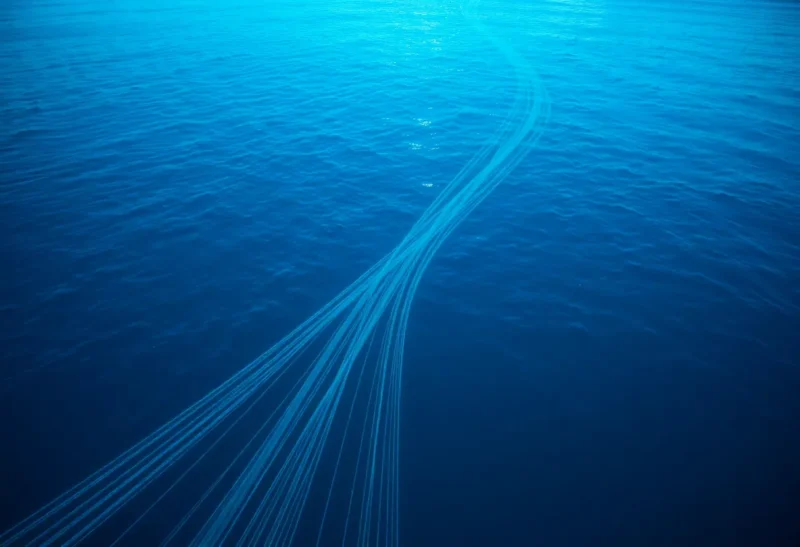
Roughly 95% of intercontinental internet traffic travels by submarine cable. Satellites get the headlines; cables get the bits. These lines are typically as thick as a garden hose, filled with fiber strands the width of a human hair, and they run for thousands of miles across some of the most hostile terrain on Earth. They’re laid by specialized ships, buried in shallow waters to avoid fishing and anchors, and left exposed in deep water where the seabed is stable. Each cable is a critical link. There are hundreds of them, but traffic tends to concentrate on a handful of key routes. When one link fails, the rest have to absorb the load.
The economics are stark. A single modern cable can carry dozens of terabits per second—enough for millions of video calls or billions of search queries. But that capacity is shared across many countries and thousands of networks. When a cable is cut, the traffic doesn’t disappear; it tries to find another path. Routing protocols shift flows onto the remaining cables, which may already be near capacity. The result is congestion, packet loss, and higher latency. For latency-sensitive applications—finance, gaming, remote work—the impact is immediate. For entire regions that depend on one or two cables, the impact can be existential until repair ships arrive.
Redundancy exists, but it’s not infinite. Major routes between Europe and Africa, or Asia and the Middle East, often rely on a small number of cables. An outage on one can mean instant congestion on the others—slower speeds, dropped calls, and for some countries, a real loss of connectivity until repairs are made. The “cloud” is, in other words, a network of very physical, very breakable wires.
Who Owns and Operates the Cables
Submarine cables are built and run by consortia of telecom operators, tech companies, and specialist cable owners. A single cable might have dozens of investors who each own a share of the capacity. That spread of ownership helps fund the enormous upfront cost—laying a transatlantic cable can run into the hundreds of millions—but it also means that decisions about where to build, when to repair, and how to price capacity are negotiated among many parties. When a cable fails, the consortium has to coordinate the repair: who pays, which ship is sent, and in what order faults are fixed when multiple cables are damaged at once.
In recent years, big tech has become a major cable owner. Google, Meta, Microsoft, and Amazon have invested in their own cables to connect data centers and reduce dependence on third-party transit. That’s improved capacity on some routes, but it hasn’t eliminated single points of failure. Many cables still converge in the same landing stations and follow similar paths. Geography and cost push cables through narrow corridors—the same straits and sea lanes where anchors and accidents are most likely.
Why Cables Get Cut
Cable faults happen for a few predictable reasons. Ship anchors and fishing trawlers account for the majority of shallow-water damage. A single anchor drag can slice through several cables in one go. Earthquakes and underwater landslides can sever or bury cables in deep water. In rare cases, sabotage or conflict has been implicated. And then there’s wear and tear: cables don’t last forever, and older segments are more likely to fail under stress.
Repair isn’t simple. First, the fault has to be located—often by testing from shore and correlating with the cable’s known route. Then a cable ship has to be dispatched. There aren’t many of these ships in the world, and they’re often booked. The ship reaches the area, grapples for the cable, brings it to the surface, splices in a new section, and drops it back. In good conditions, that can take days. In bad weather or remote locations, it can take weeks. During that time, traffic either stays offline or is forced onto the remaining cables, which can buckle under the extra load.
When a Continent Feels It
Real-world examples drive the point home. In 2008, cuts to cables in the Mediterranean disrupted internet across the Middle East and South Asia for days—millions of users saw slowdowns or outages. In 2020, a cable fault off the coast of West Africa left Mauritania and other countries with severely degraded connectivity. More recently, incidents in the Red Sea have highlighted how geopolitical risk and physical risk overlap: ships avoiding conflict zones can’t always repair cables, and cables in contested waters are more exposed to damage. In 2024, multiple Red Sea cable cuts were reported; repair timelines stretched because cable ships had to wait for safe passage.
Island nations and countries with limited cable diversity are especially vulnerable. Some depend on a single cable for most of their international bandwidth. A cut doesn’t just mean slow Netflix—it can affect banking, healthcare, education, and government services that have moved online. Backup options often mean routing through a neighboring country or over satellite, which is more expensive and higher latency. For users, the result is often a vague “slow internet” or “can’t reach this site.” For businesses and governments that depend on low-latency, high-bandwidth links—trading, remote work, cloud services—the impact is concrete. Backups and alternative routes help, but they’re not instant and they’re not free. Many regions are still one or two cable cuts away from serious disruption.
What Actually Improves Resilience
Resilience comes from more cables, more diverse routes, and better coordination. New cables are still being laid; the industry hasn’t stood still. But permitting, cost, and politics slow things down. Landing rights, environmental reviews, and sovereign concerns can delay projects by years. Diversifying routes so that no single chokepoint carries too much traffic is another lever—easier said than done when geography and economics push traffic through narrow corridors like the Red Sea or the Strait of Malacca. Better monitoring and faster repair contracts also help: knowing exactly where a fault is and having a ship on contract can shorten recovery from weeks to days. Some operators now use distributed acoustic sensing (DAS) or other techniques to detect cable movement or damage in near real time.
On the policy side, some countries have started to treat cable infrastructure as critical national infrastructure, with stricter rules around landing stations and repair readiness. International coordination remains patchy—there’s no single global body that decides where cables go or who fixes them first when multiple faults occur. In practice, the system relies on a mix of private investment, consortium agreements, and ad hoc cooperation. That’s worked well enough in peacetime; it’s less clear how it holds up when conflict or sanctions complicate repair operations.
For most of us, the takeaway is simple: the internet feels abstract, but it rests on a small number of physical assets. One undersea cable cut can disrupt a continent because we’ve built a global network that still depends on a finite set of threads under the sea. Understanding that is the first step to taking resilience seriously—whether you’re a policymaker, a network operator, or just someone wondering why the internet went weird last Tuesday.