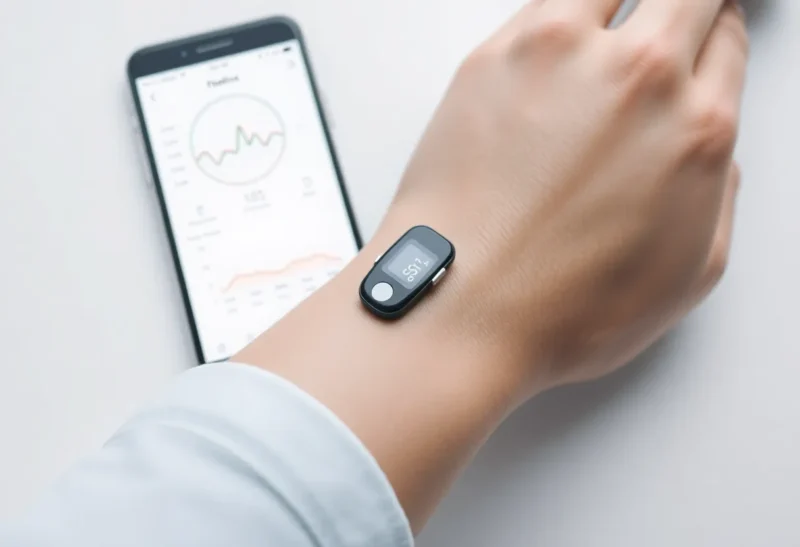
Continuous glucose monitors (CGMs) have moved from diabetes management into the wellness and biohacking world. You can now wear a sensor and watch your blood sugar in real time—no finger pricks, no lab visit. But what do those numbers actually mean, and how useful are they if you don’t have diabetes? Here’s what CGMs tell you, what they don’t, and how to interpret the data without overreacting.
What a CGM Measures
A CGM uses a tiny sensor under the skin (usually on the arm or abdomen) to measure glucose in interstitial fluid—the fluid between your cells—not directly in blood. The reading is a proxy for blood glucose: there’s a short lag (typically a few minutes) between a change in blood sugar and what the sensor reports. So when you see a spike or dip on the app, you’re seeing something that already happened a few minutes ago. For trend awareness that’s usually fine; for fine-grained timing (e.g., “did that banana cause this?”), the lag matters.
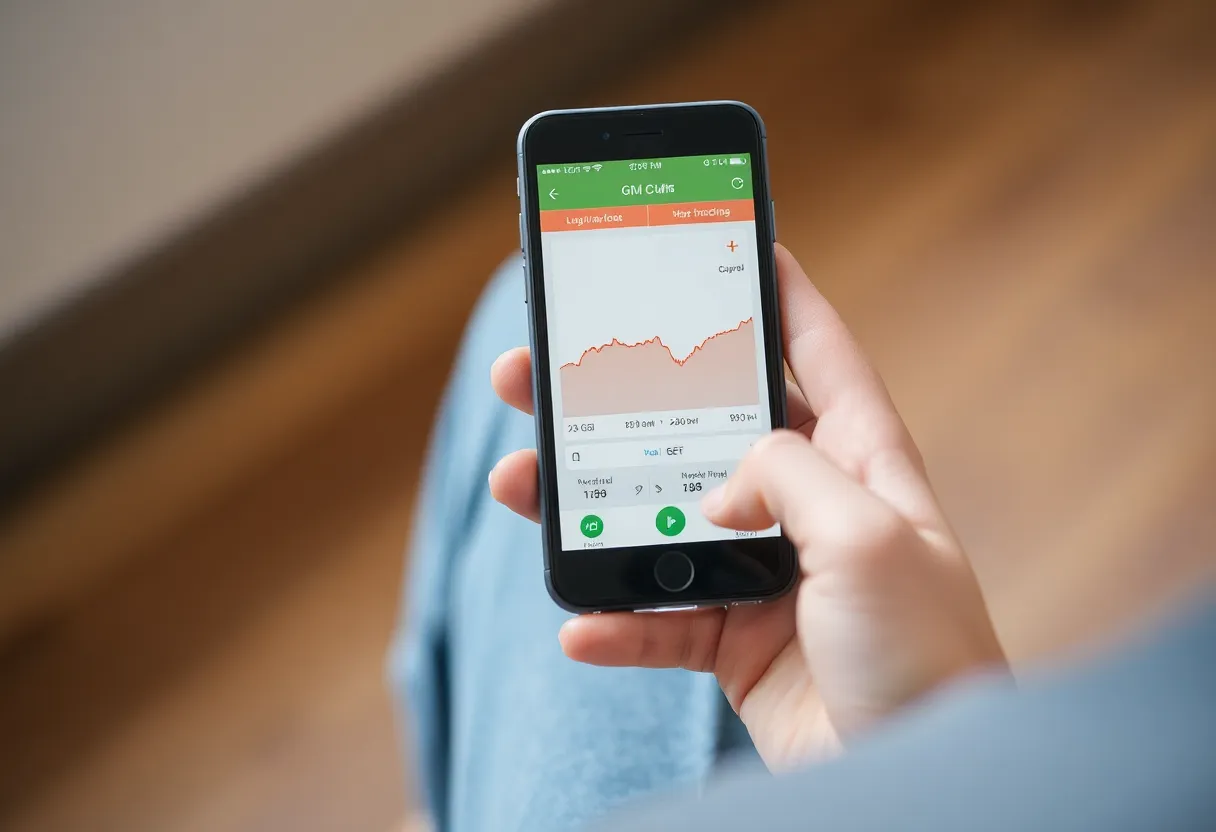
CGMs report glucose in mg/dL (or mmol/L outside the U.S.). “Normal” fasting glucose is roughly 70–100 mg/dL; after meals it can rise to 140 or higher and then come down. The device gives you a stream of readings and often a graph so you can see how your levels change over the day. That’s the core of what it “tells” you: a continuous picture of where your glucose is and which way it’s moving.
What It Can and Can’t Tell You
If you have diabetes or prediabetes, a CGM is a clinical tool: it helps you see how food, activity, and medication affect your glucose so you can adjust. For people without diabetes, the picture is fuzzier. You can see which meals or snacks cause big spikes or dips, and you can notice patterns—e.g., a sharp rise after a sugary breakfast or a drop in the afternoon. That can be useful for curiosity or for tuning diet and timing. What it can’t tell you is whether your “normal” is healthy for you in the long run. Reference ranges are population-level; individual variation is real. So a CGM gives you data, not a verdict.
It also can’t replace a proper metabolic workup. If you’re worried about insulin resistance, prediabetes, or metabolic health, you need lab tests (fasting glucose, HbA1c, possibly an oral glucose tolerance test) and a clinician’s interpretation. A CGM is a complement—it shows you patterns over days or weeks—but it doesn’t diagnose. Treat it as one input, not the whole story.
Spikes, Dips, and Variability
Two things people often focus on are spikes (sharp rises after eating) and variability (how much your glucose swings during the day). Big, repeated spikes are sometimes linked to later metabolic issues, and high variability has been associated with stress and less stable energy. So some people use a CGM to try to “flatten” their curve: eating in an order that blunts spikes (e.g., fiber or protein before carbs), avoiding large loads of simple sugar, or timing meals. There’s decent evidence that this can reduce spikes; whether that translates to long-term health in non-diabetic people is still an open question. What you can say is that a CGM makes the effect of food and behavior visible in a way that finger sticks never did.

Limitations and Noise
CGMs aren’t perfect. Sensors can be off by a few percent; compression (lying on the sensor) or dehydration can affect readings. So don’t treat every blip as gospel. Look at trends over hours and days, not single points. And remember: interstitial fluid lags blood. If you feel a crash and check the app, the number might not have caught up yet. The data is useful for pattern recognition, not for second-by-second precision.
Access, Cost, and Who Can Get One
CGMs were originally prescription-only for people with diabetes. In some regions, over-the-counter or direct-to-consumer options (e.g., Abbott’s Libre for non-insulin users, or programs that offer CGMs for “wellness”) have expanded. Cost varies: with insurance and a diabetes diagnosis, it’s often covered; without, sensors can run tens to over a hundred dollars per month. So “what a CGM tells you” also depends on whether you have access and whether the cost is worth it for you. For many people without diabetes, a short trial (e.g., two weeks) is enough to see patterns; you don’t need to wear one forever.
Using the Data Without Obsessing
The risk of any continuous biometric is over-interpretation. A single high reading after a meal doesn’t mean you “ruined” your metabolism. Variability day to day is normal. Use the CGM to notice broad patterns—e.g., “my glucose is steadier when I eat protein first” or “that afternoon slump lines up with a drop”—and then adjust if you want. Don’t chase a perfectly flat line; that’s not the goal, and it can turn into unhealthy fixation. The value is in awareness and occasional experimentation, not in optimizing every meal to the number.
What the Evidence Says for Non-Diabetics
For people with diabetes, the evidence for CGMs improving outcomes is strong. For people without diabetes, the picture is thinner. Some studies suggest that real-time feedback can help people reduce glucose spikes or improve diet quality in the short term. Long-term health effects in otherwise healthy populations aren’t well established. So wearing a CGM as a non-diabetic is partly an experiment: you’re gathering data about your own body. That can be valuable and interesting; it’s not yet a standard recommendation for everyone. If you try one, treat it as one tool among many—diet, sleep, activity, and regular checkups—not as a replacement for the rest.
Who Benefits and Who Doesn’t
If you have diabetes or prediabetes, a CGM can be genuinely useful for management and for talking to your doctor. If you’re healthy and curious, it can give you a window into how your body responds to food and routine—useful for experimentation, not required for health. If you’re prone to anxiety or obsessive tracking, the constant stream of numbers can do more harm than good. So “what a CGM actually tells you” is: your approximate glucose level and its trends. It doesn’t tell you if you’re “healthy”; it gives you one signal to interpret with context and, when needed, with a clinician’s help.