Satellite Broadband vs Starlink After Rain: When GEO Still Wins a Zoom Call

Dana Robles
September 18, 2026
Starlink wins the brochure. After a real rain, I have sat on a call where the LEO dish was the pretty one and the old HughesNet-class GEO link was the one that still had a face. Not faster. Not nicer. Present. The search that brings people here is not “which satellite is the future.” It is why a 600 ms bird can hold a Zoom when the phased array is staring at a wet sky and a crowded cell.
I have walked rural houses through both. I still tell most of them to try Starlink first if the trees allow it. I also tell them not to cancel the GEO modem on the same afternoon they see 200 Mbps in a clear app. Weather is not a speed test. Weather is a meeting you cannot move.
Two kinds of rain
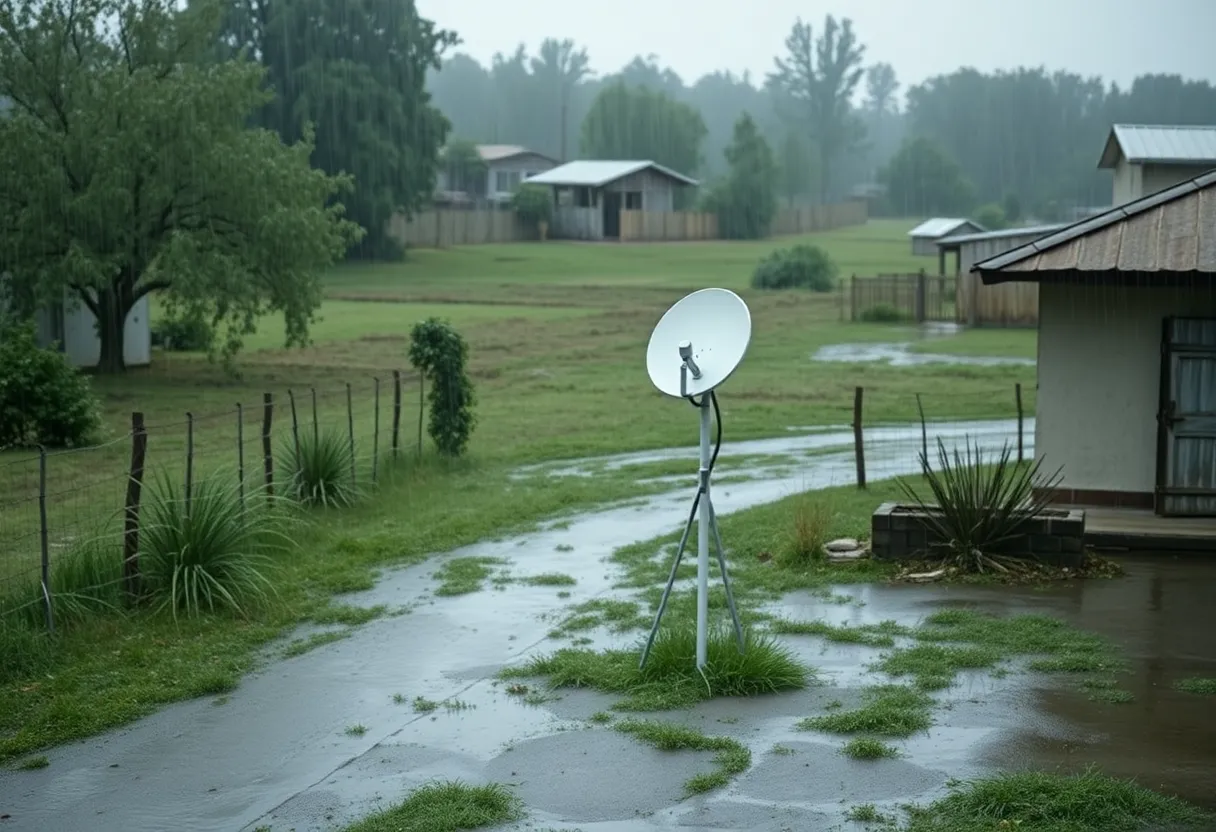
Ka-band and the higher slices Starlink uses do not like water. Rain fade is physics, not a firmware mood. GEO operators have lived with it for decades: a fat fade margin, adaptive coding, sometimes a site that just goes to sludge for twenty minutes. You know the ritual. You wait. The meeting audio turns into a radio play and then it comes back.
Starlink rain is that plus a moving mesh. The dish hunts a satellite that is not parked. A cell can be busy. A tree that was “fine in winter” is a wet wall in April. The app says obstruction. The call says freeze-frame. I have watched the download number stay “okay” on a phone while the uplink that Zoom actually needs fell apart. People screenshot the download. Zoom does not care about your screenshot.
GEO after rain is often slow and honest. Starlink after rain is often fast and then gone. Gone is worse for a face. Slow is ugly and survivable if the codec can breathe.
Why latency is not the whole Zoom story
GEO is a quarter-second each way on a good day, more when the modem is buffering. That is a joke next to Starlink’s 25–50 ms marketing band. On a clear evening the joke loses. On a wet Tuesday the LEO path can add loss, jitter, and a re-acquisition that looks like a dropped UDP stream. Zoom will ride high latency if the packets still arrive in a boring pattern. Zoom will punish a pretty average with holes.
I have done the rude test: same house, same laptop, same meeting ID, swap the default route. Clear day: Starlink is the adult. During a cell-soaking storm: I have had Viasat-era GEO keep the camera at 360p and the voice intact while Starlink spent the hour in reconnect theater. I do not claim that every storm. I claim it enough that I will not call GEO obsolete for “a call you cannot miss.”
If your work is uploads of huge files, GEO still loses after rain and before it. If your work is a voice and a slide deck, the metric is not median Mbps. It is whether the next thirty seconds exist.
Obstructions Starlink owns and GEO shrugs at
A GEO dish points at one patch of sky. You clear that patch, you live with the look angle, you deal with wet leaves on that line. A Starlink kit wants a lot of sky. Trees, a ridgeline, a neighbor’s metal roof — rain makes every edge worse. Mini kits are less forgiving than a Standard on a pole. People buy Mini because it is cute. Then they learn cute is a smaller view.
I have told people to keep GEO as the “south sky is open, north is trees” option when Starlink’s only install is a porch that sees half a dome. After rain, that porch is a coin flip. The GEO on the gable that already cleared FCC-era pointing can be the boring winner. Boring is a compliment.
Oversubscription is a dry-day problem that rain makes rude
Starlink cells fill. Evening congestion is a known rural complaint. Rain does not create the crowd. It shrinks the usable capacity while the crowd stays. GEO networks are also crowded — they always were — but the failure mode is a stable crawl, not a dance of disappearing neighbors. A crawl can still carry a muted-video call. A dance cannot.
If you only tested Starlink at 10 a.m. on a Sunday, you did not test the product. Test at 7 p.m. in a storm. Test the uplink. Then decide whether GEO’s monthly cap is a worse pain than a frozen stand-up.

Caps, fair use, and the call you keep
GEO consumer plans still punish you with priorities and depleted buckets. After you burn the priority gigabytes, you are in a swamp. Starlink residential is a different swamp: deprioritization that shows up as a soggy evening, not always as a hard cap you can count. Neither is “unlimited” in the way a fiber bill is unlimited.
For a Zoom you care about, I would rather be on a GEO plan that still has priority left than on a Starlink session that is both wet and deprioritized. That is a calendar problem as much as a radio problem. People run backups over Starlink because it is fast when it is fast. Then the storm hits during the all-hands. I tell them to park the backup. I also tell them a leftover GEO line with unused priority is a meeting insurance they already pay for. Cancel it when the dish has a winter of clean evenings, not after a sunny week.
When I tell people to drop GEO
When the Starlink view is truly open, the cell is not a meme, and they do not have a weekly call that cannot survive a five-minute fade. When they are done paying two bills to feel safe. When the GEO modem’s Ethernet is the only reason the old PC still has a default route and nobody remembers the password. Dead insurance is clutter.
I also drop GEO when the remaining product is a 3 Mbps story that cannot hold a modern meeting even on a dry day. Some legacy plans are nostalgia. Nostalgia does not win Zoom. It wins a support forum.
When I tell people to keep both
A household that sells time on camera. A clinic hour. A kid in a remote class with a teacher who will not wait. A farm office that already owns the GEO install. Failover does not have to be clever. A second Ethernet on a cheap router, or a human who swaps a cable, beats a policy-based routing thesis you will not maintain.
I have seen people put Starlink in bypass and still lose the meeting because the failover never moved default. After rain is not when you debug policy. After rain is when you want a switch you practiced on a dry Saturday. If you will not practice, keep GEO as the daily driver for voice and use Starlink as the fat pipe when the sky is kind. That sounds backwards to the internet. It is how some houses already live. They just feel guilty about it. They should not.
What I tell a school or a clinic
If the building already pays for a GEO plan that still has a serviceable modem, I do not rip it out the week Starlink lights up. I put Starlink on the fat applications and I leave the conference TV on the path that survived last spring’s storm, until we have a season of notes. Notes beat a Slack argument. I ask someone to write “call held” or “call died” with the weather. After twelve weeks the data is ruder than my opinion.
If they have no GEO left, I do not tell them to sign a new two-year GEO just for Zoom. I tell them to fix the Starlink view or add a terrestrial backup — a slow WISP, a phone tether with a real data bucket — because a new GEO contract in 2026 is a different product than the leftover dish on the barn. Leftover is cheap insurance. New is a bet I make rarely.
Hardware honesty
A Standard kit on a tall mast with a clear dome will embarrass GEO in most weather I have logged. A Mini on a picnic table next to a maple will not. People compare “Starlink” as a brand to “satellite” as a brand. I compare a specific view of the sky to a specific look angle. The winner after rain is the path that still has a carrier, not the logo on the invoice.
Power matters too. A storm that fades RF can also brown out a rural transformer. GEO modems and Starlink kits both die without juice. A UPS that only covers the LEO power brick is a vote. If the meeting is the product, the meeting path gets the battery. I have seen the opposite: a rack of toys on the UPS and the dish on the wall wart. The audit writes itself.
The decision
After rain, GEO can still win a Zoom call when Starlink is obstructed, hunting, or sharing a wet crowded cell — not because 600 ms is good, but because a stable crawl beats a pretty hole. Keep the old bird if the call cannot move and the LEO sky is not actually open. Drop it when the dish has a season of honest evenings and you are tired of two modems. Test storms, not Sundays. Then pick the face that still moves.