How Bike Share Rebalancing Algorithms Decide Where to Move Bikes Overnight

Ola Mensah
July 9, 2026
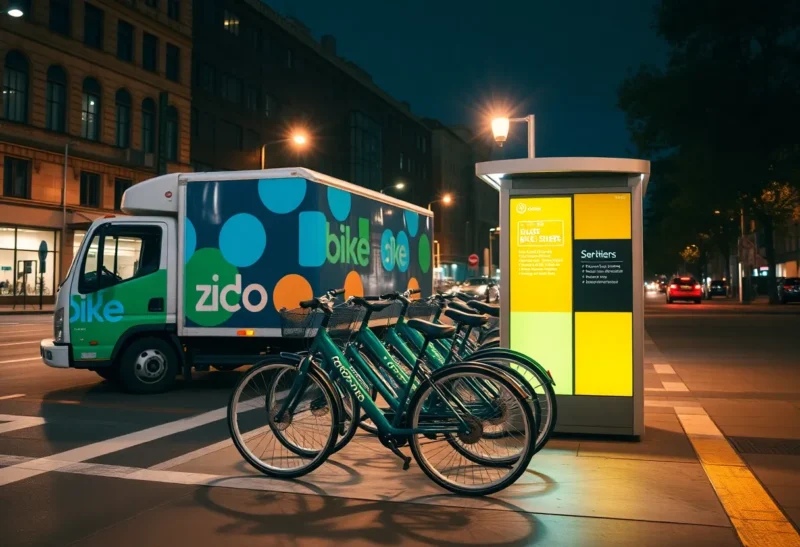
Anyone who’s tried to grab a bike share bike from an empty station, or return one to a station with no open docks, has experienced the practical downstream effect of a genuinely difficult operations problem: bike share systems experience predictable, directional commuting flow patterns that naturally drain bikes from some stations while overfilling others, and without active intervention, this imbalance would compound day after day until popular origin stations ran permanently empty and popular destination stations stayed permanently full. The truck-based rebalancing operations that move bikes between stations overnight and during the day are the direct operational response to this problem, and the routing and prioritization decisions behind that rebalancing work have become a genuinely sophisticated logistics optimization problem in their own right.
Why Bike Share Systems Naturally Drift Toward Imbalance
Urban commuting patterns are strongly directional at predictable times — a large share of bike share trips during morning rush hour flow from residential areas toward business districts and transit hubs, while evening rush hour sees the reverse flow, and this asymmetry means residential-area stations naturally empty out over the course of a typical morning while business-district stations fill up, with the pattern reversing in the evening but rarely reversing perfectly enough to naturally restore balance without any intervention.
Weekend and event-driven usage patterns add further complexity, since a large public event, particularly good weather, or seasonal usage shifts can produce station-level demand and supply patterns that differ substantially from typical weekday commuting flow, meaning a rebalancing strategy tuned purely around weekday commuting patterns would perform poorly on weekends or during atypical demand periods, requiring genuinely adaptive rebalancing planning rather than a single fixed daily routine applied uniformly regardless of actual observed demand conditions.
How Modern Systems Actually Predict Where Rebalancing Is Needed
Contemporary bike share operations rely on continuous real-time monitoring of every station’s current bike count and dock availability, combined with historical usage pattern data and, in more sophisticated systems, predictive demand modeling that forecasts which stations are likely to run empty or full within the coming hours based on current conditions, time of day, day of week, and sometimes weather forecast data that meaningfully affects bike share usage volume and patterns.

This predictive layer matters considerably beyond simple current-state monitoring because rebalancing operations take real time to execute — a truck crew needs time to reach a station, load or unload bikes, and travel to the next station on their route, meaning a rebalancing strategy that only reacts to stations that are already empty or full is systematically behind the actual demand curve compared to a strategy that can anticipate and preposition bikes toward stations predicted to need them before they actually run out, a meaningfully more effective operational posture that predictive modeling specifically enables.
Why Truck Routing Itself Is a Genuinely Hard Optimization Problem
Once a system identifies which stations need bikes added or removed, actually planning efficient truck routes to execute that rebalancing is a variant of the vehicle routing problem, a well-studied but computationally difficult class of logistics optimization problem, complicated further in the bike share context by the fact that trucks are simultaneously picking up bikes from overfull stations and dropping off bikes at empty ones, rather than simply visiting a fixed list of delivery-only or pickup-only stops.
Bike share operations software increasingly uses optimization algorithms specifically designed for this pickup-and-delivery routing variant, balancing several competing objectives simultaneously: minimizing total truck travel distance and time (a straightforward cost efficiency goal), prioritizing the stations with the most urgent predicted imbalance (since not every rebalancing task carries equal time urgency), and accounting for practical constraints like individual truck capacity and the specific mix of station types (some very high-turnover, high-priority stations near major transit hubs or business districts justify more frequent rebalancing attention than lower-usage residential stations that can tolerate somewhat more imbalance without materially degrading system usability).
Why Overnight Rebalancing Specifically Matters So Much
A large share of a bike share system’s total rebalancing effort concentrates specifically into overnight hours, for practical reasons that go beyond simply avoiding daytime traffic congestion for the rebalancing trucks themselves — overnight rebalancing lets operators reset the system to a favorable starting distribution before the next morning’s predictable commuting demand surge begins, essentially preloading stations expected to see heavy morning departure demand and clearing out stations expected to see heavy morning arrival demand, directly countering the next day’s anticipated directional flow pattern before it even starts rather than only reacting to imbalance after it has already begun accumulating during active operating hours.

This overnight strategic repositioning is generally treated as the primary rebalancing effort in most systems’ operational planning, with daytime rebalancing serving more as a supplementary, reactive correction for imbalances that emerge or exceed predictions during active usage hours rather than as the primary mechanism for maintaining system-wide balance.
Why This Optimization Problem Keeps Getting More Sophisticated
Bike share operators have continued investing in more sophisticated rebalancing prediction and routing optimization specifically because rebalancing operational cost (truck fleet size, driver labor hours, fuel) represents a substantial, ongoing operating expense for most bike share systems, and even incremental improvements in prediction accuracy and routing efficiency translate into meaningful operational cost savings at the scale most large urban bike share systems operate, while also directly improving the user-facing reliability that determines whether riders can actually count on finding an available bike or open dock when they need one. This continued optimization investment reflects bike share rebalancing’s genuine status as a nontrivial applied logistics problem, not simply a routine operational task, with real algorithmic sophistication behind what looks from the outside like a straightforward truck driving bikes between stations overnight.