Why Airline Boarding Algorithms Still Can’t Beat Random Boarding

Carlos Reyes
July 9, 2026
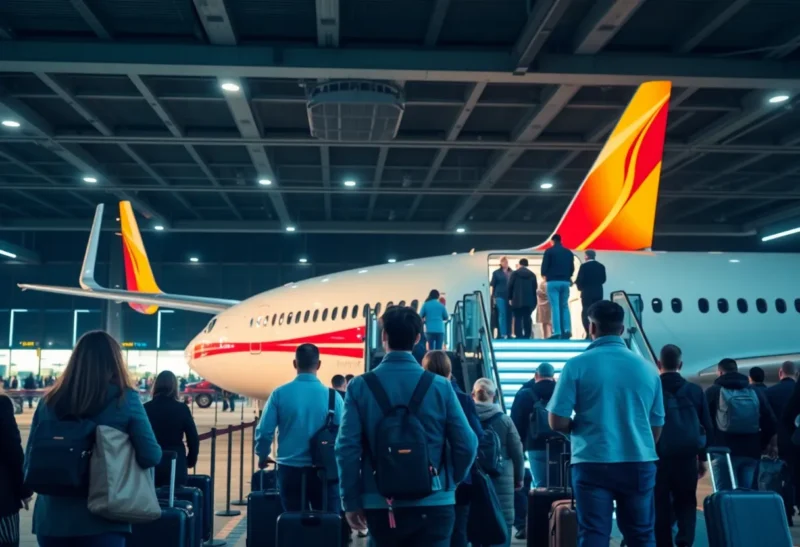
Airlines have spent decades experimenting with boarding sequencing — back-to-front, outside-in (window seats first, then middle, then aisle), zone-based boarding, and various proprietary systems — trying to minimize the total time it takes to get a full plane of passengers seated. The genuinely uncomfortable finding, borne out repeatedly in both academic operations research and airlines’ own internal testing, is that fully random boarding, with no assigned sequence at all, consistently performs competitively with or better than most of these more elaborate, seemingly more logical systems. I’m a supply chain consultant and operations researcher, and this result is a great real-world illustration of a genuinely common finding in queueing and process optimization: intuitive-seeming structure sometimes creates more bottlenecks than it resolves.
Why the Bottleneck Isn’t Where Boarding Order Assumes It Is
Boarding time is overwhelmingly dominated by a very specific bottleneck: passengers stopping in the aisle to load carry-on luggage into overhead bins, a process that takes meaningfully longer per passenger than simply walking to a seat and sitting down. This single fact reshapes what “optimal” boarding sequencing actually needs to solve for — the real problem isn’t getting passengers to their seats in the fastest walking-path order, it’s minimizing how often passengers block the aisle simultaneously while loading luggage, since aisle-blocking time, not walking time, is the dominant cost in the whole process.
This is exactly why back-to-front boarding, which seems intuitively sensible since it should theoretically prevent later-boarding passengers from having to squeeze past people already seated, actually performs relatively poorly in real-world and simulated testing: it packs a large number of passengers into the same rear cabin section simultaneously, all needing to load luggage into the same limited section of overhead bin space and aisle area at the same time, creating exactly the kind of aisle congestion and luggage-loading bottleneck the sequencing was supposed to prevent, just concentrated in a different physical location than it would occur under simpler approaches.
Why Random Boarding Actually Works Reasonably Well
Random boarding’s genuine advantage is that it naturally distributes passengers needing to load luggage across the length of the aisle simultaneously rather than concentrating them in one section at a time — with passengers randomly scattered across different rows, luggage-loading activity happens in parallel across multiple, spatially separated points along the aisle rather than serially bottlenecking in whatever single section a more structured sequencing approach happens to be processing at that moment. This parallelization of the actual bottleneck activity (luggage loading) turns out to matter more for total boarding time than the more intuitive-seeming goal of minimizing how much individual passengers have to squeeze past each other while walking to their seats, which most structured boarding approaches are implicitly optimizing for instead.
This finding has been validated across multiple academic operations research studies, including notably a widely cited study by astrophysicist-turned-boarding-researcher Jason Steffen, whose specifically engineered “Steffen method” (which alternates window-seat passengers from different rows in a specific pattern designed to maximize simultaneous, non-conflicting luggage loading across the cabin) has actually outperformed random boarding in controlled testing, but by a margin that several airlines have judged too small relative to the operational complexity and passenger confusion cost of actually implementing and enforcing such a specific, non-intuitive boarding sequence at scale across a real airport gate environment.
Why the Steffen Method Never Actually Got Widely Adopted
The Steffen method’s specific pattern — alternating passengers between different row groups in a sequence designed to keep simultaneous luggage-loading activity spatially separated across the cabin — genuinely does outperform pure random boarding in the controlled research testing that developed and validated it, sometimes by a meaningful margin. But implementing it in a real commercial airport gate environment introduces practical costs that the research studies, conducted under controlled testing conditions, don’t have to account for: passengers need clear, easily understandable instructions about a genuinely more complex and less intuitive sequence than simple zone or group-based systems, and any confusion or non-compliance with the specific sequence meaningfully degrades the pattern’s actual theoretical advantage, since its benefit depends on the specific spatial distribution pattern being followed reasonably closely rather than approximated loosely.
Real-world passenger behavior — people boarding with traveling companions who want to board together regardless of assigned sequence, families with young children who need accommodation outside strict algorithmic ordering, and general non-compliance with boarding instructions that gate agents don’t always have practical means to strictly enforce — further erodes whatever theoretical advantage more precisely engineered sequencing methods offer in idealized testing conditions, which is a large part of why airlines have generally judged the modest measured improvement from methods like Steffen’s not worth the added implementation complexity and passenger confusion cost relative to simpler approaches.
What Airlines Have Actually Settled On Instead
Most major airlines’ current boarding processes reflect a pragmatic compromise rather than a pure optimization-for-speed approach: boarding by status tier and loyalty program priority (first class, premium groups, elite frequent flyers) happens first for genuine customer service and revenue reasons that have nothing to do with pure boarding speed optimization, followed by broader zone-based general boarding that’s simpler for passengers to understand and gate agents to manage than a more precisely optimized sequencing pattern would be, even though this zone-based approach doesn’t achieve the theoretical speed advantage that either random boarding or the Steffen method can achieve in more controlled conditions.
Some airlines have also introduced targeted policy changes specifically aimed at the actual root bottleneck — carry-on bag size and count enforcement, and in some cases charging fees specifically for carry-on bags beyond a certain size, are really addressing the luggage-loading bottleneck directly at its source rather than trying to optimize around it through boarding sequence alone, arguably a more directly effective intervention than sequencing changes since it reduces the actual volume of the bottleneck activity rather than just rearranging when and where it happens during the boarding process.
The Broader Lesson This Illustrates
Boarding sequencing is a genuinely good illustration of a pattern that shows up across a lot of queueing and process optimization problems: an intuitively appealing structured approach (boarding back-to-front feels like it should obviously be faster) can actually create new, less obvious bottlenecks that offset or exceed whatever benefit the intuitive logic was trying to achieve, while a seemingly less organized approach (random boarding) can outperform it simply because it naturally distributes the actual rate-limiting activity more evenly rather than concentrating it. This is exactly the kind of finding that’s easy to dismiss as counterintuitive nonsense without understanding the underlying queueing mechanics, but that becomes genuinely obvious once you correctly identify what the real bottleneck activity actually is, rather than assuming the bottleneck is whatever the more intuitive-seeming solution happens to be optimizing for.