How Brain-Computer Interfaces Work and Where the Technology Actually Stands

Dr. Priya Krishnamurthy
July 7, 2026
Brain-computer interfaces (BCIs) occupy an unusual position in the technology landscape: genuinely useful medical devices with decades of clinical history sit alongside extraordinary consumer claims and startup valuations that significantly outpace demonstrated capability. Understanding what BCIs actually are, what the current technology can and cannot do, and where the real scientific and engineering challenges lie requires separating the clinical reality from the commercial narrative. The gap between them is large.
What Brain-Computer Interfaces Are
A brain-computer interface is any system that creates a direct communication channel between neural activity and an external device, bypassing the usual motor pathways (muscles, nerves) that translate brain intentions into physical action. The applications that motivated BCI development were primarily clinical: restoring communication and motor function to people with severe paralysis, treating neurological conditions, and understanding how the brain processes information.
BCIs vary enormously in their invasiveness, bandwidth, and precision. The spectrum runs from non-invasive scalp electroencephalography (EEG) at one end—a net of electrodes placed on the scalp that detects the summed electrical activity of large populations of neurons—to fully implanted electrode arrays that penetrate the brain tissue and record the activity of individual neurons at the other end. Between these extremes are electrocorticography (ECoG), where electrode arrays are placed on the brain surface without penetrating it, typically during neurosurgical procedures.
The Signal Recording Problem
Neural computation depends on the precise timing and pattern of activity across individual neurons. A human cortex contains roughly 16 billion neurons; even a small region relevant to motor control contains millions of neurons whose coordinated activity encodes intended movements. The information content of these signals is extremely high, and useful BCI control depends on capturing enough of it to decode intention with sufficient accuracy and speed.
Scalp EEG records the electrical field generated by millions of neurons simultaneously. By the time this signal reaches the scalp, it has been spatially blurred by the skull and intervening tissue, dramatically reducing its spatial resolution. EEG can detect broad patterns (whether someone is attempting to move, or imagining a left versus right hand movement) but cannot resolve the fine-grained population activity needed for high-bandwidth BCI control. EEG-based BCIs can achieve slow communication—on the order of tens of bits per minute—which is useful for simple applications (selecting from menus, basic communication) but limited for complex motor control.
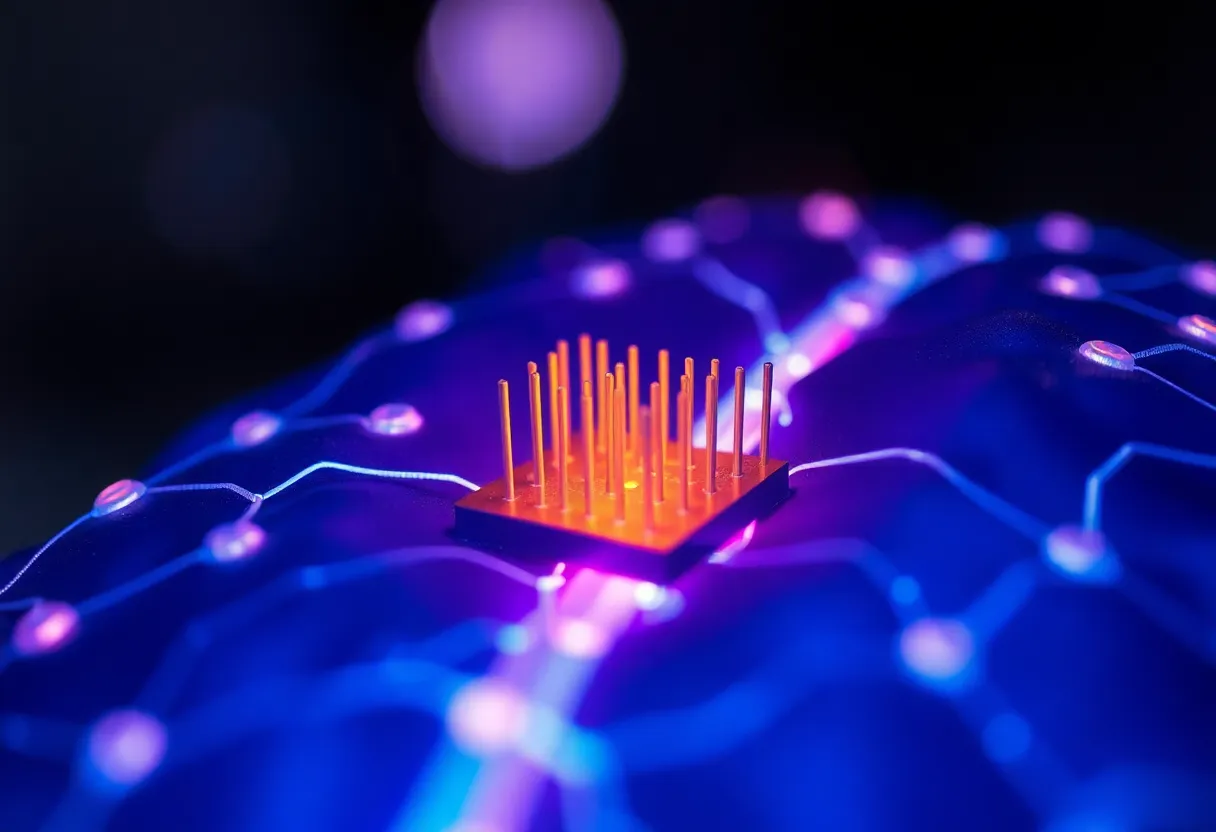
Implanted electrode arrays that record directly from cortical tissue can capture individual neuron activity with millisecond temporal resolution and single-cell spatial resolution. The Utah Array—100 microelectrodes arranged in a 10×10 grid, each recording from nearby neurons—has been the most widely used implanted BCI device in research for decades. More recently, high-density flexible arrays and thread-like probes (Neuralink uses flexible polymer threads with 1,024 electrodes) offer higher channel counts and potentially lower tissue damage.
Decoding Neural Activity
Recording neural activity is only half the problem. Translating that activity into useful commands—decoding the neural signal—requires machine learning models trained on the specific user’s neural patterns. The decoder learns to associate patterns of neural firing with intended actions (moving a cursor, speaking a word, grasping an object) through a calibration process in which the user performs or imagines actions while the neural signals are recorded.
The performance of neural decoders has improved substantially over the past decade. Landmark demonstrations include BrainGate clinical trials in which tetraplegic participants used implanted BCIs to control robotic arms, move computer cursors, and (in one case) control functional electrical stimulation to their own paralysed arm. Research groups have achieved typing rates of up to 90 characters per minute using handwriting imagery decoded from motor cortex, and speech BCIs have demonstrated word error rates competitive with standard speech recognition in some clinical populations.
The decoders are, however, non-stationary: the relationship between neural activity and decoded output drifts over time as neurons change their tuning properties, electrode positions shift relative to tissue, and the brain adapts. Many research BCIs require daily recalibration, which limits practical usability. Developing stable, long-term decoders that adapt to these changes without requiring constant recalibration is an active research problem.
The Longevity Problem
Implanted electrodes face a fundamental biological challenge: they are rigid objects inserted into soft, constantly moving tissue. The brain moves slightly with each heartbeat and breath, causing chronic micromotion between the electrode and the neurons it’s recording from. The immune response to the implant—gliosis, the proliferation of glial cells around the electrode—progressively encapsulates the electrodes in a sheath of scar tissue that attenuates signals over time. Most Utah Arrays implanted in humans show signal degradation over months to years, with some electrodes becoming non-functional.
This longevity problem is one of the central engineering challenges for BCIs that aim to provide permanent restoration of function. Flexible polymer probes that better match the mechanical properties of brain tissue, electrode surface coatings that reduce the inflammatory response, and closed-loop stimulation strategies that may reduce gliosis are all being researched as solutions. Neuralink’s claim of minimal tissue response with its flexible thread-based system is plausible in principle but needs long-term human data to validate.
Where the Technology Actually Stands
As of mid-2026, the most advanced human BCIs are research devices or early commercial products, not mature clinical technologies. Neuralink has reported first-in-human results with a small number of participants—a person with ALS using the implant to control a computer cursor and browse the internet, and a person with spinal cord injury regaining some motor function. These results are real and represent genuine engineering progress, but the participant numbers are tiny and the long-term durability in humans is not yet established.
Synchron, using an endovascular approach that deploys an electrode array via blood vessels (avoiding open brain surgery), has completed first-in-human safety trials in Australia and the US, demonstrating the ability to control digital devices. The endovascular approach sacrifices recording quality compared to penetrating electrodes but dramatically reduces surgical risk—a trade-off that may be more acceptable to a broader clinical population.
For clinical applications with lower bandwidth requirements—detecting epileptic activity to prevent seizures, treating Parkinson’s disease and depression through deep brain stimulation, or simple switch-based communication for people with locked-in syndrome—BCI technology is already in clinical use with well-established efficacy. Deep brain stimulation devices have been implanted in hundreds of thousands of patients worldwide and are an approved treatment for Parkinson’s, essential tremor, and OCD. These devices are BCIs in the broad sense, though they’re often not labelled as such in popular coverage.
The Gap Between Consumer Claims and Reality
Consumer applications—neurofeedback headsets that claim to enhance focus or reduce stress, EEG-based devices for meditation or gaming—exist and are sold commercially, but their efficacy evidence is weak. The signal quality from consumer EEG devices is significantly lower than research-grade equipment, and the claims made by many consumer BCI products exceed what the underlying technology can credibly deliver.
The more extravagant claims about BCIs—digital telepathy, memory uploading, merging human consciousness with AI—are speculative extrapolations from technology that is currently able to decode a few hundred to a few thousand neurons simultaneously. The human brain has billions of neurons forming trillions of synaptic connections. The gap between recording 1,024 channels and reading out thoughts, let alone uploading consciousness, is not a near-term engineering problem. These claims generate attention and investment but contribute to public misunderstanding of what the technology currently does.
The near-term future of BCIs is likely to be characterised by incremental expansion of clinical applications, improvement in long-term device stability, and better decoders. Fully implanted wireless devices that don’t require external equipment and that maintain performance over years are a realistic near-term goal that would significantly expand clinical utility. Reading out the entire content of thought remains science fiction.