What Running a Community Forum Teaches You That Social Media Doesn’t

Sage Collier
July 7, 2026

Running an online community forum is one of the most clarifying experiences available for anyone who thinks seriously about how people behave online. The conventional understanding of online behaviour is shaped primarily by social media—platforms built to scale engagement, optimise for reaction, and reduce friction to posting. Forums built around specific communities operate on fundamentally different dynamics, and operating one teaches you things about group behaviour, trust, and platform design that social media obscures by design.
The lessons aren’t theoretical. They come from watching what happens when you get the rules wrong, when moderation fails, when a good thread turns bad, and when a community that seemed stable suddenly fractures. They accumulate over years of paying attention to human behaviour in a space you’re responsible for.
Reputation Has Memory That Social Media Doesn’t
The most foundational difference between forums and social media is temporal depth. On Twitter or Instagram, your social presence is primarily about recent activity—the algorithm doesn’t reliably surface what you wrote three years ago, and your followers have no particular reason to remember it. On a forum with searchable, persistent archives, what you wrote in 2019 is findable in 2024. Your reputation is built on a cumulative record, not a feed of recent signals.
This changes behaviour profoundly. Forum members who expect to be around for years write differently than social media users who expect each post to be consumed and forgotten. They’re more careful about factual claims they can’t support, more willing to say “I don’t know,” and more reluctant to make enemies—because the person they dismiss harshly today will be there next month when they need help with something. The permanence of the record creates a form of accountability that ephemeral social media posting doesn’t.
It also creates a status economy with genuine structure. A member who has been actively helping others for five years has a reputation that new members can observe and verify—in the post history, in the thanks they’ve received, in the quality of answers they’ve given. This earned reputation changes how the community receives their contributions: a five-year member making a controversial claim gets more benefit of the doubt than a three-week-old account making the same claim. Forum communities develop sophisticated intuitions about who to trust and why, grounded in observable track records.
Moderation Is the Product, Not the Afterthought
Social media platforms have moderation teams, but for most users, moderation is invisible most of the time—it works in the background, and its decisions are rarely explained or contextualized. Forum moderation is visible, specific, and consequential in a way that shapes the entire character of the community.
When you moderate a forum, you quickly learn that rules are not the hard part. The hard part is applying rules consistently across cases that seem similar but differ in ways that matter, explaining decisions in ways that feel fair to people who disagree with them, and maintaining your own judgment about edge cases without either becoming rigid or becoming arbitrary. The same post, in different contexts, by different members, in different threads, may warrant completely different responses—and your community will notice if you’re applying different standards inconsistently.
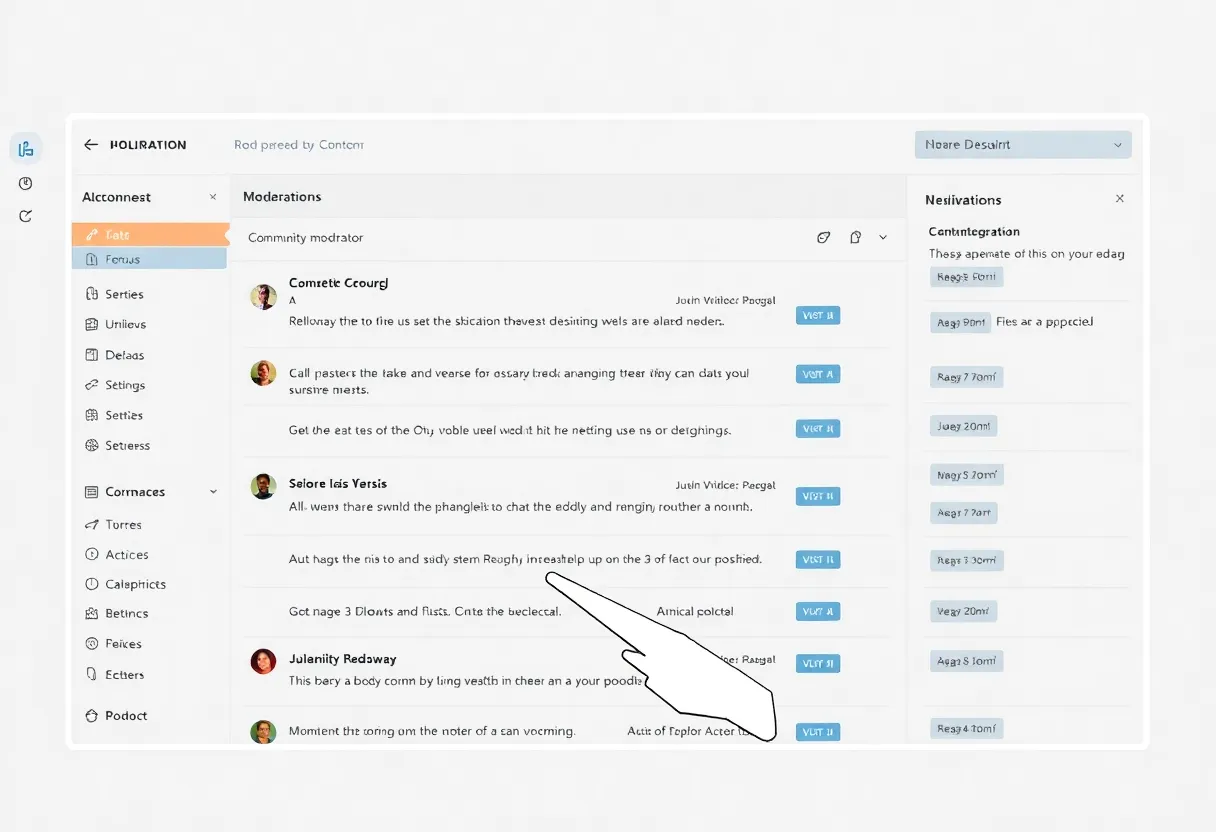
Bad moderation creates two failure modes, both of which you’ll encounter if you run a forum long enough. Over-moderation—removing too much, acting too quickly, failing to let difficult discussions reach resolution—produces a community that feels policed and sterile, where members self-censor rather than engage with hard topics. Under-moderation produces a community that fills with noise, conflict, and bad-faith participants who crowd out the members who came for substantive exchange. Both failures empty a community of the people you most want to keep: thoughtful, knowledgeable members who have other places they could spend their time.
The forums that survive and develop genuine culture are almost always the ones where moderation is applied consistently enough to be trusted but sparingly enough to feel fair. This is easier to describe than to execute, and it requires moderation teams who share judgment, not just rules.
What “Engagement” Means When the Algorithm Doesn’t Intervene
Social media platforms optimise for engagement metrics—likes, shares, comments, time-on-platform. These metrics are gamed by content that produces strong emotional reactions: outrage, delight, fear, tribal validation. The algorithm doesn’t care whether engagement was productive; it cares that engagement happened.
On a forum without algorithmic amplification, engagement looks completely different. A post gets read by people who searched for the topic or subscribed to the subforum. A useful, detailed answer to a difficult question that takes twenty minutes to write may accumulate ten replies over three years and remain one of the most valuable things in the archive. It will never trend. The platform doesn’t reward it with amplification. But it keeps getting found, read, and linked to—quietly doing its work without the metrics that social media treats as success signals.
This disconnection between social media metrics and forum value is something forum operators feel acutely when they look at their traffic numbers. A well-resourced answer thread that serves five thousand people who searched for that exact problem generates no social media engagement and produces no viral moment. It’s pure utility with no performance layer. Running a forum teaches you to see value in this mode of operation—information that serves its purpose without needing to trend.
Community Identity Requires Active Construction
Social media platforms have user identities, but community identity—the sense that a particular group of people shares values, norms, and purpose—is weak at scale. When a platform has millions of users, “community” becomes metaphorical. The algorithmic feed creates personalised experiences that reduce shared context even among people who nominally inhabit the same platform.
A forum with a defined topic and consistent membership develops a culture with real texture. In-jokes emerge. Community-specific vocabulary develops. Members who’ve been around for years can reference discussions from five years ago and be understood by others who were there. New members go through a recognisable process of acclimatisation—learning the norms, making early mistakes, gradually earning standing.

This culture is fragile in specific ways that a forum operator learns the hard way. It can be destabilised by an influx of new members who don’t share the community’s norms—something that happens when a post goes viral on social media and attracts an audience that wasn’t part of the established culture. It can be damaged by the departure of key members who contributed disproportionately to the community’s character. It can be poisoned by a small number of disruptive members who wear out the patience of the people who made the community worth being in.
Managing a community’s culture is an ongoing, active practice—not something that can be set up and then run on autopilot. The forum operator who learns this learns something important about the difference between building an audience and building a community: audience accumulates passively; community requires active tending.
The Value Problem: Who Pays for What Everyone Gets
Forums face a structural economic challenge that social media platforms resolve (badly) through advertising and data monetisation. A useful forum archive represents thousands of hours of member effort, freely given. The members who contributed that effort get status and the satisfaction of helping others; the operator gets the archive, hosting costs, and the challenge of keeping the platform running without monetising the community in ways that damage its culture.
The most successful independent forums have typically resolved this through explicit community support: paid memberships, Patreon-style patronage, or one-time donations from members who value the resource. The honest appeal—”this exists because people contribute their time and knowledge, and keeping the servers on costs money, and we won’t sell your data to pay for it”—lands well with communities whose members value the resource and understand what they’re being asked to support.
What doesn’t work, typically, is advertising that clutters the interface, paywalls on content that was contributed freely by members, or partnership deals that compromise the independence that makes the community’s trust valuable in the first place. Members of tight-knit forums have strong feelings about the integrity of the space they’ve invested in, and they’ll leave—taking their contributions with them in the knowledge economy sense, if not literally—if the platform’s direction feels like a betrayal.
What This Teaches That Social Media Doesn’t
Running a forum teaches you, concretely, that online community is fundamentally about people choosing to invest in a space—their time, their knowledge, their social credit—and that investment is contingent on the space being worth it. It teaches you that behaviour is not fixed but context-dependent: the same person who floods a social media comment section with inflammatory takes may write carefully researched answers in a forum community where their reputation is on the line.
It teaches you that scale and health are in tension. A forum with two thousand active members who know each other and share norms is often more functional than one with two hundred thousand members who don’t. Growth that dilutes the community’s character is not unambiguously good, even though the metrics say it is.
And it teaches you that most of what makes online spaces good or bad isn’t about the technology—it’s about incentive structures, accountability mechanisms, and the human beings making ongoing judgment calls about what to allow and what to remove. Social media platforms systematised those judgment calls into algorithms and scaled them to billions of users. Forums remind you that the judgment calls can’t actually be fully automated—that someone has to care about what the space is, and keep making choices in its direction.