How Noise-Canceling Headphones Actually Work—And Why the Physics Surprises People

David Shaw
July 7, 2026
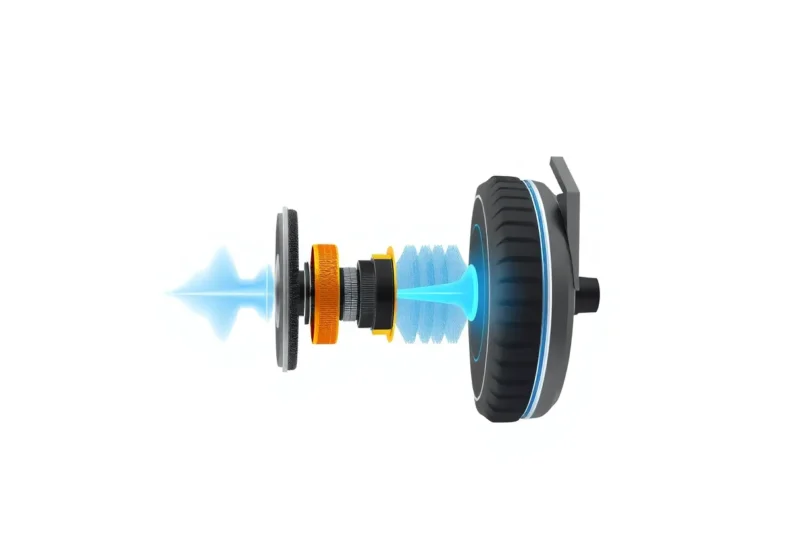
Most people who own noise-canceling headphones understand them loosely as “the headphones fight the noise.” That’s not wrong, but the actual mechanism—and the engineering compromises that follow from it—is considerably more interesting and explains several things about ANC headphones that puzzles their users: why they work brilliantly on airplane engine rumble but poorly on conversation, why turning ANC on changes the sound of your music even when there’s no noise to cancel, and why putting your hands over the earcups produces a specific pressure sensation.
Here’s the actual physics, in the detail that makes the marketing comparisons make sense.
Sound Is Pressure: The Physical Foundation
Sound is a longitudinal pressure wave—alternating regions of compression and rarefaction propagating through air (or any medium). When a sound source vibrates, it creates these pressure variations that travel outward at the speed of sound (~343 m/s in air at room temperature). When these pressure waves reach your eardrum, it vibrates, and your auditory system interprets those vibrations as sound.
Destructive interference—the principle behind active noise cancellation—works when two identical pressure waves are perfectly out of phase with each other. If one wave has a positive pressure peak at a particular moment and location, and another wave simultaneously has a negative pressure trough of exactly equal magnitude, they cancel: the net pressure disturbance at that point is zero. The sound disappears, not because the energy has gone somewhere, but because the pressure variations from both sources are simultaneously present and precisely inverse.
This is the core of ANC. But the precision requirements for real cancellation are severe. The cancelling wave must be:
- Exactly equal in amplitude to the noise wave
- Exactly 180° out of phase (inverted)
- Present at exactly the same location (your eardrum)
Any deviation from these conditions produces partial rather than complete cancellation. Understanding why these requirements are hard to meet explains everything about why ANC works well in some situations and poorly in others.
The Feed-Forward / Feed-Back Architecture
Active noise cancellation requires knowing what the noise is before generating the cancelling signal. This sensing is done by microphones, and where those microphones are placed determines the type of ANC system.
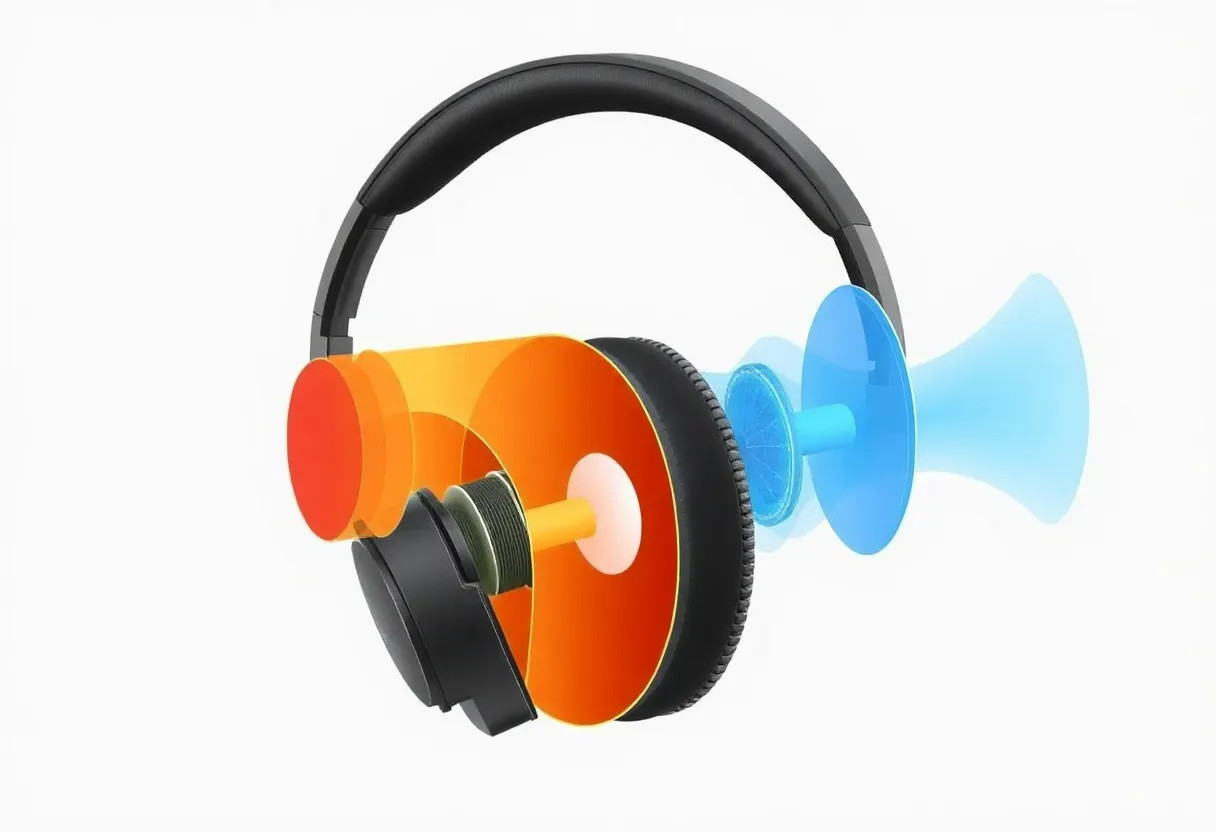
Feed-forward ANC uses microphones on the outside of the earcup—facing outward toward the environment. These microphones capture incoming sound before it reaches the ear, giving the ANC processor time to generate a cancelling signal and play it through the speaker. Feed-forward works well for predictable, relatively slow-changing noise sources because the processor needs to generate the inverse signal quickly enough that it arrives at the ear simultaneously with the noise. The processing delay (the time between the microphone capturing the sound and the speaker playing the cancelling signal) must be shorter than the time it takes the original sound to travel from the outside microphone to the ear—typically a few centimetres through the earcup structure, which is a fraction of a millisecond. This is achievable with modern DSP processors.
Feed-back ANC uses microphones on the inside of the earcup—between the speaker driver and your ear. These microphones capture residual noise that has passed through the earcup and compare it to what should be silence, generating a corrective signal for any noise that got through. Feed-back systems are better at handling the ANC system’s own imperfections but inherently reactive—they’re correcting noise that has already reached the inner ear area rather than pre-empting it.
Hybrid ANC uses both. Most premium headphones (Sony WH-1000XM series, Bose QuietComfort, Apple AirPods Max) use hybrid systems because the combination captures the benefits of both approaches: feed-forward pre-empts predictable low-frequency noise, feed-back corrects residual noise that gets through. This requires more processing power and more sophisticated tuning but produces better real-world performance.
Why ANC Works Brilliantly on Engine Noise
The physics of destructive interference are easiest to satisfy when the noise is:
- Predictable and periodic (repeating pattern)
- Low frequency (long wavelength)
- Relatively stable in amplitude and frequency
Aircraft cabin noise is exactly this. The droning sound of jet engines and fuselage airflow is dominated by frequencies in the 100–500 Hz range—low enough that the wavelengths are long (0.7 m at 500 Hz), which means the precise spatial positioning of the cancelling signal matters less. A long wavelength pressure wave looks roughly the same over the distance between the external microphone, the speaker, and your eardrum. The periodic nature of engine noise also means the ANC processor can develop accurate models of the noise and generate increasingly precise cancelling signals as it learns the pattern.
This is why ANC was pioneered by Bose for aviation headsets in the 1980s—the application matched the technology’s strengths precisely. Commercial aviation cabin noise reduction of 15–25 dB in the relevant frequency range is genuinely achievable with current ANC systems.
Why ANC Struggles with Speech and High Frequencies
Human speech occupies 300 Hz–8,000 Hz, with intelligibility information concentrated in the 1,000–4,000 Hz band. The physics of cancelling noise at these frequencies are significantly harder.
At 4,000 Hz, the wavelength is approximately 8.5 cm—shorter than the distance from the external microphone to your eardrum. At this scale, the phase of the noise wave varies significantly over the relevant distances, and the positioning of the cancelling signal relative to your eardrum matters precisely. The ANC system has to place the cancelling pressure wave with sub-centimetre precision in a physical space that has acoustic resonances, reflections off the earcup interior, and varying geometry as the headphones move. This is why high-frequency noise cancellation performance is dramatically worse than low-frequency performance.
Speech is also aperiodic and unpredictable—it changes frequency, amplitude, and pattern continuously. The ANC processor cannot develop a stable model of speech noise the way it can for engine noise. Feed-forward systems have essentially no ability to cancel speech because by the time the system generates a cancelling signal, the speech has changed. The result: conversation in a noisy environment is attenuated somewhat by ANC (the low-frequency components of voices are partially cancelled) but the intelligibility-carrying high-frequency components come through clearly. This is why ANC headphones quiet the environment without making voices unintelligible.
The Pressure Sensation and What It Means
Many people who try ANC headphones for the first time describe a pressure sensation or a feeling of their ears being “plugged”—separate from and sometimes more pronounced than the physical passive isolation of the earcups. This sensation has caused some users to avoid ANC for extended use despite its benefits.
The mechanism is this: the ANC system generates a continuous low-frequency cancelling signal that creates a slightly modified pressure environment inside the sealed earcup. This is not painful or harmful at the levels involved, but the modified pressure interacts with the middle ear in ways that the brain interprets as a pressure change. The sensation is more pronounced for some individuals than others, is typically stronger when ANC is enabled without audio playing (because the ANC signal is more audible), and usually diminishes after a few minutes of use as the auditory system adapts.
The pressure sensation also explains a phenomenon that surprises some users: cupping your hands around the earcups on ANC headphones produces a sudden pressure change or “thump.” This happens because the external microphone briefly sees a different acoustic environment (the cupped hands create a small resonant cavity) and the ANC system generates a corrective signal that then appears as a pressure transient when the hands are removed and the environment changes back.
Why ANC Changes the Sound of Your Music
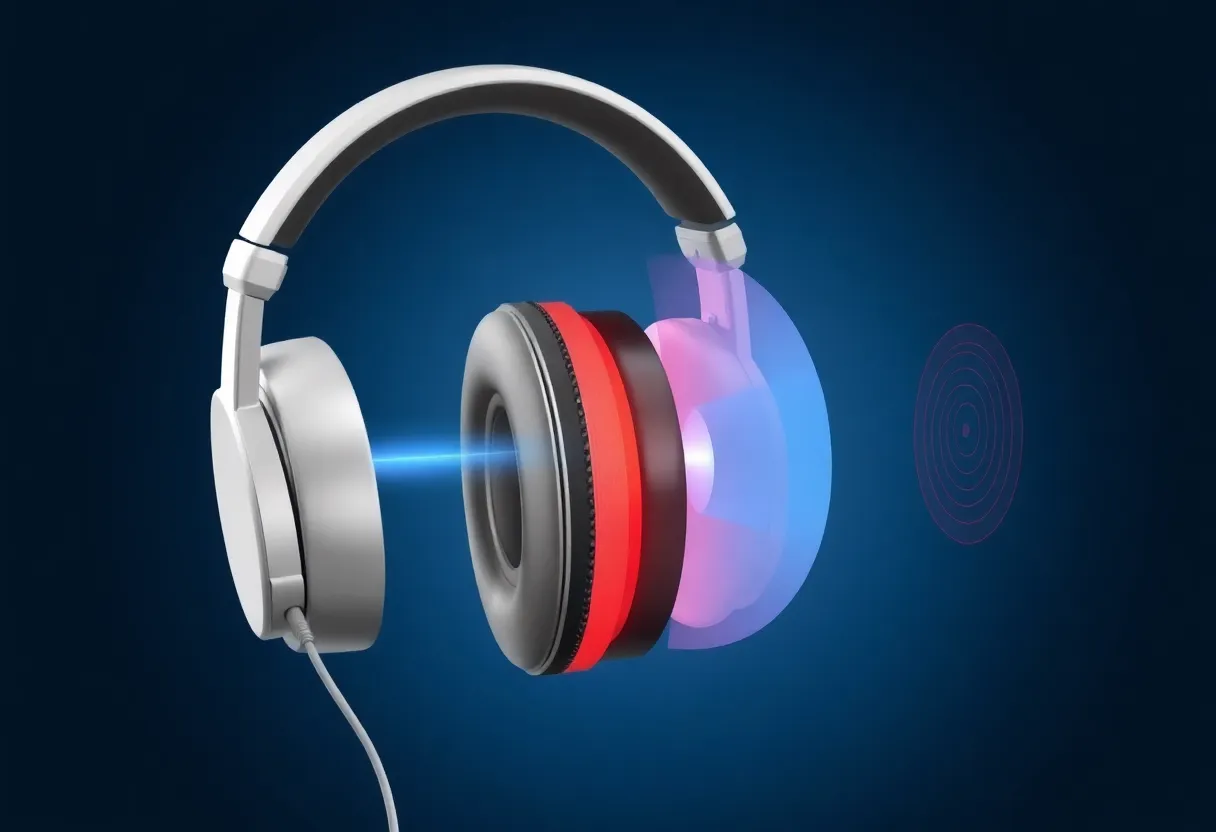
A common observation among audiophiles who evaluate ANC headphones is that enabling ANC changes the sound signature even in quiet environments where there’s no noise to cancel. This is real and has a straightforward explanation.
The ANC system operates continuously. In quiet environments, the cancelling signal it generates is small (there’s not much to cancel), but it’s still active and interacting with the acoustic environment inside the earcup. The DSP processing chain that handles ANC also typically processes the audio signal before it reaches the driver—applying equalization curves that compensate for the acoustic characteristics of the particular earcup geometry and driver placement. These EQ curves are applied regardless of whether ANC is enabled, but the ANC’s contribution to the acoustic environment inside the cup changes when ANC is toggled, which changes the effective frequency response the EQ is compensating for.
This is why many reviewers test headphones with ANC both on and off and find measurably different frequency response curves for each mode. It’s also why premium headphones invest heavily in tuning the ANC-off and ANC-on modes separately, trying to produce a consistent sound signature across modes. This tuning is as much an artistic and engineering challenge as the ANC algorithm itself.
Transparency Mode: The Inverse Engineering Problem
Transparency mode—which most current ANC headphones offer alongside full ANC—is the inverse application of the same microphone-speaker infrastructure. Instead of generating signals that cancel ambient sound, transparency mode uses the external microphones to capture ambient sound and plays it through the drivers in a processed form that makes the environment sound natural despite the physical isolation of the earcups.
Getting transparency mode right is harder than it sounds. The external microphones capture a different acoustic perspective than you’d hear with bare ears—different room reflections, different directional cues. Processing this signal to restore natural directionality and timbre requires significant DSP work. Early transparency implementations sounded tinny and artificial; current implementations on premium headphones (Apple’s AirPods Pro 2 is often cited as the current benchmark) achieve transparency that’s close to unoccluded hearing for most content.
The same microphone array handles both ANC and transparency, with the processing mode selected by the user. The hardware cost of adding transparency is relatively small once the ANC microphone infrastructure exists—it’s primarily a software and DSP problem.
The Future Direction: Machine Learning and Adaptive ANC
The current generation of ANC systems uses fixed filter models tuned during development and applied to all users in all conditions. The next generation is using machine learning to adapt the cancellation model in real time to the specific acoustic environment, the specific user’s ear geometry, and the specific noise characteristics being experienced.
Sony’s DSEE Extreme and Bose’s CustomTune (which does a brief acoustic measurement of the individual ear canal at startup) are early implementations of this approach. The hypothesis is that personalised ANC that accounts for individual ear canal resonances and geometry can produce better cancellation than a fixed model designed for an average ear—and the early evidence supports this. The computational cost is significantly higher, which is part of why this feature appears on premium rather than budget products.
The physics doesn’t change—destructive interference at the eardrum is still the mechanism. But the precision with which that interference can be achieved improves with better real-time adaptation to conditions that no static model can anticipate. The gap between “good ANC headphones” and “excellent ANC headphones” is increasingly a software and algorithm story rather than a hardware one, which is why over-the-air firmware updates to ANC algorithms have become a real feature that meaningfully affects perceived performance.