E-Skateboards and Urban Commutes: What Regulators Haven’t Figured Out

Remy Torres
March 1, 2026
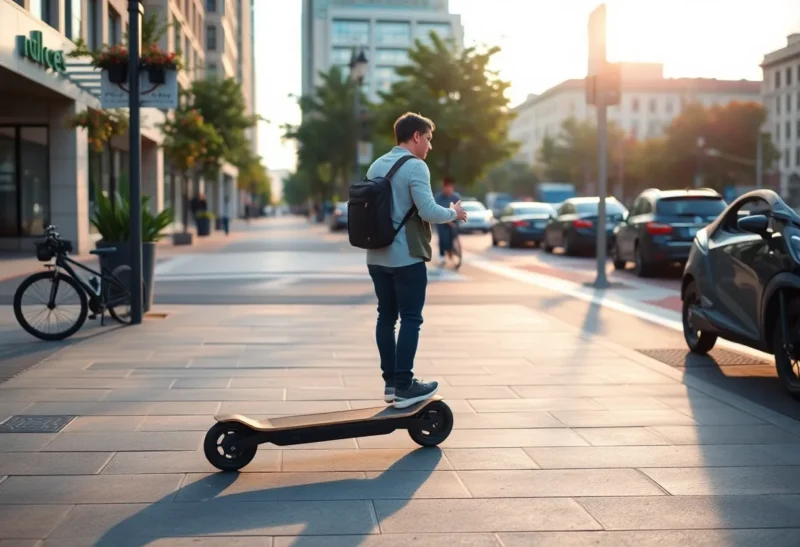
E-scooters exploded onto city streets and regulators scrambled. E-bikes followed. Now e-skateboards—and e-unicycles, and e-longboards, and whatever comes next—are carving out a slice of urban mobility. They’re fast, cheap to run, and they fit in a locker. They’re also a regulatory nightmare. Is an e-skateboard a bicycle? A motor vehicle? A toy? Most cities haven’t decided. Riders are caught in the gap: technically illegal in some places, tolerated in others, and almost nowhere clearly defined. Here’s what regulators are missing, why it matters, and what might finally give e-skateboards a legal lane.
The Regulatory Mess
E-scooters arrived first, and cities reacted with a patchwork of rules. Some require helmets. Some restrict speeds or ban them from sidewalks. Some allow them in bike lanes; others don’t. E-skateboards inherited that chaos. In many jurisdictions, they’re classified as “motorized vehicles” under laws written for cars—which means they’d need registration, insurance, and licenses. Nobody actually enforces that. In others, they fall under “personal mobility devices” with vague limits on speed and weight. In still others, they’re simply undefined, leaving riders in a gray zone where a cop could theoretically impound the board or write a ticket, but usually doesn’t.
The core problem: regulations were written for modes that don’t fit. Bikes are human-powered with optional electric assist. Cars are heavy, fast, and require licensing. E-skateboards are lightweight, typically capped at 15–25 mph, and ridden standing up. They share more DNA with skateboards than motorcycles, but they’re motorized—so traditional bike rules don’t cleanly apply. The result is inconsistency. What’s legal in Portland might get you stopped in Seattle. What’s fine on a bike path in Austin might be forbidden on the same path in Dallas. Riders have to guess, and cities have to improvise.
What Regulators Get Wrong
First, they treat all micromobility the same. E-scooters, e-bikes, e-skateboards—they’re lumped together as “e-scooters” or “personal electric vehicles” in policy discussions. But the use cases differ. E-scooters are often shared and dockless; e-skateboards are almost always personal. E-bikes can carry cargo and passengers; e-skateboards can’t. Speed limits, weight limits, and infrastructure needs vary. A one-size-fits-all rule either over-regulates the lightest options or under-regulates the heaviest.
Second, they focus on vehicles instead of behavior. The real risks—riding on crowded sidewalks, ignoring traffic signals, speeding in shared spaces—are behavioral. A 15 mph e-skateboard ridden responsibly in a bike lane is less dangerous than a 15 mph e-scooter ridden recklessly on a sidewalk. Yet rules often target the device. “No e-skateboards” is easier to enforce than “no reckless riding,” but it doesn’t solve the actual problem.
Third, they ignore infrastructure. E-skateboards need somewhere to go. Bike lanes work. Sidewalks are contentious. Road sharing with cars is dangerous at 20 mph. Cities that build protected bike lanes and shared paths see fewer conflicts. Cities that ban e-skateboards from bike lanes push riders onto sidewalks or into car traffic. The right infrastructure makes the right behavior possible; the wrong rules make it impossible.

What Might Finally Change
Three forces could clarify the picture. First, pressure from riders and advocacy groups. E-skateboard communities are growing. They’re organizing, sharing information about local rules, and lobbying for clearer classification. “Treat us like bicycles” is a common ask: same lanes, same speed limits where applicable, same right to use shared paths. It’s a reasonable default. Bikes and e-skateboards have similar mass and speed profiles. The infrastructure already exists.
Second, insurance and product standards. As e-skateboards mature, manufacturers are offering third-party liability coverage. That addresses the “what if someone gets hurt?” question that paralyzes regulators. Standardized speed limiters, brake requirements, and visibility features could also help. A board that can’t exceed 15 mph and has proper lighting is easier to justify in shared spaces than an unmodified high-performance model.
Third, precedent from e-scooters and e-bikes. Cities that figured out e-scooter rules are starting to extend similar frameworks to e-skateboards. “If it’s under 25 mph and under 100 pounds, treat it like a bike” is emerging as a pragmatic default. It’s not perfect—e-skateboards are more compact and harder to see—but it’s a starting point. The more cities adopt coherent micromobility policies, the more pressure others face to follow.
The Bottom Line
E-skateboards are here. Regulators haven’t caught up. The gap creates uncertainty for riders and inconsistency for enforcement. The fix isn’t more bans—it’s clearer classification, behavior-focused rules, and infrastructure that gives micromobility a place. Treat e-skateboards like bicycles where speed and weight are comparable. Build lanes that work for them. Enforce reckless behavior, not device type. It’s not complicated. It just requires admitting that the old categories don’t fit, and that’s something regulators are still learning.