Zapier Multi-Branch Error Recovery: When Your Retry Zap Makes Things Worse

Taylor Kim
April 8, 2026
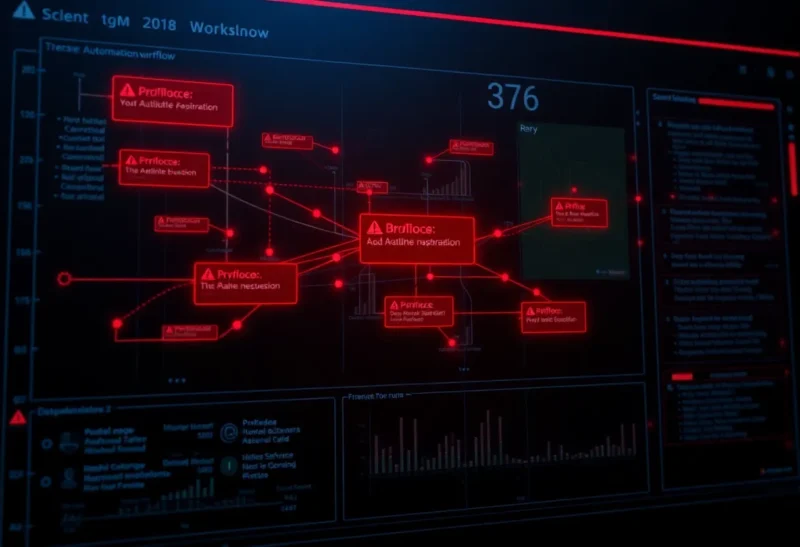
If you have ever built a “simple” Zap with three paths, a filter, and a polite retry, you already know the truth: the interface looks friendly, but failure modes are not. Multi-branch Zaps are powerful because they let you express real business rules—qualified lead versus nurture, paid invoice versus overdue, happy customer versus angry one—without spinning up a server. The catch is that each branch is also a place where errors can hide, duplicate, or cascade. When something goes wrong, your first instinct is often to add another retry step. Sometimes that is exactly how you turn a small incident into a loud one.
This article is about multi-branch error recovery in Zapier: what goes wrong, why retries are not always medicine, and how to design automations that fail in a way you can actually debug.
Why branches multiply failure surfaces
In a linear Zap, you have one spine: trigger, action, action, maybe a formatter. You can read the run history like a short story. In a branched Zap, you have parallel narratives. Paths, filters, and “only continue if” conditions mean different records take different routes. That is the point—but it also means your mental model has to include which path a given run took, not just whether the Zap succeeded.

When an API times out on step four of path B, you might still see a green check on the overall Zap if another branch short-circuited or if the failure was swallowed by a catch-all. Teams learn this the hard way when finance thinks a refund posted because the CRM updated, while the payment step never ran. Branches do not just split happy outcomes—they split observability.
The retry trap
Zapier’s retry behavior exists because the real world is flaky. Webhooks arrive twice. SaaS APIs return 502s. A spreadsheet row is locked for three seconds. Retries help when failure is transient and operations are idempotent—the same request twice does not create two invoices.
In multi-branch setups, retries interact badly with three things:
- Non-idempotent side effects. If path A creates a task and path B emails a customer, a retry might create a duplicate task or send a second email even when the “real” failure was downstream.
- Ordering assumptions. A retry can re-enter a branch after another step already mutated state—think “mark deal won” before “create onboarding project.”
- Hidden coupling between paths. Two branches might both touch the same external object. A retry on one branch can race with a successful write from another.
So when someone says, “We added a retry and it got worse,” they are usually describing one of those patterns—not a mysterious Zapier bug.
When your retry Zap makes things worse
Picture a support escalation Zap. Branch one notifies Slack if priority is high. Branch two opens a ticket in Zendesk if the customer is on a paid plan. Branch three tags the contact in HubSpot. A transient HubSpot error triggers a retry. On the second attempt, HubSpot succeeds—but Slack already fired, and Zendesk already created a duplicate ticket on the first attempt because the error happened after those steps. The retry does not rewind time; it runs forward again from the failed step, which is correct mechanically and wrong operationally.
Another common case is webhook-triggered Zaps where the sender does not guarantee at-most-once delivery. Your retry plus their retry plus a branch that “creates if not exists” without a stable idempotency key can produce tripled records. The UI will show multiple successful runs, each morally “correct” in isolation.
Design patterns that survive branches
You do not need to abandon branches to stay safe. You need to decide, up front, what “success” means for a run and where state should live.
Prefer a single writer step where possible. If three branches all update the same system, consolidate into one later step that receives a clear payload from a preceding code or formatter step. Fewer writers means fewer duplicate writes when something retries.
Use idempotency explicitly. If an API supports idempotency keys, use them. If it does not, write a deterministic key yourself in a storage step—Zapier Storage, a database via webhook, or a short script step—and check it before creating new records. Branches are much less scary when “create” becomes “create once per key.”
Separate “notification” from “commit.” It feels good to notify Slack immediately, but notifications are the least dangerous place to retry. Commits—charges, tickets, legal holds—should come after you know what path you are on and after deduplication logic runs.

Debugging branched runs without losing your afternoon
When a multi-branch Zap misbehaves, resist the urge to tweak retries first. Start with the run’s path: which filters passed, which path labels fired, and which step index failed. Screenshot or export a failing example. Then ask:
- Was the error on the first side effect or a later cosmetic step?
- Did another branch already mutate shared state?
- Is the trigger delivering duplicates or out-of-order events?
If you discover that retries amplify duplicates, the fix is almost never “turn down retries.” It is to make the side effect safe under at-least-once delivery—or to move the branching logic upstream into a system that can transactionally commit.
Filters, paths, and the illusion of exclusivity
Teams often mix up filters and paths. A filter says “do not run the rest of this path if X is false.” A path says “if X, take route A; if Y, take route B.” Both can coexist in the same Zap, which is where people accidentally build exclusivity they do not have. If two paths can both be true for the same record—or if a filter passes on a retry but failed on the first attempt because data was incomplete—you get runs that look inconsistent even though each step “worked.”
Before you add error handling, write down the truth table: for each combination of inputs, which branches should fire, and which must never fire together? If you cannot answer that in a short paragraph, the Zap will not answer it for you. In practice, this is where a single “router” step—either a Code step that emits a normalized label, or a lookup table in Storage—saves weeks of debugging. The router decides the outcome once; downstream branches only execute actions, not philosophy.
Rate limits and retries: the silent compounding effect
Every SaaS integration has a rate limit. When a retry fires, it counts against the same quota as the original attempt. In a branched Zap, you might have three API-heavy steps in sequence on different paths. A failure on the third step can retry the whole path segment, which re-hits the first two APIs again. Under load, you can trip the limit and then watch retries fail for a different reason—429 instead of 502—making the run history look like a cascade of unrelated errors.
Mitigations are boring but effective: cache stable identifiers, batch where the API allows it, and move “read then write” sequences so reads happen once before branching. If you must hammer an endpoint, space operations with explicit Delay steps, but only after you have proven idempotency. Delaying a retry without fixing duplication just delays the duplicate.
A concrete checklist before you ship a branched Zap
Use this as a preflight, not as documentation nobody will read:
- Define the single source of truth. Which system owns the customer record, the order, the ticket? The Zap should not contradict that hierarchy on retry.
- List every side effect per branch. Email, charge, Slack message, database row—each one gets a note on whether it is safe to run twice.
- Decide what “partial success” means. If Slack fires but Salesforce does not, do you need a compensating action? If not, say so explicitly.
- Test with duplicate payloads. Send the same webhook twice, or duplicate the spreadsheet row. If you cannot simulate duplicates, you have not tested the automation.
- Log the branch label somewhere durable. Even a hidden field in the CRM helps. Future you will not guess which path ran from a green checkmark alone.
When to graduate out of the branch
Zapier Paths are fantastic for human-scale business rules. They are a poor fit for long-lived state machines where you need guaranteed ordering, compensating transactions, and audit trails across dozens of edge cases. If your run history reads like a crime novel—with branches re-trying into different endings—it is a signal to graduate: a small worker service, an orchestration tool with explicit saga patterns, or even a spreadsheet with stricter discipline and fewer automatic guns.
That is not a knock on no-code. It is respect for the difference between “route this row” and “run this company process.” Graduation does not mean rewriting everything in code. It often means moving the gnarly bits—deduplication, idempotency keys, compensating transactions—into one place with tests, while keeping Zapier for the long tail of simple integrations.
Culture, not just configuration
Organizations that win with automation treat failed runs as operational data. They do not blame “Zapier” when a branch misfires; they trace the path, fix the contract with the upstream system, and add a guardrail. Retries are part of that culture when they are paired with ownership: someone knows which side effects are allowed to double, and which are not. Without that, multi-branch Zaps become a museum of almost-right fixes—each path added to patch the last incident.
If you are the person building that automation, give yourself permission to delete a branch. The best Zap is often the smallest one that still matches the business rule, with retries applied only where the math says they are safe.
Takeaways
Multi-branch Zaps fail in ways linear ones do not, because branches split both outcomes and side effects. Retries are essential for flaky networks but dangerous when your branches already wrote to the world. Treat retries as a scalpel, not a hammer: pair them with idempotency, consolidate writers, and separate noisy notifications from irreversible commits. When the run history stops making sense, the answer is usually not another path—it is a clearer source of truth upstream.