Why Your First 3D Printer Will Teach You More Than Any Tutorial

Jamie Torres
March 7, 2026
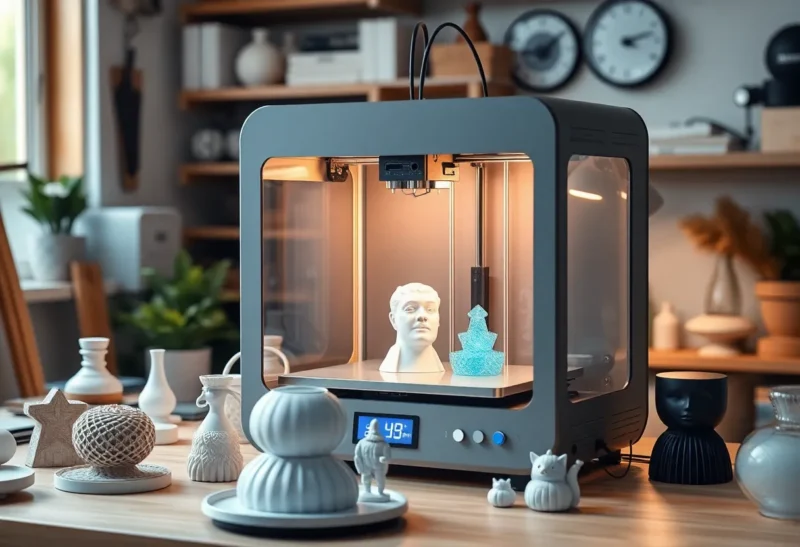
You’ve watched the videos. You’ve read the buying guides. You know which printer to get, which slicer to use, and which settings to tweak. So you hit order, unbox the machine, and run your first print. Then the bed won’t stick. Then the nozzle clogs. Then the layers shift. And somewhere in the middle of that mess, you learn something no tutorial ever put in a bullet point: your first 3D printer isn’t a product—it’s a teacher.
That might sound like a stretch. After all, a 3D printer is just a tool that melts plastic and lays it down in layers. But the process of going from “I have no idea what I’m doing” to “I can usually get this thing to work” teaches you a kind of systems thinking and hands-on debugging that no amount of passive learning can replace. Here’s why your first machine—with all its frustrations—is one of the best learning investments you can make.
What Tutorials Leave Out
Most 3D printing guides focus on the happy path. They show you a clean first layer, a perfect benchy, and a tidy time-lapse. What they don’t show is the hour you spend re-levelling the bed because one corner is 0.1 mm too high. They don’t show the stringing, the warping, or the moment you realise your “calibrated” machine has been lying to you about its own dimensions. That gap between the ideal and the real is where the real education happens.
When you’re alone with a failed print at 11 p.m., you’re not just fixing a printer—you’re learning to read cause and effect. You’re learning that “it didn’t stick” can mean bed temperature, first-layer speed, nozzle height, or the humidity in the room. No single tutorial can hand you that diagnostic instinct. You build it by failing, inspecting, and trying again.
This is the same skill set that separates junior from senior engineers in any field: the ability to form hypotheses, test them, and narrow down a problem when the manual doesn’t have your exact error code. Tutorials give you a script; your first printer gives you the stage to improvise when the script falls apart.

Materials, Not Just Models
Tutorials tend to treat filament as a given. Pick PLA, set the temp, hit print. But your first printer teaches you that materials have personalities. PLA is forgiving and great for learning; it also warps less and sticks to build surfaces more predictably. PETG is sticky and stringy until you get the retraction right—and then it’s tough and durable. TPU bends the rules of what “solid” means and forces you to think about squish, speed, and support. You learn that the same model can behave completely differently when you switch from one brand of PLA to another, or when the room gets colder and the filament absorbs more moisture.
That awareness—that the physical world has variables that software doesn’t—is something you can’t get from a screen. You have to feel the difference between a brittle print and a tough one. You have to see how overhangs behave when you change the cooling. You have to learn that “dry filament” isn’t marketing fluff: wet PETG or nylon will give you weak, bubbly prints no matter how good your settings are. That kind of intuition only comes from doing it wrong a few dozen times.
For anyone who spends most of their day in code or spreadsheets, this is a useful jolt. We’re used to abstractions that behave the same every time. A 3D printer reminds you that real materials have history, humidity, and batch variation. Learning to work with that—instead of fighting it—carries over to any kind of physical prototyping or manufacturing.
Iteration Beats Perfection
In software, we’re used to “build once, run everywhere.” In 3D printing, it’s “design once, then iterate until it fits.” Your first printer hammers that home. You’ll design a part that looks right on the screen and comes out too tight, too loose, or with supports that won’t break off cleanly. You’ll learn about tolerances—the intentional gap between parts so they can actually slide or snap together—and shrinkage, the way some materials contract by a percent or two as they cool. You’ll discover that “0.4 mm” on the screen is not always 0.4 mm in your hand, and that flow rate, line width, and layer height all interact in ways that don’t show up until you measure the result.

That iterative mindset—design, print, measure, adjust—is valuable far beyond the printer. It’s the same loop you use for prototyping anything physical, from enclosures to custom tools. Tutorials can give you the steps; only practice gives you the patience and the eye for “that’s close enough” versus “that’ll break in a week.” And because each iteration takes time (often hours per print), you learn to think ahead: can I test this with a smaller version? Can I print just the critical section? That kind of resource-conscious experimentation is a habit that pays off in any domain.
The Slicer as a Second Language
Before long, you’ll stop treating the slicer as a black box. You’ll start to understand what infill percentage actually does to strength and print time, why wall count matters more than infill for thin parts, and when to use tree supports instead of the default. You’ll learn that “faster” isn’t always better—sometimes slowing down the first layer or the outer walls is the difference between success and spaghetti. None of that is obvious from a single tutorial; it’s the accumulated wisdom of many failed and successful prints.
That transition—from “I’ll use the default profile” to “I know why I’m changing this setting”—is another form of literacy. You’re not just following a recipe; you’re understanding the knobs and what they control. That’s the same shift that happens when you go from copying Stack Overflow answers to understanding why the solution works. Your first printer gives you a concrete, physical domain where that shift is unavoidable.
Why It Matters
None of this is to say tutorials are useless. They get you from “I have a box of parts” to “I have a working machine” faster than trial and error alone. They’re essential for safety (hot ends and moving parts can hurt you) and for not wasting money on the wrong gear. But the real value of your first 3D printer is the stuff that doesn’t fit in a ten-minute video: the intuition for when a print is about to fail, the patience to re-slice and try again, and the habit of looking at a physical object and asking “how was this made?”
That last habit is underrated. Once you’ve run a printer, you start seeing the world differently. You notice layer lines on consumer products. You think about draft angles and support removal. You understand why some shapes are cheap to make and others aren’t. That’s not just maker culture—it’s systems thinking applied to the physical world.
So when your first benchy looks like a melted candle, or your calibration cube is 0.3 mm off, don’t just reach for another tutorial. Sit with the failure for a minute. Look at the layers. Think about what the machine was doing when it went wrong. That’s the lesson no one can give you—and the one your first printer is there to teach.