Why Every Developer Should Learn a Bit of Hardware

Kira Okamoto
February 24, 2026
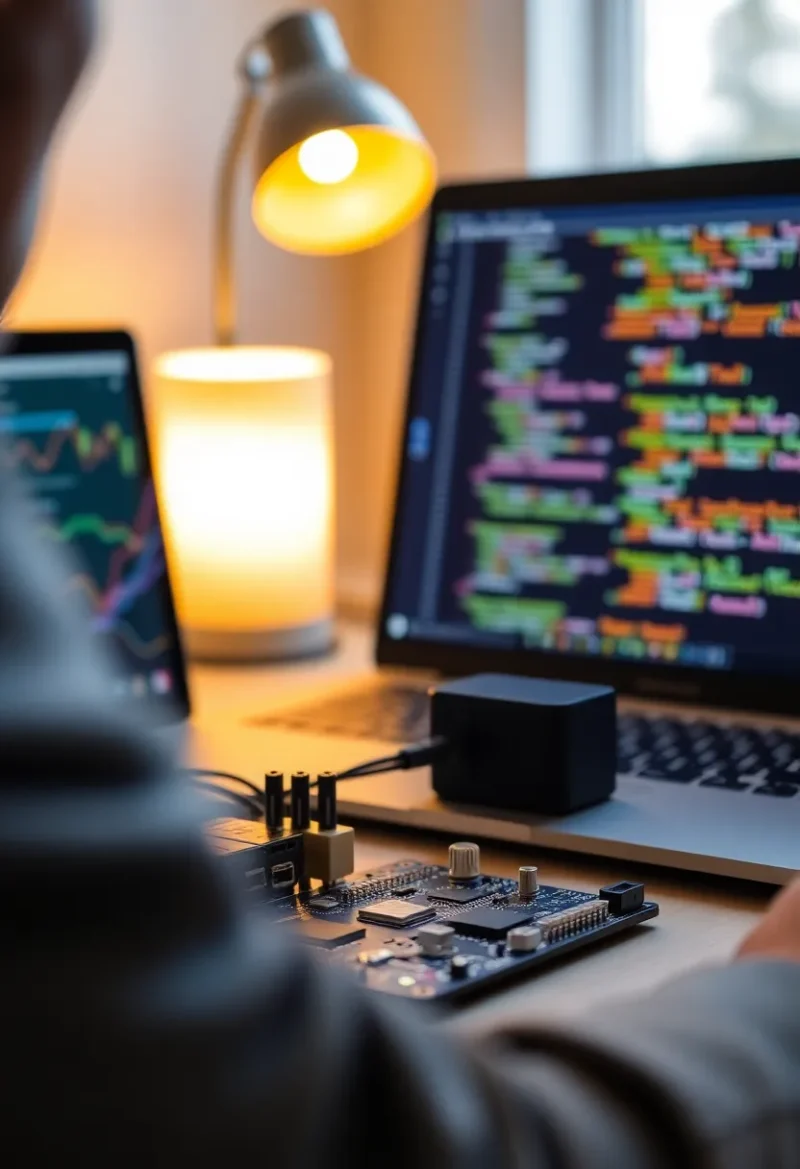
Most of us write code that runs on someone else’s machine, in a data center we’ll never see. That abstraction is powerful—but it can also hide how the physical world actually works. Spending even a little time with hardware—a microcontroller, a sensor, a simple circuit—changes how you think about software, performance, and what “working” really means.
Software Doesn’t Run in a Vacuum
Every program eventually runs on silicon: CPUs, memory, storage, and networks made of real physics. When you’ve never touched that layer, it’s easy to assume that “fast” and “slow” are just about algorithms and big-O. But in reality, cache lines, branch prediction, and memory bandwidth shape performance as much as your choice of loop. Learning a bit of hardware doesn’t make you an electrical engineer, but it gives you a mental model of what’s actually happening when your code runs. When you’ve never touched that layer, it’s easy to assume that “fast” and “slow” are just about algorithms. But latency comes from caches, buses, and how many times your code has to talk to memory. Power consumption isn’t abstract—it’s electrons moving through traces. Learning a bit of hardware doesn’t make you an electrical engineer, but it gives you a mental model of what’s actually happening when your code runs. That model makes you better at debugging performance, choosing the right data structures, and understanding why “it works on my machine” sometimes means “my machine has different hardware.”
Constraints Clarify Your Thinking
Embedded systems have brutal constraints: kilobytes of RAM, megahertz of clock speed, milliwatts of power. When you write for a tiny microcontroller, you can’t “just add more memory” or “scale horizontally.” You have to think about every byte and every cycle. That discipline carries back to the server and the laptop. Not every app needs to be optimized to the last byte—but knowing what’s possible when you have almost nothing makes you more intentional about the resources you do have. You start asking: do I really need this dependency? This allocation? This network call? Hardware teaches scarcity; scarcity teaches clarity.
Feedback Loops Are Immediate and Physical
When you blink an LED or read a temperature sensor, you see (or measure) the result in the real world. There’s no staging environment that’s “close enough”—either the light blinks or it doesn’t. That immediacy is a great teacher. You learn to reason about state, timing, and cause and effect in a way that pure software sometimes obscures. Bugs in hardware-adjacent code often have visible, tangible consequences. That kind of feedback sharpens your debugging and your design sense. You start thinking in terms of “what actually happens when this runs?” rather than “what do I expect the API to return?”
IoT and Edge Are Everywhere
The world is full of devices that run code: thermostats, cars, industrial sensors, wearables. Even if your day job is web or backend, you’re increasingly likely to work with systems that touch hardware—APIs that talk to devices, pipelines that process sensor data, or products that depend on firmware. Knowing the basics—how sensors work, how microcontrollers are programmed, what “real-time” means in practice—makes you a better collaborator and a more informed architect. You don’t have to become an embedded specialist; you just need enough context to ask the right questions and understand the answers.
Prototyping and Side Projects
Hardware has never been more accessible. Boards like the Raspberry Pi Pico, ESP32, or Arduino cost a few dollars and have huge communities. You can build a simple weather station, a smart button, or a custom controller in a weekend. Those projects are fun—but they’re also practice. You learn to read datasheets, wire things correctly, and deal with the messiness of the physical world. That experience translates: when you’re designing a system that has to work in the real world (not just in a simulator), you’ll have a better feel for failure modes, timing, and user experience. Plus, there’s something satisfying about making something you can hold. It reconnects code to the world.
Debugging Gets a New Dimension
When something goes wrong in pure software, you have logs, stack traces, and the ability to attach a debugger. With hardware, you often have a multimeter, an oscilloscope, or just your eyes: is the LED on? Is the voltage right? That forces you to form hypotheses and test them systematically. You learn to isolate variables—is it the code, the wiring, or the component?—in a way that generalizes to any complex system. Many of the best software debuggers have spent time in the physical world, where you can’t just “print and see”; you have to reason about state and causality. Bringing that rigor back to your main codebase pays off.
You Don’t Need to Go Deep
You don’t need a degree in electrical engineering or to build a robot from scratch. A single project—a small script that talks to a board over USB, or a weekend spent with a kit—is enough to shift your perspective. The goal isn’t to become a hardware expert; it’s to demystify the layer below your usual abstraction. Once you’ve seen how a pin goes high and low, how I2C or SPI actually moves bits, and how tight the coupling can be between code and physics, you’ll write better software everywhere else. Every developer can benefit from that. The rest is optional.
The Bottom Line
Learning a bit of hardware makes you a more rounded developer. It improves your intuition about performance and resources, sharpens your debugging, and prepares you for a world where software and physical devices are increasingly intertwined. You don’t have to quit your job and become an embedded engineer—just give yourself one small project. Pick up a cheap board, blink an LED, read a sensor, and see how it changes the way you think about the code you write every day.