What Happened to the Promise of Smart Glasses After a Decade of Tries

Dex Hartmann
July 7, 2026
Google Glass launched in 2013 with a level of cultural buzz that most consumer technology products never approach. Tech journalists wore them to conferences. Vogue ran photo shoots. Science fiction had spent decades imagining heads-up displays and augmented reality overlays, and here was something that looked—superficially—like the real thing. The promise was clear: computing would move off the phone screen and onto a transparent overlay in your visual field, making information available without the friction of taking out a device.
Twelve years later, smart glasses exist in a market that’s far more populated than 2013 but far less transformative than the original promise implied. Meta’s Ray-Ban glasses are genuinely popular. Apple shipped the Vision Pro headset. Several enterprise AR headsets work reliably in industrial settings. And yet the mass-market breakthrough moment—the point where wearing a heads-up computer on your face becomes as normal as carrying a phone—hasn’t arrived. Examining what’s happened in the intervening decade explains both why it’s been so hard and why the technology has started to genuinely move forward.
Why Google Glass Failed—But Not for the Reason Most People Remember
The popular account of Google Glass’s failure focuses on the social dynamics: the term “Glasshole” entered the language, people wearing Glass were photographed in restaurants, and the privacy concerns around always-on cameras made Glass wearers unwelcome in many spaces. This is all real, but it explains the product’s specific failure more than it explains the technical difficulty of smart glasses.
Google Glass failed for several compounding reasons. The hardware was genuinely limited: the battery lasted a few hours, the display projected a tiny floating window in the upper right corner of the visual field rather than a meaningful augmented overlay, and the processing capability supported only basic applications. The form factor was clearly tech-prototype rather than eyewear—conspicuous in ways that normal glasses aren’t. The use cases were underdeveloped: the original Glass functionality was essentially a hands-free way to take photos, get turn-by-turn navigation, and check notifications. These were conveniences, not transformations.
The social problems accelerated the failure but weren’t its root cause. A product that delivered genuinely transformative utility would have survived social friction—smartphones survived waves of “don’t be a phone zombie” criticism. Glass failed because the utility-to-cost-and-friction ratio was never compelling, not primarily because people disliked the camera.
Google learned this lesson and redirected Glass toward enterprise, where the social dynamics are different and the specific use cases—hands-free access to information during surgery, assembly line inspection checklists, remote expert support for field technicians—justify the form factor. Glass Enterprise Edition has been used successfully in these contexts for years, with limited media coverage because enterprise is less exciting than consumer products.
The Physics and Engineering Constraints
Smart glasses face hardware constraints that aren’t marketing failures or social issues—they’re physical and engineering challenges that have been difficult to solve simultaneously.
Display optics. Projecting a clear, bright, full-color image into a human eye while maintaining eyewear-scale size and weight requires optical solutions that are still expensive and technically complex at consumer scale. The approaches include micro-LED projectors, laser scanning displays, holographic waveguides, and diffractive optical elements. All of them face trade-offs between field of view (how much of your visual field the display fills), brightness (readability in sunlight), and size/weight. The reason Glass had a tiny floating display element was precisely this constraint: a wider, brighter display would have required heavier, bulkier optics.
Battery life at form-factor scale. Eyewear form factors have extremely limited volume for battery. Running a display, a processor, wireless radios, and a camera continuously requires more power than a small battery can provide for a useful daily-wear duration. The approaches are offloading computation to a connected phone or cloud (reducing local processing requirements), accepting limited feature sets, or accepting reduced battery life. Meta’s Ray-Ban smart glasses solve this by having no display at all—audio, camera, and AI assistant only—which dramatically reduces power demands.
Heat dissipation. Wearable computing devices produce heat that cannot be dissipated through a fan (too loud, too large) and must be managed through passive means. Processors that produce significant heat cannot be placed near the face. This constrains what processing can be done locally and pushes capable computation to connected devices or the cloud.
Social acceptability. Beyond the Glass-era backlash, there’s a genuine engineering constraint here: glasses that look substantially different from conventional eyewear face adoption barriers. People won’t wear conspicuous technology on their faces for daily use. The form factor requirements of normal eyewear are strict, and fitting meaningful technology into normal-looking frames is genuinely hard.
What Has Actually Made Progress
Despite the challenges, meaningful progress has happened—though in forms different from the 2013 vision.
No-display smart glasses. Meta’s Ray-Ban collaboration with EssilorLuxottica has produced a genuinely useful product: normal-looking glasses with built-in speakers for spatial audio, an open-ear listening experience for calls and music, a built-in camera for photos and video, and—increasingly importantly—an AI assistant accessible by voice. The product trades the display away entirely and gets normal glasses form factor in return. Battery life in the four-to-five hour range for active use is manageable for many users. This product sells in volume because it delivers clear utility without conspicuous hardware or privacy concerns beyond what a phone already creates.
Enterprise AR headsets. Microsoft HoloLens, Magic Leap, and various other enterprise AR headsets have found genuine product-market fit in specific professional contexts. The industrial use cases—maintenance, surgery, training, remote expert collaboration—justify the hardware cost and compromise the social concerns because these are professional work contexts. The limitation is that enterprise AR headsets are work tools, not consumer products, and they remain too heavy, too expensive, and too limited in battery life for all-day wear.
Apple Vision Pro and the spatial computing category. Apple’s Vision Pro is a different product from glasses—it’s a fully immersive headset rather than a glasses-scale overlay device. But it represents meaningful progress in display technology, hand tracking, and software design for spatial computing. Apple’s framing of “spatial computing” rather than AR or VR reflects a real ambition to move computing off flat screens over time, even if the current hardware is a first step rather than a consumer-ready product.
Where AI Has Changed the Equation
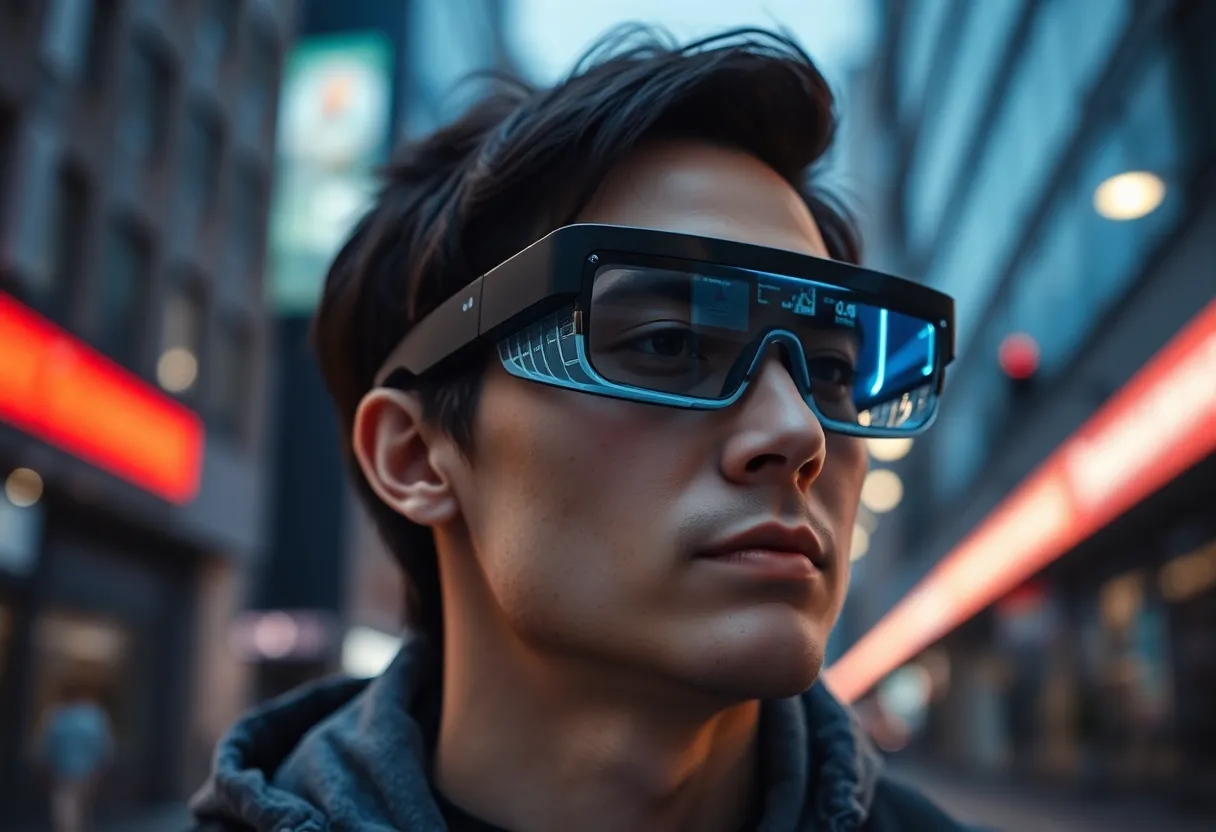
The most significant development for smart glasses in 2025–2026 isn’t display technology—it’s AI. Large language models and multimodal AI that can interpret images, understand speech, and provide contextually relevant information have substantially increased what’s possible with a camera and speaker pair that looks like normal glasses.
Meta’s Ray-Ban glasses with their Meta AI integration demonstrate this: point your glasses at something and ask what it is, ask for help with something you’re looking at, or ask for information while your hands are occupied. The AI assistant replaces some of what a visual overlay would have provided—not with a heads-up display, but with a voice response that’s nearly as fast and requires no display optics at all.
This doesn’t mean display-based AR glasses are obsolete as a direction—visual information is often more efficient than auditory information for many use cases. But it has created a viable product category (camera + audio + AI assistant in eyewear form factor) that delivers meaningful utility without solving the hardest hardware problems. This may be the actual near-term market success story while the display and optics technology continues to mature.
The Honest Timeline
Mass-market AR glasses that project meaningful overlays in a normal-looking eyewear form factor remain years from mass consumer deployment. The companies making the most credible progress—Meta’s hardware division, Apple, and several well-funded startups working on waveguide optics—are probably looking at meaningful consumer products in the early-to-mid 2030s at optimistic estimates. The optical and battery challenges are not yet solved at the cost and size points that mass-market eyewear requires.
What does exist and continues to sell is the no-display smart glasses category and enterprise AR headsets, both of which address real use cases without requiring the full physics problems to be solved. These are not the 2013 vision, but they’re real products with real utility—and the AI improvements have made them meaningfully more useful in the last two years than they were in the preceding decade of tries.
The 2013 promise was directionally correct but wrong about timeline and wrong about which specific form—full AR overlay in normal frames—would arrive first. The practical near-term success is a humbler product: good audio, a camera, and an AI assistant, in something that looks like glasses. That’s not science fiction. But for a large number of everyday use cases, it turns out to be enough.