What Deep-Sea Mining Regulations Actually Cover Right Now

Futurion Editorial
July 9, 2026
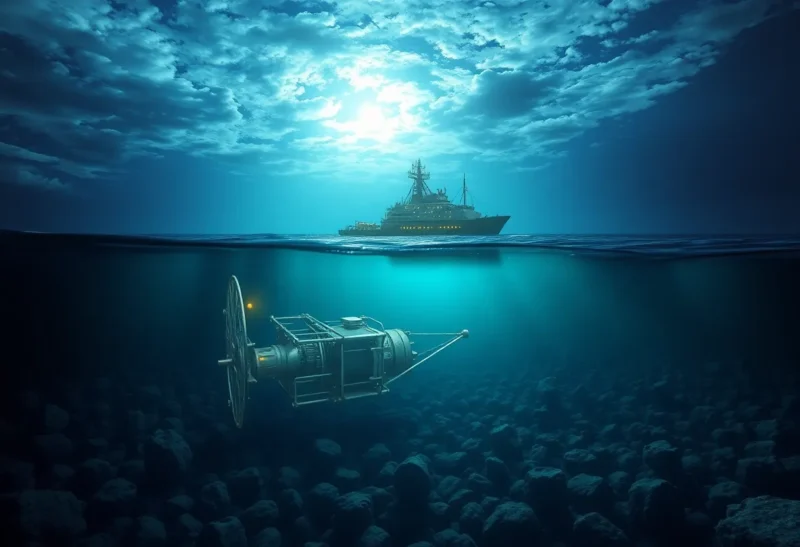
Deep-sea mining occupies a strange legal position: an industry that doesn’t yet commercially exist at scale, operating in a jurisdiction — the international seabed beyond any nation’s exclusive economic zone — that has its own dedicated regulatory body, its own decades of negotiated framework, and still no finalized rules for the exact activity everyone expects to start happening soon. Understanding what’s actually covered right now means separating three things people commonly conflate: the international regime, national and territorial-water mining, and the political maneuvering happening around both.
Who Actually Has Jurisdiction
The seabed beyond any country’s exclusive economic zone — roughly 200 nautical miles from shore — is legally classified under the United Nations Convention on the Law of the Sea (UNCLOS) as “the Area,” governed on behalf of humanity as a whole by the International Seabed Authority (ISA), an intergovernmental body headquartered in Jamaica. This matters immediately for one specific reason: the United States never ratified UNCLOS, which means it isn’t an ISA member and has no formal standing within the ISA’s regulatory process, a fact that becomes directly relevant to some of the more contentious recent developments described below.
Mining within a country’s own exclusive economic zone or territorial waters is governed entirely by that country’s domestic law, completely separate from the ISA framework. Norway, the Cook Islands, and several Pacific nations have already granted or explored domestic seabed mining licenses within their own waters, under their own environmental review processes, and none of that activity is subject to ISA rules at all — a distinction that gets lost in a lot of general coverage of “deep-sea mining regulation,” which often conflates activity in national waters with activity in the international Area.
What the ISA Has Actually Finalized
The ISA has spent more than a decade negotiating what’s formally called the “Mining Code” — the full regulatory framework that would govern commercial deep-sea mining exploitation (as opposed to exploration, which is already permitted and licensed) in the Area. As of the most recent negotiating sessions, that code remains unfinished. The ISA has issued exploration contracts — more than thirty of them, to state-sponsored contractors from countries including China, Russia, South Korea, Japan, India, and several European nations — covering polymetallic nodule fields, primarily in the Clarion-Clipperton Zone of the Pacific, along with separate exploration licenses for seafloor massive sulfide deposits and cobalt-rich crusts elsewhere.

Exploration contracts allow surveying, sampling, and environmental baseline studies. They do not authorize commercial extraction at scale. That authorization — the exploitation regulations — is what remains unfinished, covering critical unresolved questions like environmental impact assessment standards, royalty and revenue-sharing arrangements (since the ISA framework is explicitly designed to share benefits from “the Area” with humanity broadly, not just the mining contractor and its sponsoring state), liability for environmental damage, and inspection and enforcement mechanisms.
The “Two-Year Rule” That Forced the Issue
A specific provision buried in UNCLOS’s implementing agreement, informally called the “two-year rule,” states that if any ISA member formally requests that the exploitation regulations be finalized, the ISA Council must complete them within two years — and if it doesn’t, the Council must still consider and provisionally approve exploitation applications under whatever rules exist at that point, even if they’re incomplete. The Pacific island nation of Nauru triggered this provision in 2021 on behalf of its sponsored contractor, Nauru Ocean Resources Inc. (a subsidiary of The Metals Company), specifically to force the ISA’s hand.
That two-year deadline passed without finalized regulations, which has created genuine legal ambiguity: contractors could technically submit exploitation applications now, and the ISA would be obligated to consider them under an incomplete framework, but no contractor had actually done so as of the most recent ISA sessions, largely because doing so under an unfinished, contested regulatory framework invites exactly the kind of legal and reputational risk that deters the institutional investors most deep-sea mining ventures need.
Where the U.S. Fits Into This Awkwardly
Because the United States isn’t an ISA member, it has taken a separate and controversial path: in 2025, the U.S. government moved to authorize deep-sea mining permits under existing domestic law — specifically the decades-old Deep Seabed Hard Mineral Resources Act — for areas in international waters, entirely outside the ISA process. This drew immediate objections from ISA member states and from companies operating under ISA-sanctioned exploration contracts, on the grounds that unilateral national permitting for international waters undermines the entire premise of a shared international regime, and potentially creates a legal conflict where the same seabed area could be claimed under two mutually exclusive licensing systems.
This is the most consequential open question in deep-sea mining regulation right now, arguably more consequential than the ISA’s own unfinished Mining Code: whether the international seabed regime that’s operated for decades under a broad, if imperfect, multilateral consensus will hold, or whether major non-ISA-member states acting unilaterally under domestic law creates a parallel, competing system that fragments the whole framework.
The Environmental Standard That’s Still Undefined
Underneath all of this sits a scientific and regulatory problem that the ISA has acknowledged but not resolved: nobody has an agreed, binding standard for what level of seafloor ecosystem disturbance is acceptable, largely because the deep ocean ecosystems being discussed — many in the Clarion-Clipperton Zone — remain scientifically under-studied enough that baseline biodiversity data is still incomplete. Multiple ISA member states, along with a coalition that has grown to more than thirty countries, have called for a moratorium or precautionary pause on exploitation until environmental baselines and impact standards are established, while sponsoring states of active exploration contracts have generally pushed for the Mining Code to be finalized rather than paused indefinitely.
That disagreement is the actual current state of deep-sea mining regulation: an international body with real authority and a real, if incomplete, licensing history, sitting on an unfinished rulebook it’s legally obligated to complete, while at least one major power tests whether it can route around the whole system entirely. Nothing about that is settled, and anyone claiming deep-sea mining is either “regulated” or “unregulated” right now is skipping past the actual, considerably more complicated, in-between state the industry is operating in.