Space Debris Is Everyone’s Problem—Here’s Why We’re Failing to Fix It

Robin Hayes
February 24, 2026
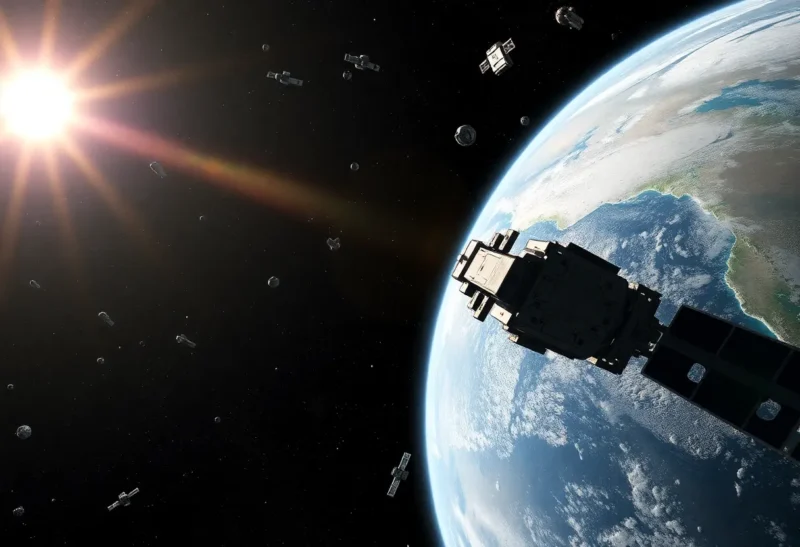
Orbital debris is a shared problem: one actor’s junk can kill another’s satellite or endanger crew. Yet cleanup and prevention are stuck in a mix of technical difficulty, weak incentives, and fragmented governance. Here’s why we’re failing to fix it—and what would have to change.
The Problem in a Nutshell
Low Earth orbit is a shared resource. No one owns it; everyone uses it. Satellites for comms, Earth observation, science, and national security all share the same crowded shell. When a satellite dies or a rocket stage is left behind, it becomes debris—and that debris is a threat to every other object in orbit. Thousands of defunct satellites, spent rocket stages, and fragments from collisions and anti-satellite tests orbit Earth. They travel at several kilometers per second. A paint chip at that speed can crack a window; a bolt can disable a satellite. Collisions create more debris; in the worst case, a cascade of collisions could make certain orbits unusable (the “Kessler syndrome”). So space debris is everyone’s problem: it threatens every operator and every mission. The more we launch—constellations, one-way missions, military tests—the worse it gets unless we remove debris and limit new creation. Tracking networks catalog tens of thousands of objects; estimates put the total count of trackable and untrackable debris in the hundreds of thousands or more. The population is growing faster than natural decay and occasional re-entries can remove it. So the trend is in the wrong direction.
Why Cleanup Is Hard
Removing debris is technically tough. You have to find, track, and rendezvous with objects that often have no power, no transponder, and unknown orientation. Then you have to capture or deorbit them without creating more fragments. Proposed solutions include nets, harpoons, robotic arms, and lasers—each with tradeoffs. Demonstrations have happened—ESA’s ClearSpace and commercial efforts like Astroscale are making progress—but operational, cost-effective removal at scale has not. So we’re failing in part because the tech is still immature. Even when it works, who pays? The object’s owner may be defunct or unwilling; other operators benefit from cleanup but didn’t create the debris. So the economics are broken: the cost is private, the benefit is public. Without a clear “who pays,” cleanup stays experimental. Insurance and liability could eventually push operators to fund removal, but today there’s no mandate and little economic pressure. So we’re failing because the business case for cleanup hasn’t closed.
Why Prevention Is Underpowered
Prevention should be easier: don’t leave things up there. Best practice is to deorbit or move satellites to a graveyard orbit at end of life. Many operators do that; many don’t. There’s no global enforcement. Guidelines (e.g. the 25-year rule: deorbit within 25 years of end of life) are voluntary in most jurisdictions. Launch traffic is exploding—megaconstellations add thousands of satellites—so even “good” behavior might not keep the population stable if enough actors skip or fail. And anti-satellite tests keep adding sudden bursts of fragments. Russia’s 2021 ASAT test created a cloud of debris that threatened the ISS and will linger for years. So we’re failing because prevention is underpowered: no binding rules, no penalty for non-compliance, and a few bad actors or accidents can undo a lot of good. National regulations are tightening in some countries (e.g. the FCC’s 5-year rule for US-licensed satellites), but that doesn’t bind others, and enforcement is still limited.
Governance Is Fragmented
Space is governed by treaties and national law. No single body owns orbit or can mandate cleanup. The UN Committee on the Peaceful Uses of Outer Space and other forums produce guidelines; states implement (or don’t). Liability exists in theory—if your debris damages someone else’s asset, you can be liable—but attribution is hard and enforcement is rare. So we’re failing because governance is fragmented: everyone agrees it’s a problem, but no one can compel action. Voluntary measures and national regulations help at the margin but don’t solve the collective-action problem. Space traffic management—who moves when to avoid a conjunction—is improving thanks to better data sharing, but it’s still ad hoc. So we’re failing on governance: no referee, no fines, no mandatory cleanup fund. Until that changes, the tragedy of the commons in orbit will continue.
What Would Have to Change
Fix would require at least three things. First, credible cleanup capability: proven, affordable removal of high-risk objects (big intact pieces and collision fragments). That means more investment in R&D and demo missions, and eventually a business model—perhaps operators pay into a fund, or a regulator mandates removal of your own debris. Second, stronger prevention: binding end-of-life rules, no ASAT tests that create long-lived debris, and design-for-demise so that what re-enters burns up. Third, better governance: either a treaty or a coalition of major spacefaring nations that sets and enforces norms. None of that is easy. Politics, sovereignty, and military interests get in the way. But without it, we keep adding more debris and hoping we don’t hit a tipping point. So far we’re failing—not because we don’t know what to do, but because the incentives and institutions aren’t there yet. The good news is that awareness is rising and some governments and companies are putting money and policy behind debris mitigation. The bad news is that the debris population has momentum; even with better behavior, we may need active removal to avoid a runaway problem. We’re not there yet.
Bottom Line
Space debris is everyone’s problem, but cleanup is hard and underfunded, prevention is voluntary and uneven, and governance is fragmented. We’re failing to fix it because no one is clearly on the hook and no one can force the rest to act. Turning that around needs better tech, binding rules, and real accountability. Until then, the risk keeps growing with every launch.