Lunar South Pole Site Selection: Why Two-Week Nights Still Dictate Every Power Budget

Robin Hayes
April 7, 2026
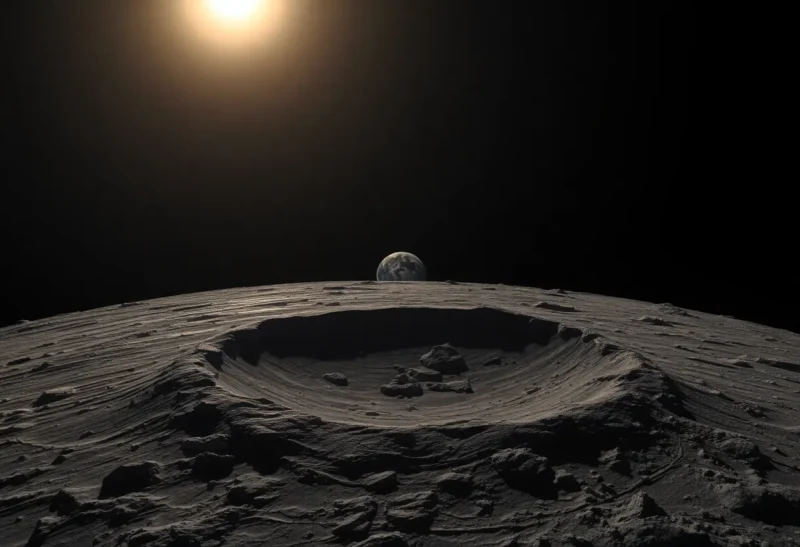
The lunar south pole is magnetic to mission planners for the same reason it is cruel to engineers: long shadows, permanently shadowed regions that may harbor water ice, and lighting conditions that turn “sunny” into a narrow band of geography and time. Marketing slides compress that into a crisp arrow—“land near ice”—but power budgets do not compress. A two-week lunar night is still fourteen Earth days of darkness and cold, and a pole-adjacent site can spend alarming stretches in partial shadow even when the Sun is “up.”
Site selection is therefore not only geology. It is a wager on how you will generate, store, and thermally manage energy when photons are scarce and every watt has a mass penalty on the ride from Earth. Coordinates that look adjacent on a map can differ by kilometers of shadow once local slopes enter the model—enough to separate a viable outpost from a battery farm that eats the mass budget alive.
Why the south pole at all
Orbital mechanics and illumination geometry make high-latitude sites interesting. Some crater floors never see direct sunlight, keeping volatiles cold enough to remain trapped for eons. If those volatiles include usable water ice, they could feed life support, propellant production, and closed-loop logistics that do not import every kilogram from Earth. That possibility justifies the engineering headache.
The headache is that “permanently shadowed” is an asset for chemistry and a liability for solar power. You do not park your arrays in eternal night. You perch them on rims and ridges where summer-like peaks of sunlight might exist—then you model how quickly those peaks disappear when terrain is wrong by a few meters.
The lunar day-night rhythm in human terms
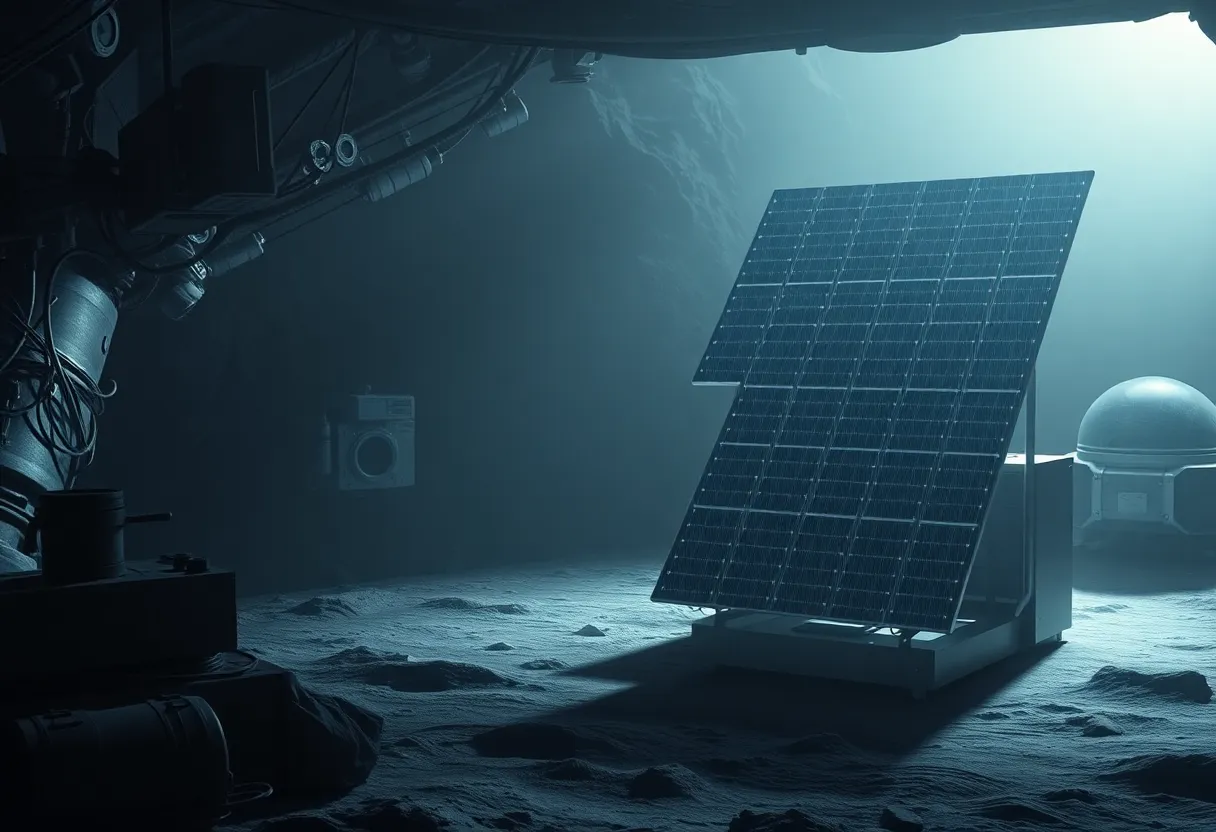
At most landing zones, a lunar day lasts about two Earth weeks, followed by two Earth weeks of night. Temperature swings are brutal for materials and operations. Solar-dependent architectures must either survive the night on stored energy, hibernate with minimal draw, or hybridize with nuclear or beamed power. Each choice ripples into mass, complexity, and crew safety.
Near the poles, the story splinters. Some locations enjoy extended periods of near-continuous illumination at certain altitudes—an attractive fantasy of “solar that never sets.” The reality is terrain-sensitive: a ridge that looks perfect on a coarse digital elevation model may still lose the Sun behind a neighboring peak for hours that add up to mission risk. High-fidelity mapping from orbit turns site selection from guesswork into statistics—but statistics still leave tails.
Permanently shadowed regions: science gold, power kryptonite
PSRs are cold traps that preserve volatile molecules scientists want to study and engineers want to use. They are also places where solar arrays go to die. Practical architectures therefore split the problem: extract cold-trap resources with targeted equipment while keeping generation and habitation elements on sunlit real estate with favorable azimuth and slope. The distance between those two worlds—horizontal and vertical—becomes a logistics line item: cables, rovers, thermal isolation, and time on the clock for every EVA or robotic round trip.
Thermal control is secretly an energy bill
Keeping electronics alive through night is not only batteries—it is heaters, insulation, and radiators sized for rejecting waste heat when the environment swings. Materials embrittle; lubricants misbehave; regolith dust coats radiators and optical surfaces. Thermal models assume cleanliness; the Moon assumes dust. Power budgets must include maintenance headroom or accept graceful degradation that still preserves crew safety margins.
Communications and pointing loads
High-bandwidth Earth links via relay orbiters add continuous draw. Steerable antennas and gimbals consume power and create failure modes during storms of charged particles. If comms must stay up through night for crew psychological support and mission rules, that load joins the battery stack requirement even when science instruments could sleep. Silent night is rarely truly silent in the power model.
What a power budget actually contains
Power is not a single number. It is a histogram of loads: life support, comms, science instruments, rover charging, ISRU pilot plants, thermal control heaters, and propellant conditioning. Peaks matter for inverter sizing; integrals matter for battery depth-of-discharge; uncertainty matters for margins. Lunar night forces the integrals to dominate: you are no longer optimizing average watts; you are optimizing worst-case Wh/kg across fourteen days of darkness unless you have an alternate source.
Batteries are honest about mass. Nuclear surface power trades political and safety complexity for steadier baseload. Beamed power from orbit sounds elegant and demands precise pointing and cooperative infrastructure. The “right” answer may be hybrid: solar for the sunny season of operations, fission or stored chemical energy for the long cuts.
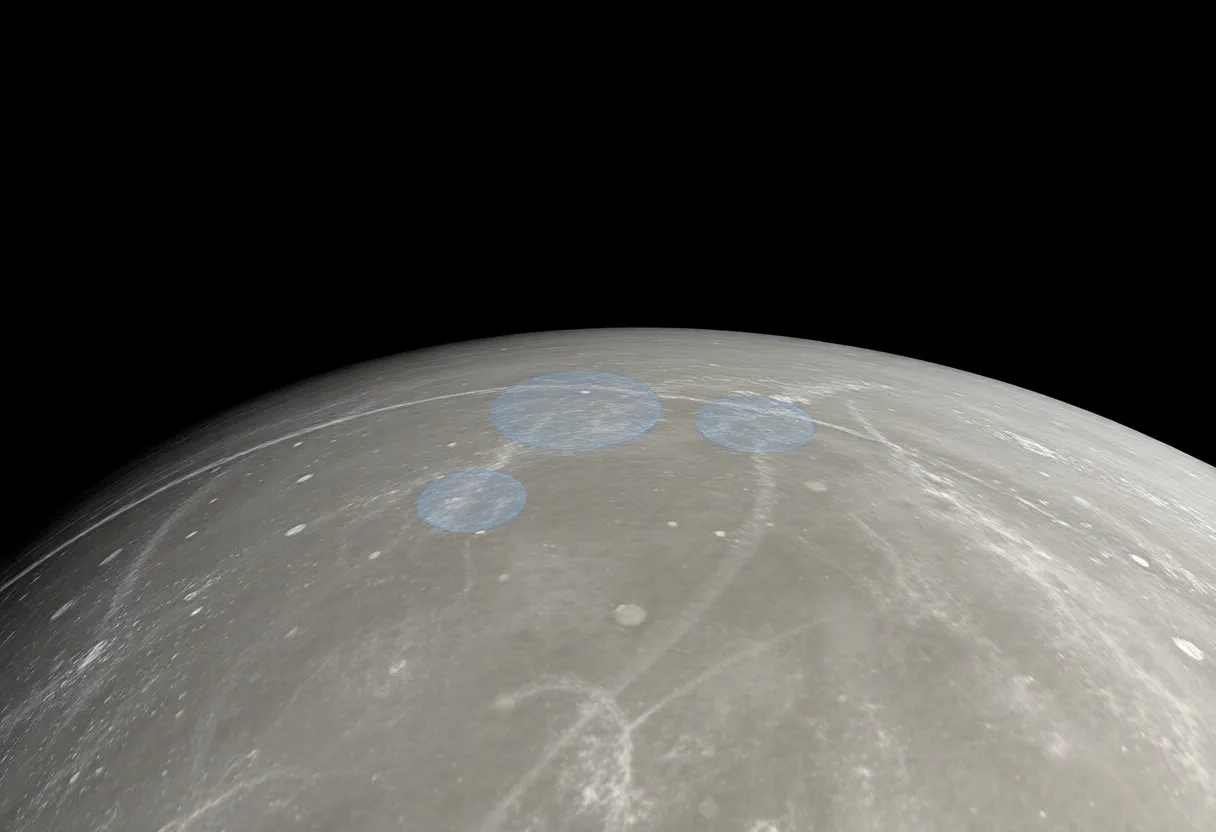
Ellipse error and the tyranny of landing uncertainty
Maps are crisp; touchdowns are fuzzy. Until landing precision tightens, planners must assume the vehicle could arrive on the less-favorable side of a ridge, shifting insolation hours in ways a nominal site study never intended. That uncertainty flows directly into oversized energy storage or conservative operational rules—fewer concurrent systems, delayed ISRU spin-up, shorter traverses. Tighter landing performance is not bragging rights; it is mass back in your pocket.
ISRU pilots and the spike loads problem
Demonstrating water extraction or oxygen generation is not a steady dribble of watts. Crushers, ovens, and cryo systems introduce spikes that stress cabling and thermal subsystems designed for gentle housekeeping loads. Site selection interacts with those spikes: if you must perch far from ice, long cable runs add resistance losses and mass. If you nestle close to shadowed terrain, radiative coupling to cold walls changes your heater budget in models that looked fine on a spreadsheet.
Site selection as risk allocation
Choosing a rim over a floor, a plateau over a talus slope, or a route with shorter shadow gaps is allocating risk between navigation, power, and science yield. Closer to suspected ice may increase drilling difficulty and thermal complexity; farther may strand you with logistics penalties. Mission architects iterate with rover precursors, seismic models, and simulated traverses because maps do not shovel regolith.
Orbital data versus boots-and-wheels truth
Surface operations teams inherit lighting constraints every time a traverse takes longer than planned; shadows move while rovers inch across uncertain footing.
Lunar Reconnaissance Orbiter and companion missions gifted planners with meter-scale topography and illumination movies across months. Those datasets are indispensable—and still incomplete without ground truth. Boulders below resolution thresholds, unexpected mechanical properties in regolith, and local electrostatic effects can change traverse plans. Each change feeds back to power: a rerouted road costs time, motor heating, and sometimes an extra comms relay hop if line-of-sight to Earth breaks around a new obstacle.
Robotic precursors as flying power experiments
Cargo landers that deploy small rovers with instrumented solar panels and battery packs turn a landing site from a hypothesis into a timeseries. Night survival at modest loads de-risks night survival at crew loads the way a kiddie pool de-risks swimming—not identical, but not worthless. The value is trendlines: how fast dust accumulates on cells, how battery temperatures drift, how often survival heaters kick in when the Sun grazes the horizon.
International sites and interoperability
Partners bring modules with their own voltage standards, connector philosophies, and fault containment assumptions. A “good” site for one nation’s solar wings may be awkward for another’s docking orientation. Power budgeting becomes negotiation: shared relay satellites, time-sliced high-power activities, and agreed-upon emergency load shedding. Geography does not care about flags; interfaces must still close.
Implications for Artemis-class timelines
Until flight systems prove sustained night survival with realistic loads, schedules stay conservative. A landing that demonstrates solar production in favorable geometry is not the same as a base that operates through winter-like darkness. Cargo precursors that test power systems in situ reduce uncertainty; without them, PowerPoint timelines are fiction. Night demonstrations do not need to match final crew loads on the first try, but they must climb a ladder of realism—otherwise “base by decade’s end” remains a slogan, not a specification.
Crew psychology meets the joule ledger
Humans do not tolerate arbitrary blackouts well. Lighting, life support fans, and contact with Earth are not luxuries in early outposts—they are part of the minimum viable habitat. Planners therefore embed social continuity into electrical budgets even when pure engineering would prefer aggressive sleep modes. That choice steepens battery requirements and pushes some teams toward nuclear baseload earlier than pure energy-minima spreadsheets suggest.
What investors and taxpayers should ask for
When reviewing lunar programs, ask for power-duration curves, not hero images. How many kilowatt-hours of usable storage reach the surface? What depth of discharge is assumed, and what cycle life remains after the first dozen nights? Which instruments defer if a dust storm of fines coats arrays? Clear answers align rhetoric with thermodynamics.
Conclusion
The lunar south pole’s promise is inseparable from its lighting economics. Two-week nights did not vanish because we want ice—they remain the dominant constraint that turns pretty maps into engineering arguments. Site selection is where science meets joules: the winning coordinates are the ones where geology, sun angles, and power architecture converge without pretending shadows do not exist. Treat every landing site as a power plant location first; the science harvest follows if the electrons behave.