Indoor Solar: What Actually Works for Charging Your Gadgets in 2026

Evan Pierce
March 7, 2026
Indoor solar sounds like a dream: leave your phone by the window, let it charge from ambient light, never plug in again. Reality is messier. Indoor light is hundreds of times weaker than direct sunlight. Most solar panels are tuned for outdoor conditions. And yet, a new generation of small panels, better cells, and power-efficient devices has made indoor solar charging genuinely useful—for the right gadgets and the right setups. Here’s what actually works in 2026.
The Physics Problem
Direct sunlight delivers roughly 1,000 watts per square meter. A bright office or living room might hit 100–300 lux—enough to read by, but equivalent to maybe 1–3 watts per square meter for typical solar cell efficiency. That’s a 300–1000x drop. A standard 100W rooftop panel would produce well under half a watt indoors. No wonder early indoor solar chargers felt like novelties.
Things have improved. Amorphous silicon and organic photovoltaic (OPV) cells work better in low light. Perovskite cells, now commercializing, promise even higher efficiency under indoor illumination. Dedicated indoor solar panels—often small, flexible, and tuned for 200–500 lux—can now generate useful power for low-drain devices. The keyword is “low-drain.” A smartphone charging at 15W needs a lot of panel. A wireless mouse, a keyboard, or a small sensor? That’s where indoor solar shines.
What Actually Charges Well
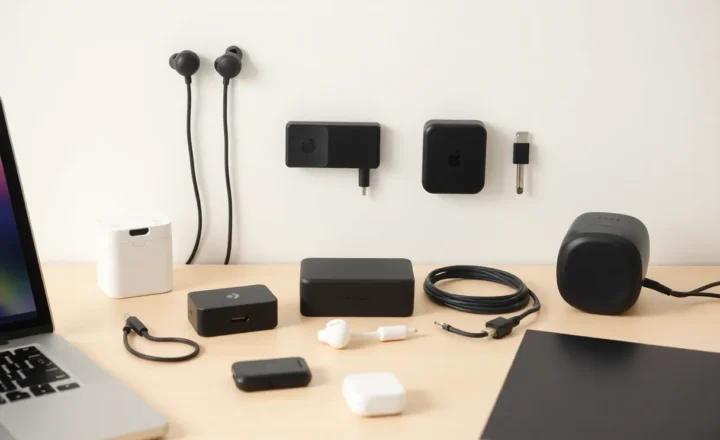
Wireless peripherals. Logitech’s solar keyboard, several solar-powered wireless mice, and similar devices use tiny panels that keep a small battery topped up. They’re designed for desk lighting. A few hours near a window or under an LED lamp, and they’ll run for months. These work because the power draw is tiny—microwatts when idle, milliwatts when in use. Indoor solar can keep up.
Low-power sensors and trackers. Tile, AirTag competitors, and some smart home sensors use small solar cells or energy-harvesting modules. They’re not fast-charging; they’re trickle-charging. A few minutes of decent light extends battery life. For devices that spend most of their time idle, that’s enough.
Solar-powered calculators and small electronics. Old tech, but it proves the concept. Indoor light has always been sufficient for these. The same principle applies to newer gadgets with very low power budgets.
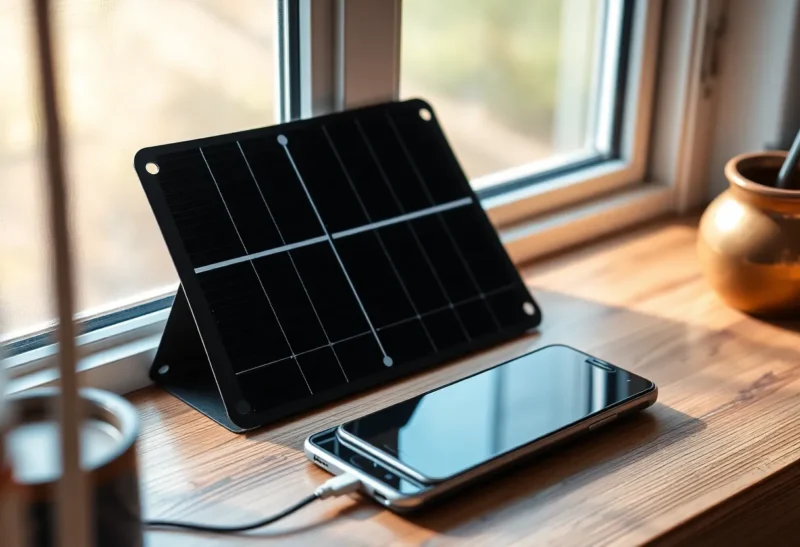
Dedicated solar phone chargers (with caveats). Fold-out panels with 5–10W outdoor rating might produce 0.5–2W indoors. That’s enough to slowly charge a phone over many hours—useful for emergencies or off-grid backup, not for daily use. Leave the panel by a south-facing window all day and you might get 20–30% charge on a typical phone. Don’t expect a full charge before dinner.

What Doesn’t Work
Laptops. A MacBook or Windows laptop draws 30–65W when charging. Even a large indoor panel produces a watt or two. You’d need a wall of panels. Not practical.
Tablets. Similar story. iPads and Android tablets charge at 10–20W. Indoor solar could theoretically trickle-charge over a full day, but placement would be finicky and results inconsistent. Better to plug in.
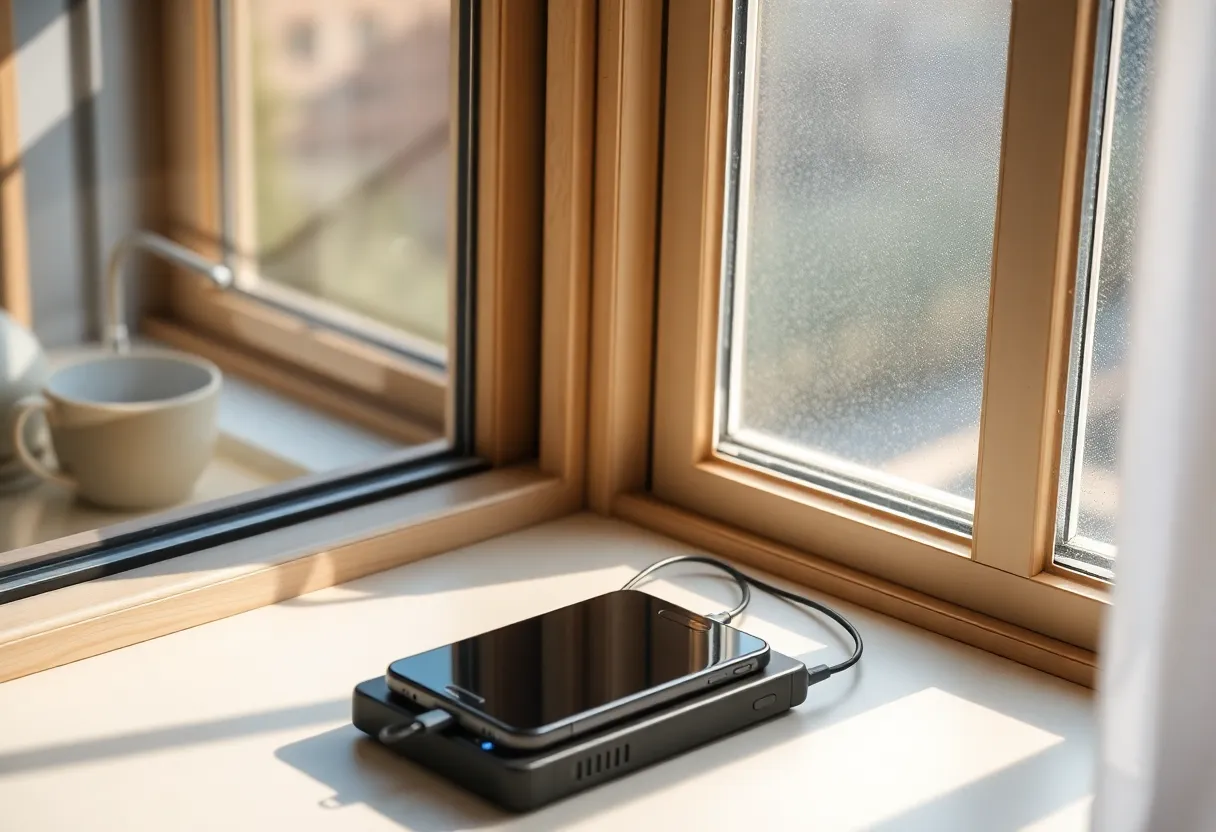
Smartphones as primary charging. Possible in theory; tedious in practice. You’d need a panel the size of a placemat, good placement, and patience. Fine for a backup setup. Not for everyday.
How to Maximize What You Get
Place panels near windows—south-facing in the northern hemisphere, north-facing in the southern. Even indirect light helps. Avoid deep shade. LED desk lamps can supplement; many modern LEDs put out a useful spectrum for solar cells. Clean the panel surface. Dust and fingerprints cut output.
Match the device to the panel. A 5W panel (outdoor rating) might deliver 0.5W indoors. That’s enough for a 500mAh battery in a few hours. Do the math: power draw × time = energy. If your gadget uses 50mW on average, 0.5W from the panel leaves headroom for charging. If it uses 2W, you’ll barely keep up.
The Verdict
Indoor solar works for low-power devices: keyboards, mice, trackers, sensors, and small electronics. It can slowly charge phones as a backup or emergency option. It won’t replace the wall outlet for laptops, tablets, or daily phone charging. In 2026, the tech is good enough to be genuinely useful—if you pick the right gadgets and have realistic expectations. For most people, that means a solar keyboard or mouse, or a small panel for camping and backup, not a fully solar-powered desk.