How Mechanical Keyboard Switches Have Evolved Beyond Just Clicky vs. Quiet

Finn Mercer
July 7, 2026
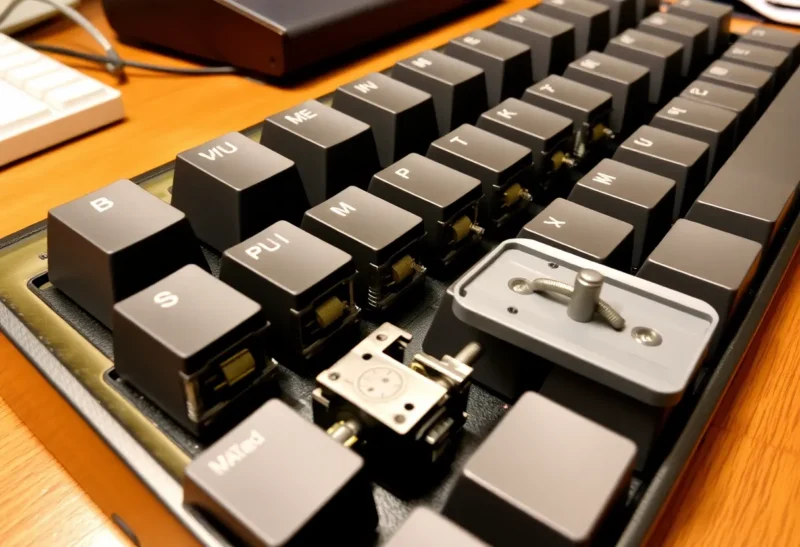
For a long time, mechanical keyboard switch selection was summarized as a three-way choice: Cherry MX Red for gaming (linear, light), Cherry MX Brown for typing (tactile, quiet), Cherry MX Blue for satisfying typing feedback (clicky, loud). This framing is still how some mainstream buyers approach the category, and it’s not entirely wrong — those three characteristics (linear/tactile/clicky, weight, and noise) still describe the fundamental axes of switch design.
What the clicky-vs-quiet framing misses is that the switch market has expanded dramatically beyond Cherry’s original lineup, that enthusiast switch design has introduced new characteristics that matter for specific use cases, and that the quality range between budget and premium switches is now wide enough that “linear” describes a spectrum rather than a single experience. Understanding how switches have evolved helps make better decisions — whether you’re buying a first mechanical keyboard or trying to understand why enthusiasts spend significant money on switches when decent ones cost pennies per unit.
The Core Switch Categories
The three fundamental types still map onto real use cases. Linear switches travel from top to bottom in a smooth, consistent arc — no tactile bump, no click. They’re preferred by gamers who want consistent actuation at any point in the travel and by typists who want a smooth keystroke without feedback that can slow down fast typists. Tactile switches produce a bump at the actuation point — you feel when the key has registered without the audible click. Clicky switches add an audible click (from a click bar or click jacket mechanism) to the tactile bump, providing both tactile and auditory feedback.
Within each category, the design variables include actuation force (how hard you need to press for the key to register), pre-travel (how far the key travels before actuating), total travel (the full keystroke depth), and the shape and intensity of the tactile bump for tactile and clicky switches. These variables produce meaningfully different typing and gaming experiences, not just different noise profiles.
The original Cherry MX Brown’s tactile bump, for example, is famously mild — often called “scratchy linear with a hint of bump” by enthusiasts who don’t find it satisfying as a tactile switch. This isn’t a knock on Cherry specifically; it’s a case where the marketing category (“tactile”) doesn’t fully capture the experiential character. The Brown’s feel is a product of its specific design rather than a definitive statement about what tactile switches feel like.
What the Enthusiast Market Developed
The growth of custom keyboard communities, particularly through platforms like GeekHack and Reddit’s r/MechanicalKeyboards, produced a wave of switch manufacturers that approached design with different priorities than Cherry’s original commercial lineup. Gateron, Kailh, NovelKeys, Prevail Key Co., Gazzew, KTT, TTC, and dozens of others now produce switches that compete on feel quality, smoothness, and tactile character rather than just price or noise profile.
The “smooth linear” became an enthusiast focus. Stock Cherry MX switches have a somewhat scratchy feel due to lower manufacturing tolerances and simpler stem designs. Factory-lubed switches with tighter tolerances — Gateron Yellow Pro, NovelKeys Cream, Gateron Oil King, Aqua King — produce linear switches that feel noticeably smoother than standard Cherry Reds. For typists who want linears, the smooth feel of a quality linear is a qualitative improvement that’s noticeable even to non-enthusiasts when switching between a budget linear and a premium one.
Tactile switch design became more sophisticated. The Holy Pandas (a combination of two different switches’ housings and stems) became the canonical enthusiast tactile for having a sharp, pronounced tactile bump that’s very different from the mild Cherry Brown bump. Subsequent designs — Boba U4, Zykos Topre-inspired tactiles, Gazzew’s lineup — explored different bump shapes, positions, and intensities. “Strong tactile” versus “light tactile” is now a meaningful sub-category distinction, and the position of the bump relative to the actuation point varies between designs.
Gasket-mounted and bottom-out focused switch design emerged in response to the custom keyboard community’s preference for “thocky” sound profiles — keyboards that produce a deeper, lower-pitched sound rather than the higher-pitched clatter of typical gaming keyboards. Switch characteristics interact with keyboard case materials, PCB mounting styles, and foam dampening to produce the overall sound. Some switches (KTT Strawberry, Durock Piano) are specifically designed with bottom-out sound in mind.
The Lubing and Modification Layer
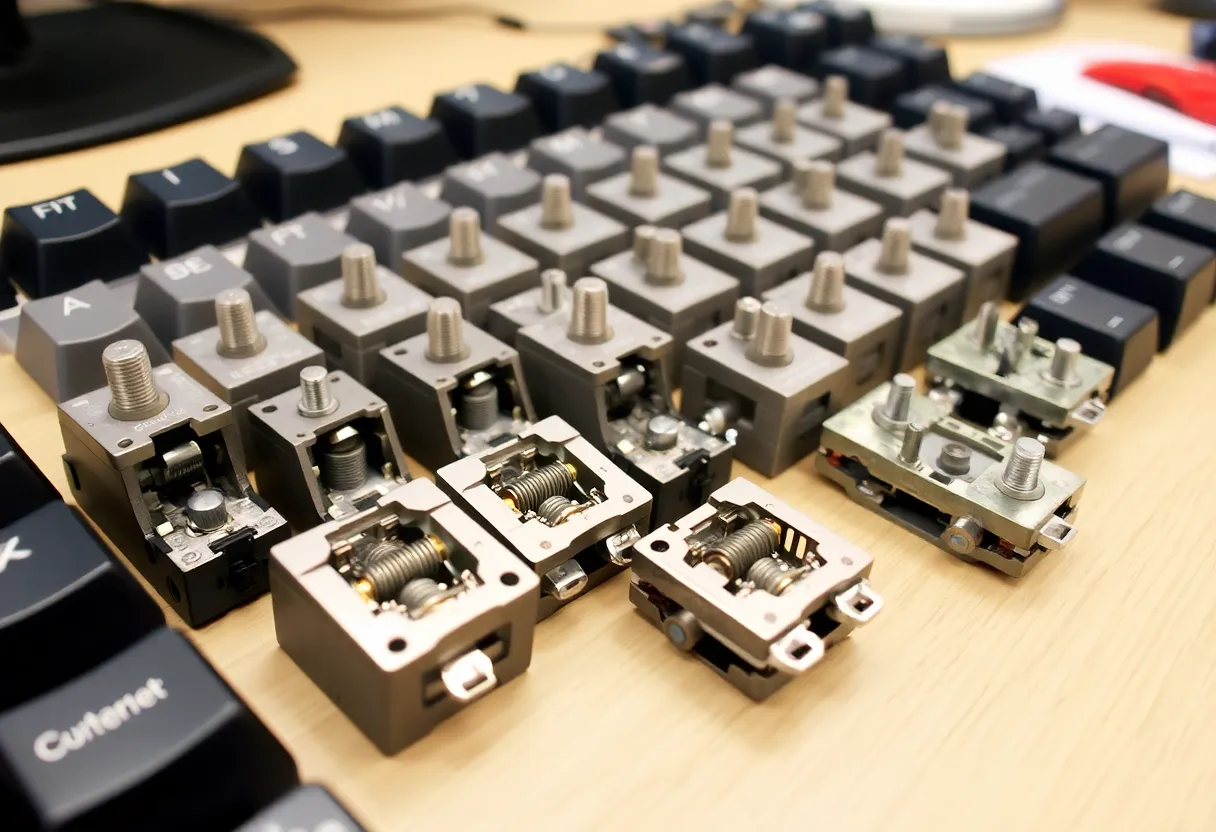
Factory-lubed switches are now common even in mid-range offerings, but the enthusiast practice of hand-lubing switches remains a meaningful performance upgrade for those willing to do the work. Hand-lubing involves disassembling each switch, applying appropriate lubricant (Krytox 205g0 for linears, thinner 105 oil for spring noise, 203g0 for tactiles to preserve bump feel) to specific contact surfaces, and reassembling.
The difference between unlubed and well-lubed switches is substantial for feel and sound: roughness disappears, spring ping (the high-pitched metallic noise from an unlubed spring) is eliminated, and keystrokes become more consistent. For tactile and clicky switches, lubing has to be done carefully to avoid coating the tactile legs and flattening the bump. This is a skill that takes some learning but produces results that premium factory switches rarely match.
Filming — adding a thin film between the top and bottom housings of a switch — addresses wobble from loose tolerances and is another common enthusiast modification. Switch sockets (Kailh hot-swap sockets) allow switch swapping without soldering, making it practical to experiment with different switches in the same keyboard without permanent commitment.
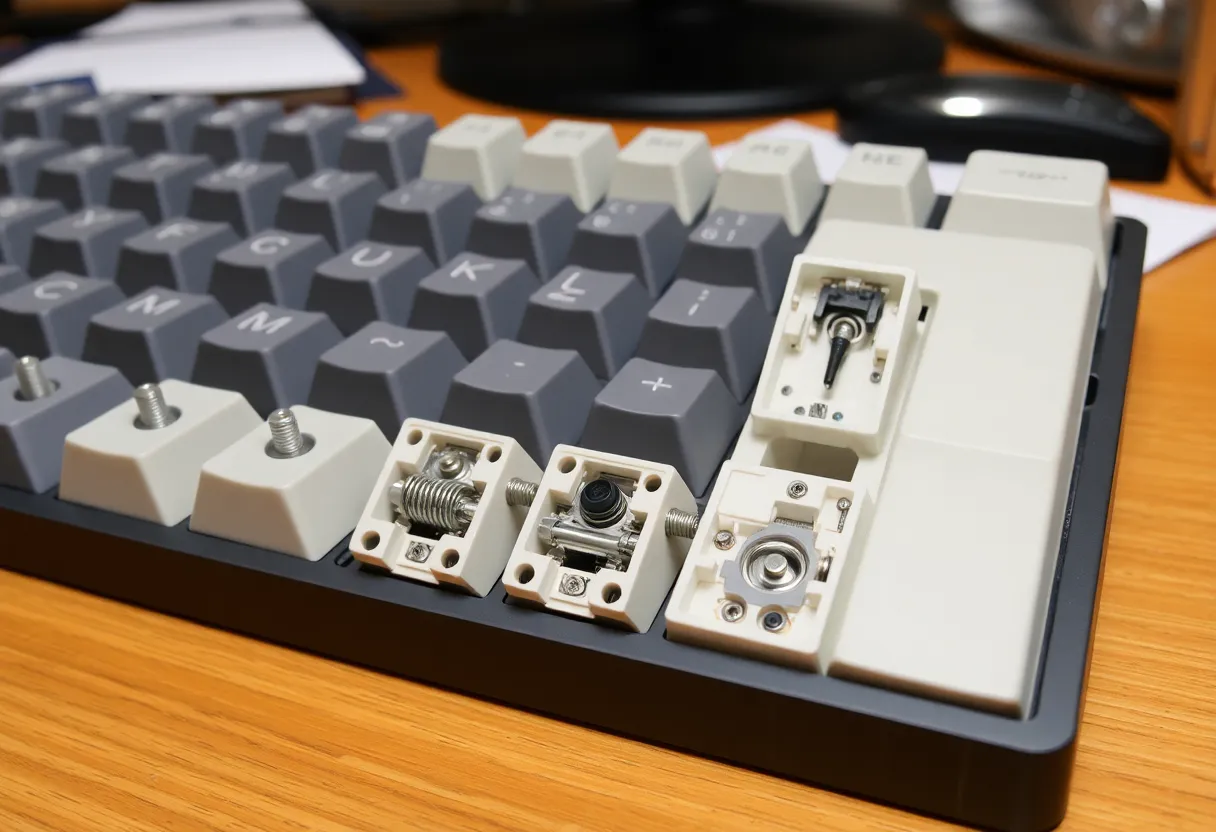
New Switch Technologies
Beyond traditional mechanical designs, several newer switch technologies have entered the mainstream consumer market and offer genuinely different experiences.
Hall effect switches use magnetic sensors rather than physical contact to detect keypresses. The absence of physical contact means no wear over time, no cleaning requirement, and — importantly — programmable actuation points. You can set how far down you want the key to register, and some implementations allow per-key actuation point adjustment. The Wooting keyboard line popularized hall effect switches for gaming because adjustable actuation allows rapid-fire input techniques (rapid trigger) that weren’t possible with fixed actuation. They’re also excellent for longevity — theoretically nearly unlimited lifespan without mechanism wear.
Optical switches use a light sensor to detect keystroke actuation rather than metal contacts. Razer’s optical switch line and SteelSeries’ competing design are the most visible implementations. The lack of contact bounce means registration is slightly faster than mechanical, though the difference is under 1 millisecond — more marketing point than practical difference. Like hall effects, opticals offer long lifespan due to no contact wear.
Analog switches that report key position rather than a binary on/off — implemented in some gaming keypads and controllers for decades before keyboards — allow variable input for games that support it (driving games with variable throttle on keyboard, for example). Hall effect switches enable this in keyboard form.
For most buyers choosing a first mechanical keyboard or upgrading from a membrane keyboard, the traditional tactile/linear/clicky framing is still the right starting point — but exploring the switch tester and spending $10–15 on a switch sampler before committing to a full keyboard is time well spent. The difference between a mid-tier Cherry Brown and a well-regarded enthusiast tactile is noticeable in a way that specifications don’t capture, and the right switch for your typing style and sound environment is still ultimately a personal preference that benefits from hands-on testing.