Asteroid Mining: The Economics Nobody Wants to Talk About

Robin Hayes
February 24, 2026
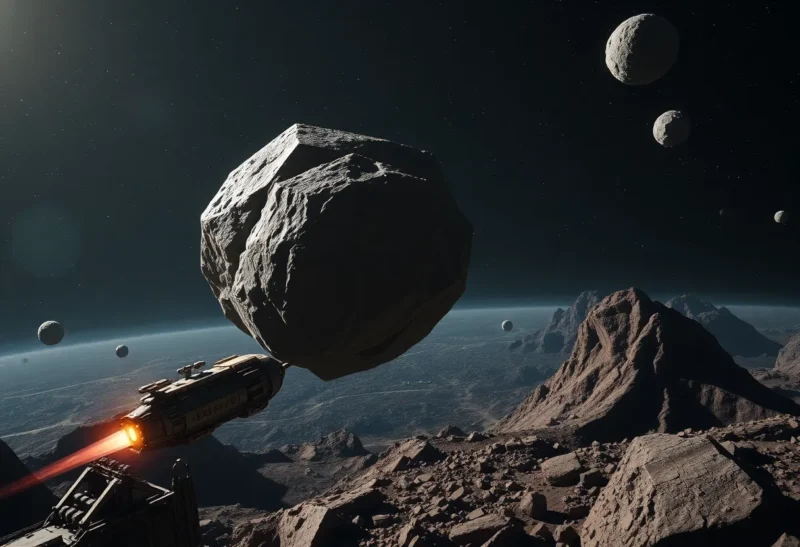
Asteroid mining sounds like the kind of thing that belongs in a pitch deck: trillions of dollars in platinum-group metals, rare earths, and water ice, all floating in the belt, waiting for someone to go get them. The narrative is seductive. The economics are messier. Behind the headlines about “space resources” and “in-space manufacturing” are questions that the industry would rather not lead with—who actually pays, over what timeline, and who bears the risk when the numbers don’t add up.
The Promise and the Spreadsheet
Proponents point to near-Earth asteroids that could contain more platinum than has ever been mined on Earth. Water ice could be split into hydrogen and oxygen for propellant, turning the Moon or Mars into way stations instead of dead ends. The logic is simple: if you can get there and process the stuff, the margins could be enormous. The logic is also incomplete. Getting there is expensive. Processing in microgravity is unproven at scale. And “could” is doing a lot of work—most asteroid compositions are inferred from spectroscopy, not drill cores.
Realistic cost models put the first commercial asteroid-mining missions in the tens of billions of dollars, with payback measured in decades, not years. That implies either patient capital with a very long horizon or a business model that doesn’t depend on selling bulk ore back to Earth. So far, the money has flowed to companies that talk about space resources, but the revenue has mostly come from government contracts, spin-off tech, and storytelling. The economics of actually landing a tonne of platinum on the market—and not crashing that market in the process—are rarely spelled out in the same slide deck.

Who Pays for the First Decade?
Space infrastructure is a classic chicken-and-egg problem. To make asteroid mining profitable, you need cheap launch, in-space refuelling, and maybe a lunar or orbital base to process and store material. To get those, you need someone to build them. To get someone to build them, you need a customer. The customer, in practice, has been government: NASA, ESA, national space agencies, and defence. They fund the first wave of capability; private actors then try to find a business on top of it.
That creates a dependency that rarely gets discussed in public. Asteroid-mining startups don’t usually say “our path to revenue is winning a NASA contract to demonstrate water extraction.” They say “we’re building the future of space resources.” Both can be true, but the second obscures who’s underwriting the first decade of development. When public budgets shift or priorities change, the economics of the whole sector shift with them. That’s not a reason to stop—it’s a reason to be honest about where the money is coming from and what happens when it doesn’t.
The Market Problem
Suppose you succeed. You land a few hundred tonnes of platinum-group metals back on Earth (or you sell them in orbit to someone building satellites). What happens to the price? Platinum and palladium are valuable precisely because they’re scarce. Flood the market and the price drops. The same logic applies to rare earths: the value is in the concentration and the supply chain, not just the raw tonnage. So the “trillions in the belt” argument has to be qualified: trillions at today’s prices, in a world where you’re the only supplier and you can meter your output. In a world where multiple players are bringing back material, or where in-space use (propellant, construction) dominates over Earth return, the economics look completely different.
That doesn’t kill the case for asteroid mining. It does mean the case is more nuanced than “go get the gold.” The real opportunity may be in-space consumption—selling propellant to satellites and deep-space missions—rather than in hauling ore home. But that opportunity depends on a level of traffic and demand in cislunar space that doesn’t exist yet. You’re betting on a future market, not an existing one.
Externalities and Rules
Then there are the costs that don’t show up on any balance sheet. Space debris is already a problem. Mining implies more hardware in orbit, more collisions, more fragments. Who’s liable? Who sets the rules? The Outer Space Treaty says nations are responsible for their nationals and objects; it doesn’t spell out mining rights, environmental standards, or cleanup obligations. We’re edging toward a regime where some countries have passed domestic space-resource laws, but there’s no international framework for who can take what from where, or what they owe the rest of humanity for the use of a shared environment.
Labour and safety are another blind spot. Mining on Earth is dangerous. Mining in space will be riskier—radiation, isolation, and the fact that rescue is not a quick helicopter ride away. Who bears that risk? Who insures it? The economics of asteroid mining often assume that automation will do the work. Maybe. But someone has to build, maintain, and repair the robots, and for the foreseeable future that means humans in harm’s way. The cost of keeping them alive and healthy—and the cost of failure—rarely appears in the “cost per tonne” slide.
The Honest Pitch
None of this means asteroid mining is a fantasy. It means the honest pitch is harder than the glossy one. The honest pitch is: we’re building capability that might pay off in 20 or 30 years, with a lot of technical and market risk, funded in part by public money and in part by investors who are betting on a space-faring future. The upside is real—cheaper propellant, more resilient supply chains, and maybe one day a genuine off-Earth economy. The path to get there is long, expensive, and dependent on choices that governments and the public haven’t fully debated.
So when someone says “asteroid mining is the next trillion-dollar industry,” the right response isn’t “no.” It’s “show me the economics—who pays, who benefits, and what happens when the spreadsheet meets reality.” The economics are the part nobody wants to talk about. That’s exactly why we should.