How Bail Bond Algorithms Are Quietly Reshaping Pretrial Detention Decisions

Remy Torres
July 9, 2026

Pretrial risk assessment algorithms — statistical tools that generate a numerical score or risk category predicting whether a defendant is likely to fail to appear for future court dates or be arrested for new criminal activity if released before trial — have quietly become a standard part of bail and pretrial detention decisions across a large and growing share of US jurisdictions over the past fifteen years. These tools were adopted largely as a reform measure, intended to reduce the well-documented problems with traditional cash bail systems, but their actual implementation has generated its own set of complicated, still-unresolved questions about fairness, transparency, and what these algorithms are actually capable of predicting reliably.
What These Tools Were Designed to Fix
Traditional cash bail systems, where a judge sets a monetary bail amount a defendant must pay (or pay a percentage of to a bail bond company) to be released before trial, drew sustained criticism for effectively conditioning pretrial freedom on wealth rather than on any assessment of actual flight or public safety risk — a low-risk defendant without resources to pay bail could remain detained for months awaiting trial, while a higher-risk defendant with sufficient financial resources could secure release regardless of underlying risk factors, an outcome widely viewed as fundamentally disconnected from the stated purpose of bail as a risk-management tool rather than a punishment or a simple ability-to-pay filter.
Pretrial risk assessment tools were developed and promoted largely as a more objective, evidence-based alternative to both unstructured judicial discretion (which research has documented shows meaningful inconsistency and demonstrable bias across different judges handling similar cases) and pure cash bail, aiming to give judges a standardized, statistically grounded risk estimate that could inform release decisions and conditions without simply defaulting to whether a defendant can afford to pay.
How These Algorithms Actually Generate a Risk Score
Most widely used pretrial risk assessment tools, including the Public Safety Assessment (PSA) used across numerous jurisdictions and various other proprietary and jurisdiction-specific tools, generate their risk estimates using statistical models trained on historical data about which defendant characteristics correlated with failure to appear or new criminal activity in past cases. Common input factors across most of these tools include criminal history details (prior convictions, prior failures to appear, pending charges at time of arrest), age, and details about the current charge, deliberately excluding factors like race and, in most modern tool designs, income or employment status specifically to avoid building known problematic bias sources directly into the scoring model.
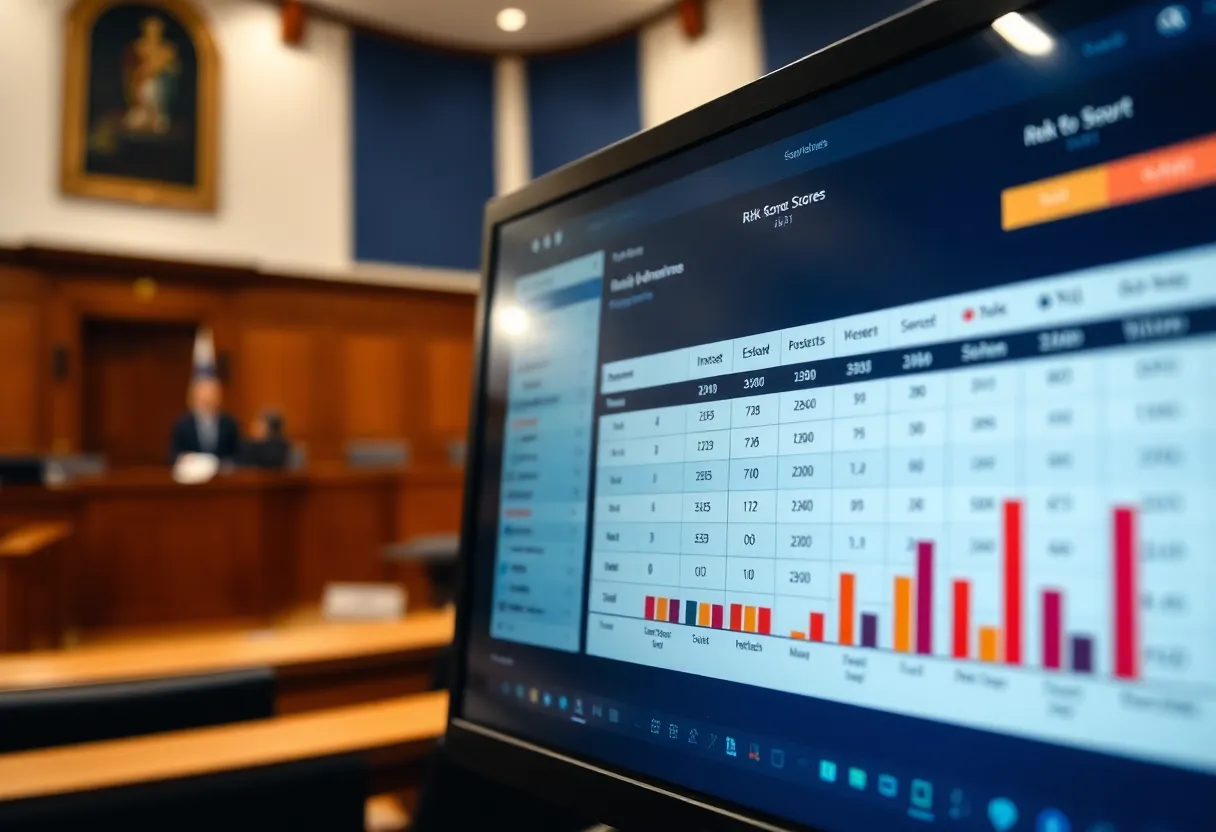
The resulting output is typically a numerical score or categorical risk level (low, moderate, high) presented to the judge alongside other case information, intended as one input into the release decision rather than a fully automated, binding determination — though the actual practical weight judges give these scores in real courtroom decision-making varies considerably by jurisdiction and by individual judge, a variation that itself has become a subject of ongoing research and concern.
Why the Fairness Debate Hasn’t Been Resolved by Removing Race as an Input
Deliberately excluding race as a direct input factor turned out not to fully resolve fairness concerns, because several of the remaining input factors these tools do use — most prominently criminal history — are themselves statistically correlated with race in the United States, a well-documented consequence of documented disparities in policing intensity, charging decisions, and historical enforcement patterns across different communities. This means a risk assessment tool can produce racially disparate outcomes in practice even without race as an explicit input variable, because it’s effectively using proxy variables that carry embedded historical bias forward into supposedly neutral, purely statistical risk scores.
Independent research and audits of specific tools, including widely cited analysis of the COMPAS tool used in some jurisdictions for broader criminal justice risk assessment, have found measurable racial disparities in error rates — different rates of false positive high-risk classifications across racial groups — that sparked substantial academic and public debate about whether these tools, despite explicitly excluding race, were nonetheless perpetuating rather than correcting the discretionary bias problems they were partly designed to address in the first place.
The Deeper Technical Problem: What These Tools Can Actually Predict Reliably
Beyond the racial fairness debate specifically, a separate and more fundamental technical criticism concerns how reliably these tools can actually predict the outcomes they claim to predict at the individual level, as opposed to aggregate statistical patterns across large defendant populations. A tool that shows reasonable statistical association between certain risk factors and outcomes across thousands of historical cases doesn’t necessarily translate into confident, accurate prediction for any single individual defendant’s actual future behavior, and several researchers studying these tools have specifically questioned whether the underlying predictive accuracy is strong enough to justify the significant liberty and public safety consequences riding on individual pretrial detention decisions.

This has fed into a broader “black box” transparency concern specific to some proprietary risk assessment tools, where defendants, their attorneys, and even the judges using the tool’s output sometimes have limited visibility into exactly how a specific score was calculated or which specific factors most heavily influenced it, making it difficult to meaningfully challenge or contextualize a risk score the way a defendant could challenge more traditional, visible evidence presented in a bail hearing.
Where the Policy Debate Currently Stands
Some jurisdictions that adopted pretrial risk assessment tools with genuine reform intentions have since scaled back or eliminated their use, citing exactly these fairness and transparency concerns, while other jurisdictions continue using and refining these tools, often alongside additional bias auditing requirements and increased transparency mandates about how specific tools calculate their scores. This split reflects a genuinely unresolved policy question rather than a settled consensus: risk assessment tools clearly offer more standardized, arguably more consistent decision-making than pure unstructured judicial discretion, but the evidence that they’ve actually succeeded in reducing the racial and wealth-based disparities that motivated their original adoption remains genuinely mixed, and the field continues to grapple with whether algorithmic standardization solves the underlying problem it was designed to address or simply reformulates the same disparities in a more technically obscured form.