Why Vertical Aquaculture Startups Are Betting on Land-Based Salmon

Futurion Editorial
July 9, 2026
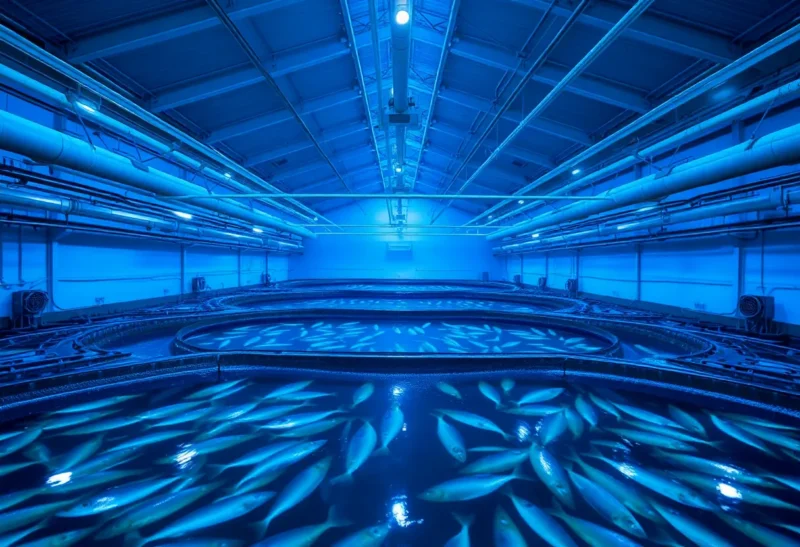
Salmon farming has always meant net pens in cold coastal waters — Norway’s fjords, Chile’s southern coast, Scotland’s sea lochs, and British Columbia’s channels. That geography has been non-negotiable for a century of aquaculture because salmon need cold, oxygen-rich, well-flushed water, and open ocean provided all three for free. A wave of startups is now betting they can break that dependency entirely, growing full-sized Atlantic salmon to market weight inside steel tanks in industrial warehouses, sometimes hundreds of miles from any ocean at all. The pitch is compelling: shorter supply chains, no sea lice, no escapes, no seabed pollution. The actual results, so far, have been considerably messier than the pitch decks suggested.
The Technology Making This Possible
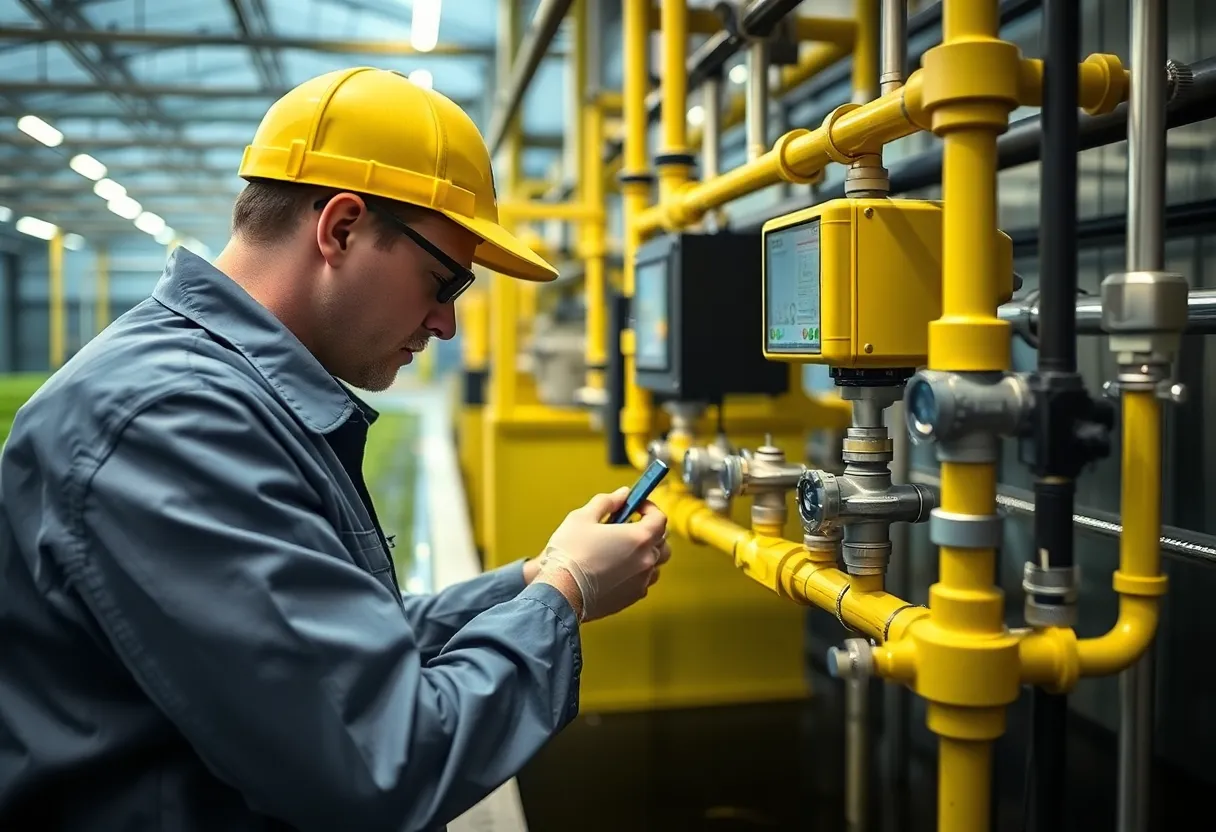
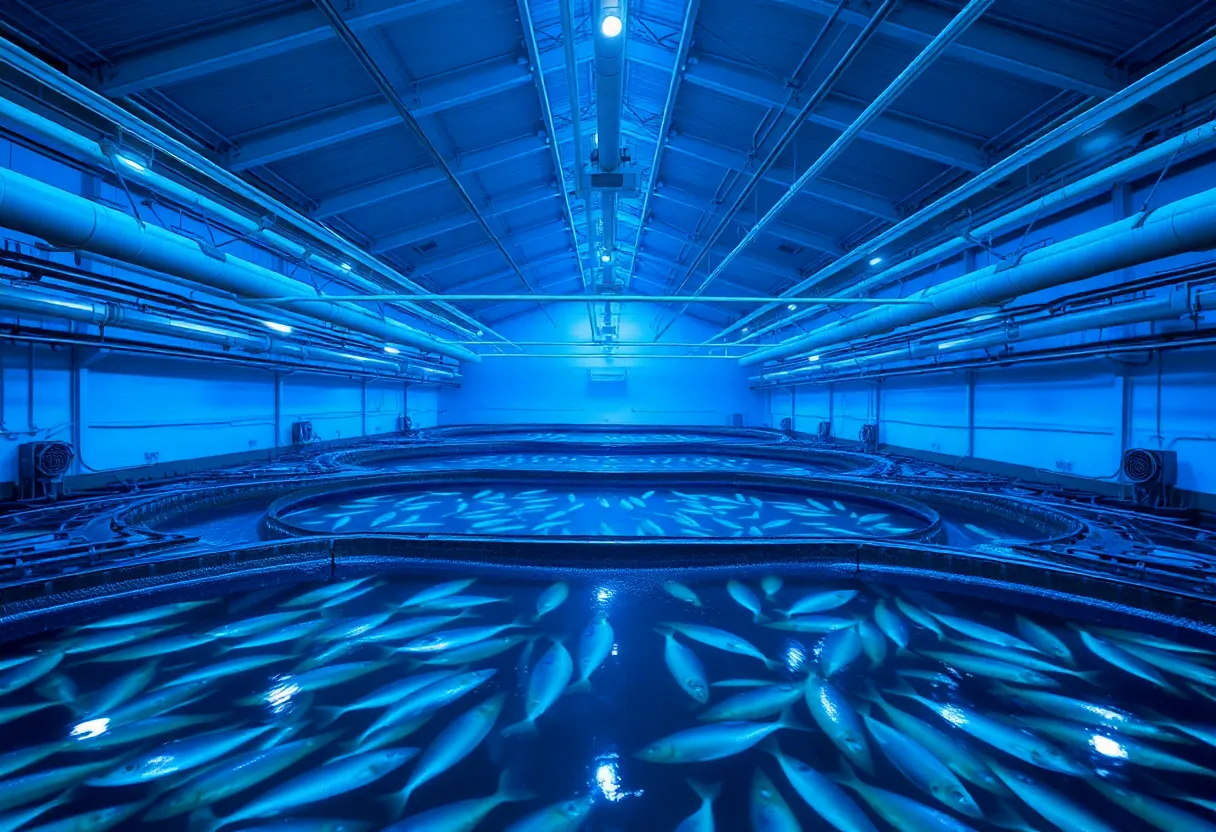
Land-based salmon farming runs on a system called recirculating aquaculture, or RAS, which continuously filters and reconditions the same water rather than flushing it through and discharging it, the way traditional flow-through fish farms operate. A RAS facility layers together mechanical filtration to remove solid waste, biological filtration where bacteria convert toxic ammonia excreted by the fish into less harmful compounds, degassing towers to strip out excess carbon dioxide, and oxygen injection systems to keep dissolved oxygen at the levels salmon need, all monitored continuously by water quality sensors that trigger automated adjustments faster than any human operator could manage manually.
This technology stack isn’t new — RAS systems have been used for decades in fish hatcheries and for growing smaller, less oxygen-demanding species. What’s new is the ambition to run full life-cycle salmon production, from egg to four-kilogram market-weight fish, entirely within a closed RAS system, rather than using RAS only for the early hatchery stages before transferring juvenile fish, called smolts, to traditional ocean pens for growout. Atlantic salmon are a genuinely difficult species to keep healthy at that scale in a closed system precisely because they evolved for open ocean conditions, and replicating that environment’s water chemistry stability at industrial density, inside a steel tank, turns out to be a much harder engineering problem than doing the same for hardier species like tilapia or barramundi.
Why Investors Found This Story So Compelling
The case for land-based salmon farming rests on several genuinely real advantages over ocean-pen aquaculture. Sea lice, a parasite that costs the traditional salmon farming industry hundreds of millions of dollars annually in treatment and lost growth, simply cannot establish in a closed system with no ocean water intake carrying wild lice larvae. Fish escapes — a recurring problem for ocean pens during storms, which can release farmed salmon that then interbreed with or spread disease to wild salmon populations — become essentially impossible in a sealed tank system. Seabed impact from concentrated fish waste, a major environmental criticism of traditional net-pen farming, disappears because waste is captured and treated within the facility rather than settling on the ocean floor beneath the pens.
There’s also a logistics argument that appealed strongly to investors: a RAS facility can theoretically be built near major population centers rather than requiring specific coastal geography, cutting transportation time and associated carbon footprint between farm and consumer, and allowing “locally grown” marketing claims in inland markets that have never had access to genuinely fresh salmon before. Companies including Atlantic Sapphire, which built a large-scale facility in Florida specifically to serve US East Coast markets without the transport time and cost of importing from Norway or Chile, made this logistics case central to their investor pitch.
Where It Has Actually Gone Wrong
The gap between the pitch and the operational reality has been significant, and it’s worth being direct about it because it illustrates a broader pattern in capital-intensive biological manufacturing ventures. Atlantic Sapphire’s Florida facility, one of the most closely watched land-based salmon projects globally, experienced multiple serious fish mortality events after opening, including a 2020 incident where the company reported losing roughly 200,000 pounds of fish, and further significant mortality events in subsequent years tied to water quality management issues during scale-up. The company’s stock, listed on the Oslo exchange, lost the large majority of its value from its post-IPO highs as these operational problems became public and repeated.
The underlying pattern across multiple land-based salmon ventures has been consistent: RAS technology works well and is well proven at smaller scale and for shorter portions of the salmon life cycle, but scaling a fully closed system up to the tank sizes and fish densities needed for commercially viable full-cycle production introduces water chemistry management challenges that are genuinely difficult to predict from smaller pilot-scale operations. A biofilter that maintains stable water chemistry at one density and tank volume does not necessarily scale linearly and predictably to ten times that volume — biological systems tend to have less forgiving failure modes at scale than purely mechanical ones, because a cascading water-quality problem can kill an entire tank’s population within hours once certain thresholds are crossed, in a way that a mechanical equipment failure in a simpler industrial process typically would not.
Norwegian company Nordic Aquafarms, another prominent player pursuing full-cycle RAS salmon in the US and pursuing similar projects in Norway, has faced its own scaling delays and cost overruns, and has been notably more conservative than some competitors about public production timelines after watching peers announce ambitious dates that then slipped repeatedly. Industry analysts covering the sector have increasingly noted that the companies moving more cautiously, phasing scale-up gradually and building in more redundancy for water treatment systems even at higher upfront capital cost, appear to be managing the biological risk more successfully than the ones that tried to reach full commercial scale in a single large step.
The Economics Nobody Fully Solved Yet
Even setting aside the mortality events, the underlying unit economics of land-based salmon remain genuinely challenging to make work at a price point competitive with traditional net-pen production. RAS facilities require enormous upfront capital investment in tanks, filtration equipment, and energy infrastructure — energy costs for pumping, filtration, and often supplemental heating or cooling to maintain optimal water temperature represent a much larger ongoing operating cost than traditional ocean farming, which gets its water conditioning essentially for free from the surrounding ocean.
This means land-based salmon has to command a price premium over traditionally farmed salmon to be profitable, and that premium has to be justified to consumers and retailers on attributes — freshness from proximity, lower environmental footprint, no antibiotic or lice-treatment use — that not every buyer is willing to pay extra for, particularly in a category where price sensitivity is already high and traditional Norwegian and Chilean salmon supply chains have decades of efficiency refinement behind them.
Where the Model Is Actually Working Better Than the Headlines Suggest
It’s worth noting that the difficulties at the most ambitious full-cycle, largest-scale projects have somewhat overshadowed quieter successes in more modest applications of the same underlying technology. Hybrid models, where RAS handles the early hatchery and smolt-growing stages before fish are transferred to traditional ocean pens for the final growout phase, have expanded significantly and with far fewer dramatic failures, because that approach only asks RAS technology to do the part of the job it has the longest, most proven track record doing. Norwegian regulations actually pushed the industry in this direction by requiring longer land-based smolt-rearing periods specifically to reduce the time young fish spend in ocean pens vulnerable to sea lice, and that regulatory nudge has driven real, successful RAS capacity expansion across the traditional salmon farming industry, even as the more ambitious full-cycle land-based ventures struggled.
Smaller-scale full-cycle RAS operations focused on premium, smaller regional markets — rather than trying to compete at commodity volume and price against the entire traditional industry — have also shown somewhat steadier, if less headline-grabbing, results, suggesting the technology may find its most durable near-term home in smaller, carefully managed facilities rather than the massive scale that drew the biggest investment rounds and generated the most public attention.
What This Means for the Technology’s Future
Land-based salmon farming is not a failed technology — the underlying engineering works, and the environmental and logistics case remains genuinely compelling. What the last several years of real-world deployment have demonstrated is that the biological risk of scaling closed aquatic systems was significantly underestimated relative to how well-understood mechanical and chemical engineering risk in other industrial contexts tends to be. The companies and investors still active in this space appear to be recalibrating around more conservative scale-up pacing, more redundant water treatment engineering, and in some cases a strategic retreat from full-cycle ambitions back toward the hybrid model that traditional aquaculture has already proven works. Whether land-based, full-cycle salmon farming eventually becomes a mainstream production method or remains a smaller niche within a still-ocean-dominated industry will likely be decided less by any single technology breakthrough and more by how patient the capital backing these ventures is willing to be while the industry works through exactly this kind of expensive, humbling scaling lesson.