The Engineering Behind Modern Submarine Cables That Carry the Internet

Kofi Asante
July 7, 2026
Approximately 95% of all international internet traffic travels through submarine cables—thin strands of glass fibre stretched across ocean floors, carrying hundreds of terabits per second between continents. Satellites handle the margins: remote regions, maritime communications, and contexts where the cable infrastructure doesn’t reach. The cables are the internet’s actual backbone, a physical infrastructure as critical to global communication as any other piece of engineering, and significantly less discussed than the software and services that run over them.
Understanding how they work—technically, economically, and geopolitically—illuminates both the engineering achievement they represent and the vulnerabilities they embody.
The Cable Structure
A submarine cable is a fibre optic cable engineered specifically for the deep ocean environment: long-term immersion in seawater, extreme pressure at depths reaching 8,000 metres, physical protection from anchors, fishing trawls, and other hazards in shallow water, and the need to carry electrical power to the amplifiers and repeaters distributed along the cable length.
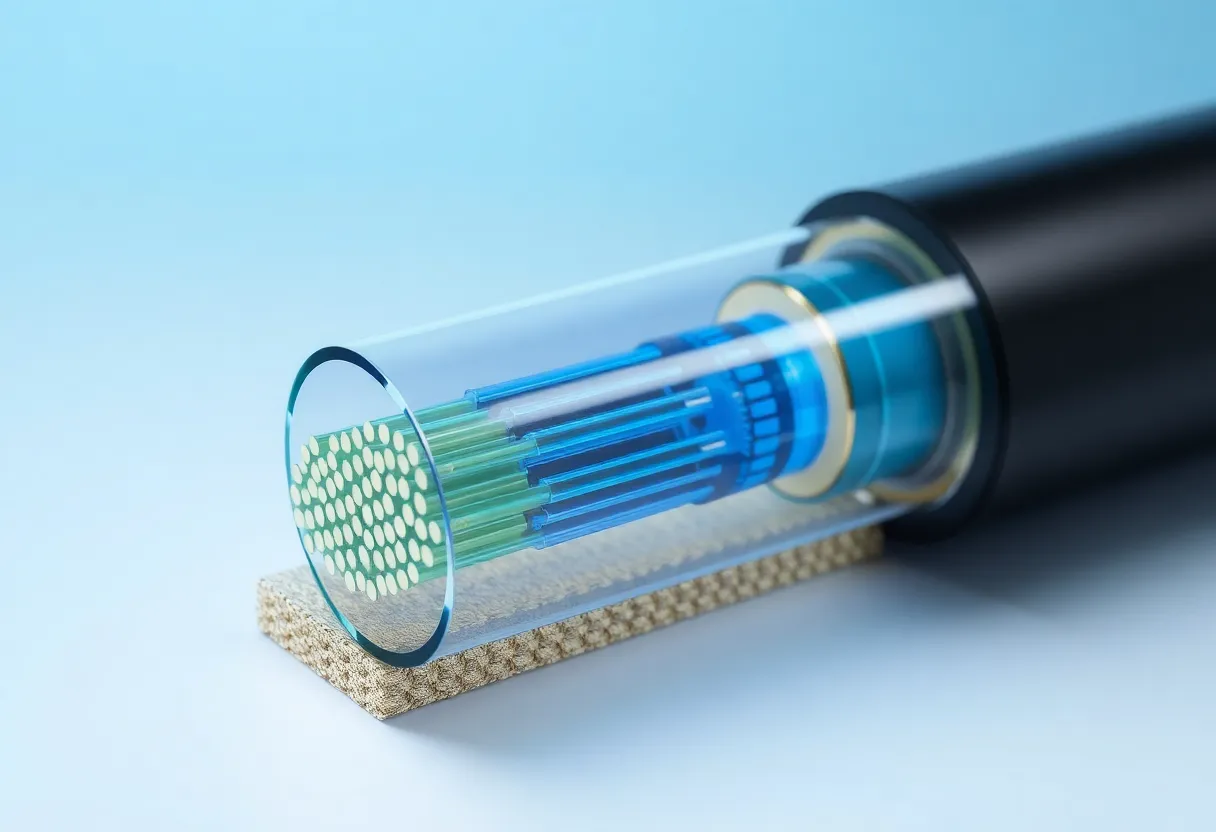
Working from the inside out, a modern submarine cable contains the fibre pairs at its core—multiple pairs of single-mode optical fibres, each pair capable of carrying multiple wavelength-division multiplexed channels. Modern cables deploy 8–16 fibre pairs; each pair can carry terabits per second through wavelength-division multiplexing, giving a complete cable total capacity in the hundreds of terabits per second range.
The fibres are bundled and surrounded by a steel strand core that provides tensile strength—the cable must be strong enough to support its own weight when being laid or lifted from depth. Around this is a polyethylene inner sheath and copper tube that serves as the power conductor, carrying the high-voltage DC current (typically 5,000–15,000 volts at a few amperes) that powers the optical amplifiers distributed along the cable every 50–100 km.
The copper tube is surrounded by more polyethylene insulation, and in shallow-water sections (roughly the first 1,000 metres from shore, where physical hazards are greatest), additional layers of steel wire armour provide protection against anchors and fishing gear. In deep water, where physical threats are minimal, cables are much thinner—roughly the diameter of a garden hose—because armour isn’t needed at depth, where the pressure itself holds the cable against the seabed.
Optical Amplification Over Thousands of Kilometres
Light signals in optical fibre attenuate with distance: after roughly 100 km of cable, the optical signal has weakened enough to require regeneration. Early submarine cable systems used electronic regenerators that converted optical signals to electrical signals, processed them, and retransmitted them—a complex, reliability-critical process that required separate regeneration for each data channel.
Modern cables use erbium-doped fibre amplifiers (EDFAs), which amplify the optical signal directly without converting to electrical form. EDFAs work by splicing a short section of erbium-doped fibre into the signal path and pumping it with a laser at a specific wavelength; the erbium ions in the doped section amplify passing optical signals through stimulated emission. The pump laser is powered by the electrical current transmitted through the cable’s copper conductor.
The EDFA approach allows all wavelength-division multiplexed channels to be amplified simultaneously with a single device, rather than requiring separate amplification for each channel. This is the critical enabler of high-capacity wavelength-division multiplexing over transoceanic distances—the same amplifier that served a 10 Gbps cable in 1996 can be upgraded by adding more wavelength channels on the same fibre without replacing the repeater hardware.
Cable Laying and Route Planning
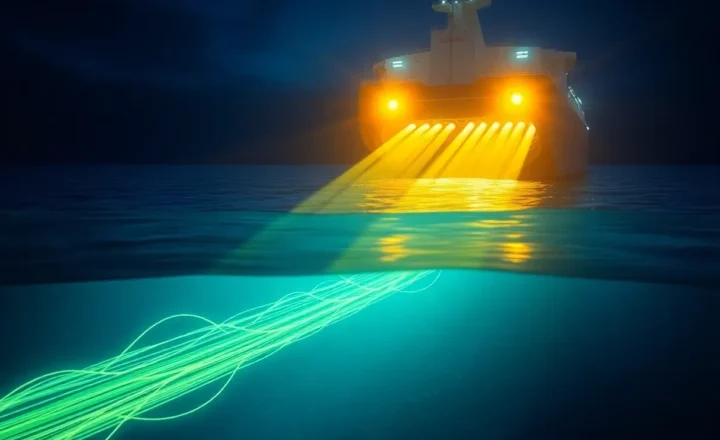
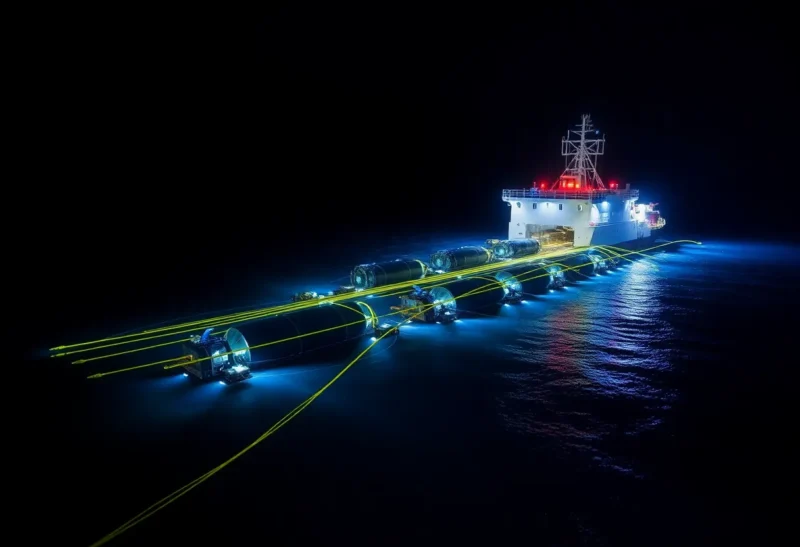
Deploying a submarine cable involves a purpose-built cable ship that stores the cable in large tanks, pays it out through a linear cable engine that controls the rate of lay to match the ship’s speed, and uses a plough in shallow water to bury the cable against anchor and trawl damage. The route is surveyed in advance using submersibles and multibeam sonar to map the seabed and identify hazards: submarine landslides, tectonic fault zones, fishing grounds, and shipping anchorage areas that would put the cable at risk.
A typical transoceanic cable takes 6–12 months to lay and requires 2–3 cable ships working simultaneously on different segments. The total length of cable stored and deployed exceeds the great-circle distance between endpoints because the cable follows the seabed topography rather than a straight-line path, requires slack for movement and future repairs, and must be routed around hazards.
Cable splicing at sea—joining cable segments, installing repeaters, and connecting branching units—is precision work performed in a controlled environment on the cable ship deck, with skilled technicians handling fibre connections that must maintain signal integrity over 10,000+ km cable lengths. A misaligned fibre splice would degrade the signal budget of the entire cable.
Failures and Repairs
Submarine cables fail at a rate of roughly 100 faults per year globally across the roughly 400 active cables and 1.3 million km of fibre in service. The majority of faults occur in shallow water (less than 200 metres depth), where cables are exposed to fishing gear, anchors, and in some cases intentional damage. Deep water faults—caused by submarine landslides, tectonic events, or equipment failure in repeaters—are less frequent but more difficult to repair.
Repairing a submarine cable fault involves deploying a cable ship to the fault location, using an acoustic or optical reflectometry measurement to locate the break precisely, cutting the cable with a grappling cutter, raising the cable ends to the ship surface, splicing in a replacement section, and laying the repair section back to the seabed. A deep-water repair can take 2–3 weeks from fault detection to cable restoration, during which traffic is rerouted to other cable systems.
The 2022 Tonga volcanic eruption and the associated tsunamis severed the single submarine cable connecting Tonga to the global internet, cutting the country off from international connectivity for several weeks until repair ships arrived. This incident illustrated both the vulnerability of island nations dependent on single cable systems and the timeframes involved in submarine cable repair when the cable ship must transit from distant locations.
Economics and Ownership
A modern high-capacity transoceanic submarine cable costs $200–500 million to build and deploy. Historically, cables were built by consortia of telecommunications carriers who each took capacity proportional to their investment. The funding model has shifted dramatically: major technology companies—Google, Meta, Amazon, Microsoft—now fund a substantial fraction of new submarine cable construction, either through dedicated cables (Google’s Curie, Dunant, and Grace Hopper cables; Meta’s 2Africa cable) or as anchor investors in consortium cables.
The technology company investment reflects the economics of their traffic patterns: these companies generate and receive a disproportionate fraction of global internet traffic, making the capacity and routing of submarine cables a direct business infrastructure concern rather than something they can depend on carriers to provide at adequate quality and cost.
The geographic concentration of submarine cable landing stations and the chokepoints created by the necessity of routing all traffic between major continents through a limited number of cable systems create geopolitical and security vulnerabilities that have attracted increasing attention from governments. Several cable cut incidents near sensitive locations have been attributed to deliberate interference. The limited number of entities capable of building, deploying, and repairing submarine cables—primarily ASN Alcatel Submarine Networks, SubCom, and HMN Technologies—has also become a supply chain security concern as geopolitical competition intensifies.