How Noise-Canceling Technology Actually Works—And Where It Still Fails

Soren Bell
July 7, 2026

Active noise cancellation is one of the most genuinely impressive features in consumer electronics — the ability to effectively silence a jet engine, train, or open-plan office while wearing headphones seems almost implausible when you first experience it. It’s also one of the most misunderstood technologies in terms of what it actually does, why it works well in some environments and poorly in others, and why the specs and marketing claims don’t always predict real-world performance.
Understanding how ANC actually functions helps set appropriate expectations, explains the specific scenarios where it excels, and clarifies why certain types of noise remain challenging for even the best current ANC systems.
The Physics: Anti-Phase Sound Cancellation
Sound travels as pressure waves — alternating compressions and rarefactions in air. When two sound waves of equal frequency and amplitude arrive at the same point 180 degrees out of phase with each other (where one wave’s compression coincides with the other’s rarefaction), they cancel each other destructively. No pressure variation means no sound. This is the physical principle behind ANC.
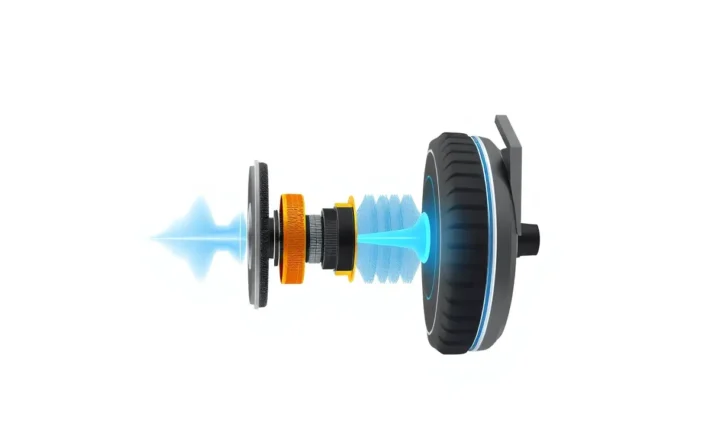
An ANC headphone has microphones (typically both on the outer ear cup, facing outward to pick up ambient sound, and on the inner surface near the ear) that continuously sample the noise environment. The ANC processor analyzes this signal and generates an anti-phase signal — a mirror image of the incoming noise — which the headphone’s drivers play simultaneously with any music. Where the anti-phase signal and the ambient noise meet (inside the ear cup), they cancel, producing a quieter environment.
The microphone-to-processor-to-driver loop must operate fast enough that the anti-phase signal arrives at the ear at the right moment to cancel the noise — latency in the ANC system directly reduces cancellation effectiveness. Modern ANC systems process this loop in microseconds, which is fast enough to handle low-frequency noise effectively. The latency constraint is why ANC works better on low frequencies (where wavelengths are longer and the timing window for cancellation is larger) than on high frequencies.
Why ANC Excels at Some Noise and Struggles With Others
ANC effectiveness is highly frequency-dependent, and this explains the consistent pattern in how users experience it. Low-frequency, continuous, and predictable noise — aircraft cabin rumble (typically 50–250 Hz), HVAC hum, train rumble, road noise — is exactly what ANC handles best. These sounds have long wavelengths (making the timing requirements for anti-phase cancellation easier to meet), consistent patterns (making prediction and modeling more accurate), and are the dominant noise component in travel environments where ANC became popular.
Higher frequency noise is harder to cancel for two reasons. Shorter wavelengths make timing precision more critical — a small error in the anti-phase timing that doesn’t matter at 100 Hz matters significantly at 3,000 Hz. And high-frequency noise is more directional and spatially variable, meaning the noise captured by the microphone on the outside of the ear cup may differ from what arrives at the ear through different paths, making the anti-phase calculation less accurate for what actually reaches the ear.
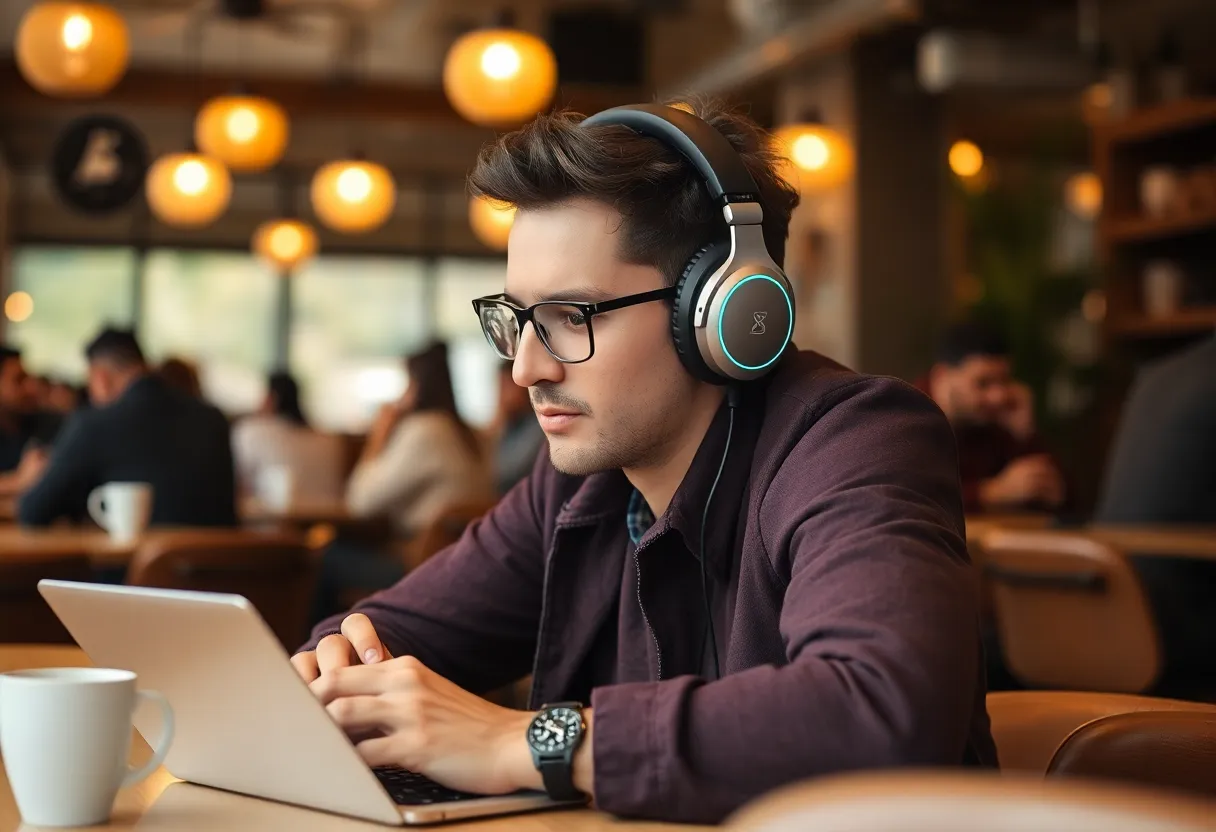
Human speech sits in the 300–3,000 Hz range, which is exactly the range where ANC transitions from very effective to moderately effective. This is why ANC dramatically reduces aircraft roar but leaves voices and conversation partially audible. A colleague speaking to you from across an office is partially attenuated by ANC; a jet engine at altitude is nearly eliminated. Users who expect ANC to silence a noisy open-plan office are often disappointed because the voice frequencies that constitute the most distracting noise are precisely the frequencies where ANC is least effective.
Transient noise — sudden, unpredictable sounds like a door slamming, keyboard clicks, or a phone ringing — is also difficult for ANC systems because the predictive modeling doesn’t have time to adapt before the sound arrives and passes. ANC works on the assumption that the noise environment is somewhat consistent and predictable over the microseconds of processing time; transient sounds by definition violate this assumption.
The Passive Isolation Component
A critical but often underappreciated element of noise reduction in ANC headphones is passive isolation — the physical blocking of sound by the ear cup seal and padding. Even the best ANC headphones provide both active cancellation and significant passive isolation, and for high-frequency noise, the passive isolation is doing the heavier lifting.
This is why over-ear headphones with firm, well-sealed earcups generally provide better total noise reduction than in-ear ANC earbuds, even if the earbuds have technically more advanced ANC processing. The larger ear cup creates better passive isolation, and the combined effect of passive plus active isolation beats active-only in practical use. It’s also why well-fitting foam ear tips on in-ear earbuds improve ANC performance significantly — better passive seal means the ANC system has less work to do and performs better in its effective frequency range.
When headphone reviews test ANC “passively off” by covering or blocking the ANC microphones, the passive isolation of the earcup design itself is often significant — many over-ear headphones provide 15–25 dB of passive attenuation before any active processing. Understanding that passive isolation is part of the total noise reduction equation helps explain why ANC performance varies with fit and why some headphones outperform others despite similar ANC chipsets.

Where Current ANC Technology Actually Performs Best
The performance sweet spot for modern ANC headphones (Sony WH-1000XM5, Bose QuietComfort 45/Ultra, Apple AirPods Max, Bose QC Earbuds II) is: aircraft cabins, train journeys, subway commutes, car travel, and sustained HVAC noise in offices or coworking spaces. In these environments, modern flagship ANC can reduce ambient noise enough that you either don’t need music playing, or the music volume required for a comfortable listening experience is substantially lower than without ANC.
The measured performance difference between 2019 and 2026 flagships in these environments is real. The Sony WH-1000XM3 through XM5 progression shows measurable improvement in low-frequency cancellation and in the mid-range frequencies where earlier systems struggled most. Adaptive ANC — systems that adjust their anti-phase response to the current noise environment in real time rather than using a fixed filter — is now standard in flagship headphones and provides better performance across varying noise environments than older fixed-filter approaches.
Where ANC still won’t satisfy users who expect it to create silence: open-plan offices with multiple conversations, cafes and restaurants with background music in addition to voices, high-frequency noise sources (HVAC with a high-pitched component, computer fans close to the ear), and highly variable noise environments where the predictive model can’t stabilize. For these situations, the combination of ANC and passive isolation is useful but not transformative; in-ear earbuds with well-fitted foam tips may actually outperform over-ear headphones in some of these scenarios because their passive isolation is more effective at the mid-range frequencies where voices live.