Edge Inference on Raspberry Pi 5: Thermal Reality vs Marketing Slides

Jade Wu
April 8, 2026
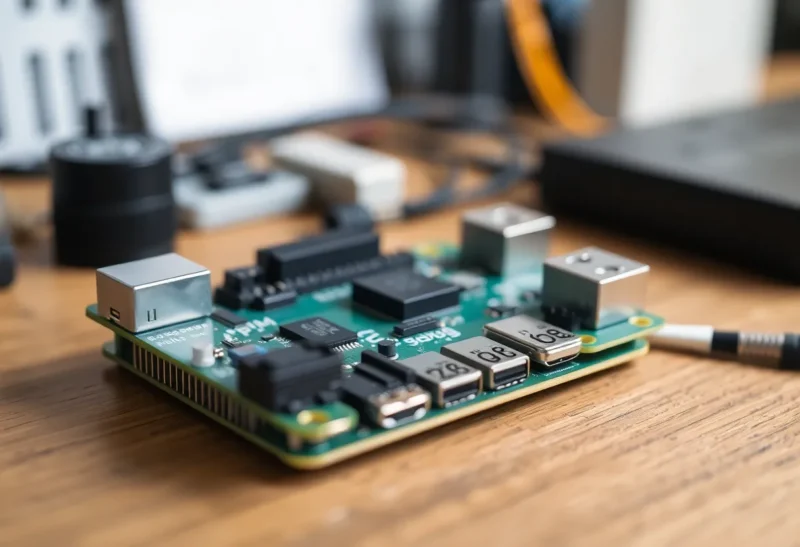
Slide decks love “edge AI on Raspberry Pi.” The hardware sitting on your bench loves to throttle when you actually run a transformer at anything resembling useful batch sizes. Raspberry Pi 5 is a serious leap for general-purpose Linux and I/O; it is still a watt-bounded ARM SBC, not a GPU server wearing a hobbyist disguise. This article separates thermal reality from marketing: what runs well, what runs only after quantization and prayer, and when you should buy an Orange-sized NUC instead of another heatsink.
We will talk about CPUs, not fairy dust. If you need a spiritual pep talk about “democratizing AI,” read a manifesto; if you need shipping advice, stay here. Bring measurements; skepticism welcome. If something here stings, it is probably saving you a month of thermal debugging.
What Pi 5 is genuinely good at
For lightweight inference—vision models slimmed to a few hundred megabytes, keyword spotting, classical ML, signal processing pipelines—the Pi 5’s CPU performance and memory bandwidth are a meaningful upgrade over Pi 4. You can serve ONNX Runtime or TensorFlow Lite models with respectable latency if you stay inside the envelope: small input tensors, int8 weights, and batch size one.
Developer experience matters too: PCIe opens doors to accelerators (with caveats), USB 3 handles cameras and storage, and the ecosystem means your prototype can become a field trial without a firmware team.
Pi 5 also improves the RAM ceiling versus older generations, which matters more for certain model formats and intermediate activations than raw GHz numbers suggest. Still, this is DDR4-class memory on a modest TDP budget—do not confuse it with workstation bandwidth.
Latency percentiles beat average FPS
Benchmarks love reporting mean inference time. Production cares about p95 and p99 when a vision pipeline triggers a safety interlock or a voice command wakes a device. Thermal throttling and background tasks turn pretty averages into tail latency spikes. Your test harness should include CPU contention—network stack, logging, systemd timers—because the field will.
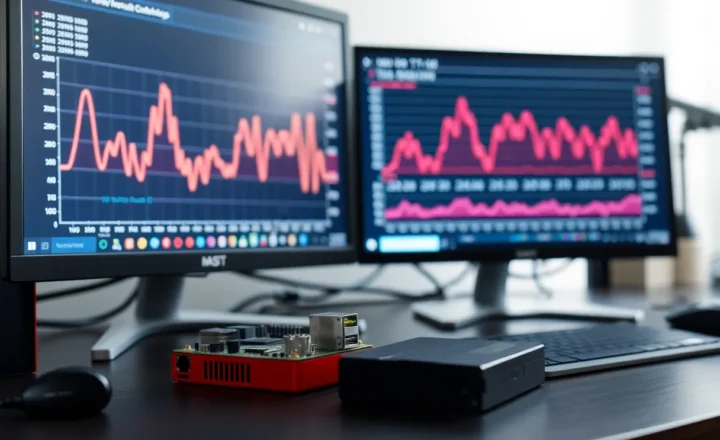
Also log temperature curves alongside latency. A spike that correlates with fan ramp or SoC junction temp tells you to fix cooling, not rewrite kernels. Correlation beats superstition.
Where marketing overshoots
“Run LLMs locally” is true in the same sense that a bicycle can cross a continent. The 8 GB version of that demo is Pi 5 local LLM versus the marketing slides. People do it; it does not mean you will enjoy the trip at production SLAs. Large language models on CPU-only ARM boards spend their time memory-bound and thermally stressed. You might achieve a few tokens per second on quantized small models—useful for demos, brutal for interactive assistants unless your UX tolerates latency.
If your product vision depends on sub-second multimodal responses, plan hardware accordingly. The Pi can be the glue that aggregates sensors and calls cloud APIs; it may not be the place the giant model lives.
Consider hybrid architectures: tiny local models for filtering and triggering, heavier models in the cloud or on a local x86 box with a GPU. The Pi becomes an orchestrator—still “edge,” still valuable—without pretending to be a datacenter.
Thermals: the silent spec
Passive cooling can work for bursty loads in ventilated enclosures. Sustained inference is not bursty. Active cooling—quality heatsink-fan combos or well-designed cases with ducted airflow—buys clock stability. Throttling shows up as jitter in latency percentiles exactly when customers notice.
Measure with stress-ng plus your model server, not idle temps. Watch for throttling flags in kernel logs. If your enclosure is IP-rated outdoors, derate expectations hard: sun + sealed box + AI is how you cook berries.
Thermal mass helps short demos; sustained duty cycles need airflow. If your product cannot tolerate fan noise, budget for larger heat spreaders, lower clocks, or fewer inferences per second. Physics does not negotiate.
Power delivery is part of performance
Undervoltage from cheap cables or marginal USB-C supplies causes reboots that look like software bugs. Budget for a known-good PSU. If you hang multiple peripherals, account for USB current—not every hub is honest.
Also plan for brownouts in industrial settings where motors kick on and voltage droops. A UPS or supercap board might sound dramatic; so is a false negative on a safety model because the board reset mid-inference.
Software stack choices that actually matter
Use runtimes that respect ARM: ONNX Runtime with the right execution providers, TFLite with XNNPACK, OpenCV with NEON-friendly builds. Avoid “works on my x86 laptop” Docker images that silently fall back to slow paths.
Quantize aggressively for edge; validate accuracy on your real inputs afterward. Nothing substitutes for a labeled test set from your cameras or microphones.
If you ship Python, mind interpreter overhead and the GIL for multithreaded serving. Sometimes a thin C++ wrapper around the hot path pays rent immediately. If you ship Node, remember FFI costs when crossing into native libraries. Profilers are cheaper than lore.
Containerization is convenient; it can also hide CPU feature flags and SIMD paths. Profile inside the same container you ship. A “small” performance gap between laptop and Pi might be 5× when NEON paths fail to activate.
Accelerators: HATs, USB, and PCIe reality
Neural accelerators can help if your toolchain supports them end-to-end. Budget engineering time for driver integration, firmware updates, and thermal stacking. A HAT that runs hot next to the SoC may require mechanical creativity.
USB accelerators are easier to swap but contend on the same bus as cameras. PCIe devices can win on bandwidth yet complicate enclosure design. There is no free lunch—only trade-offs you document.
Security and supply chain
Edge devices sit in hostile physical environments. Secure boot where possible, verify model weights with checksums, and plan for key rotation. A stolen Pi with your model file is a different problem than a stolen API key, but both deserve threat modeling.
Also track component availability. Pi shortages taught everyone about allocation. If your BOM assumes one exact board revision, have alternates or a modular carrier strategy.
When Pi is the wrong tool
Heavy video analytics at high frame rates, large-batch offline training, or models that need CUDA ecosystems belong in different hardware. The Pi shines when cost, size, and Linux flexibility beat raw TOPS.
If your pipeline needs decoding many HD streams concurrently, test CPU load from video ingest separately from model inference. Demuxing and scaling frames can steal watts before the first conv layer runs.
Also be honest about throughput maintenance: will this device sit in a closet untouched for years, or will someone update models monthly? If the latter, invest in remote diagnostics and a repeatable deployment pipeline now—not after your fleet is scattered globally.
Operational truths for prod
Ship with remote logging, watchdog timers, and a plan to replace SD cards with reliable storage if you write a lot. Edge inference without observability is a demo; production needs health metrics and rollback.
Automate firmware updates with staged rollouts; a bad kernel or library can silently tank inference accuracy. If you cannot roll back quickly, you do not have edge—you have a fragile ornament.
Cost math: engineer time vs silicon
A cheaper board that costs three weeks of integration is not cheaper. Sometimes stepping up to an x86 mini PC with a known GPU tier saves calendar time and support tickets. Pi wins when your software stack is already ARM-friendly and volumes justify tuning.
Write down the acceptance test you will show a skeptical colleague: frames per second, wattage at the wall, worst-case temperature after thirty minutes, and accuracy on a held-out set. If you cannot pass that test on the bench, no amount of marketing adjectives will help in the field. Rehearse the demo with the enclosure closed, not open-air, because nobody runs production with the lid off for long.
Bottom line
Raspberry Pi 5 is a capable edge Linux node for right-sized models and honest about watts when you are honest about cooling. Treat marketing slides as inspiration, thermals as the contract, and you will ship something that survives the summer—not just the conference booth.
Before you freeze hardware, prototype the full pipeline on a desk with the same camera modules, same resolution, same night-time noise profile you expect in deployment. Surprise: preprocessing eats half your budget; surprise: your model was never the bottleneck.
Document your environmental limits: ambient temperature range, orientation (vertical boards shed heat differently), and whether the customer can hear a fan. Those constraints belong in the same appendix as accuracy metrics.
If you walk away with one habit, make it thermal profiling under load with the final enclosure—not the open bench where everything feels possible. The slide deck lives in air conditioning; your product might not.
Pi 5 can absolutely be the right brain for an edge device—just pair it with modest models, honest expectations, and a cooling story that would survive peer review from a mechanical engineer, not only a software demo.
Edge AI is not magic; it is thermodynamics plus software discipline. Raspberry Pi 5 gives you a flexible place to practice both—if you refuse to let a slide deck do your thinking for you. Bring a thermometer and a skeptic; leave the fairy tales at home.