Blue Origin vs SpaceX for Lunar Logistics: What 2026 Contracts Actually Fund

Robin Hayes
April 7, 2026

Headlines love a horse race: which company “wins” the Moon. The budget reality is messier. NASA’s lunar program is a portfolio of vehicles, services, and international obligations — cargo landers, crew landers, space station modules, science payloads — each with different risk profiles and payment schedules. In 2026, comparing Blue Origin and SpaceX is less about aesthetics of rocket plumbing and more about what specific contract lines pay for: integration labs, propellant demos, launch cadence, and the unglamorous paperwork that keeps astronauts from becoming statistics.
This article separates lunar logistics into understandable buckets, maps how two radically different corporate cultures pursue them, and clarifies what public money is actually buying right now — not what social media wishes were true.
Nothing here is classified tea-leaf reading; it is a framework for interpreting public programs the way program offices do — as chains of evidence that hardware can be operated safely, repeatedly, and in concert with international partners who also have taxpayers at home asking questions.
Two philosophies: incremental landers vs deep-space trucks
SpaceX’s Starship architecture is designed as a general-purpose, high-mass system. Lunar variants hinge on solving orbital refueling, rapid reuse, and an enormous vehicle that can serve Earth orbit, the Moon, and eventually Mars advocacy slides. Blue Origin’s lunar stack — anchored around the Blue Moon lander family and New Glenn lift capacity — targets a more modular, incrementally expanding cargo and crew story tied closely to NASA’s stepwise Artemis milestones.
Neither approach is “science” versus “engineering.” Both are engineering with different gambles. Starship bets that solving big reusable stages collapses marginal cost per kilogram to the surface. Blue Moon bets that pairing a heavy orbital launcher with dedicated lander hardware matches agency oversight rhythms and creates a predictable path for cargo precursors before crew tempo rises.

What “lunar logistics” means in procurement language
Logistics is not a single medal event. Break it into layers:
- Cargo delivery — Rovers, experiments, habitat subsystems, consumables that do not need human pilots on the way down.
- Crew landing and ascent — Human-rated environments, abort philosophy, comms, and surface EVA interfaces.
- Orbital transfer and staging — Tug functions, propellant storage, navigation assets that turn “launched” into “inserted into useful lunar orbit.”
- Sustainment — Spares, recurring flights, ground software updates, and the contractual incentives that keep vendors honest after first success.
Public contracts rarely buy a glossy render; they buy milestones: tests, analyses, hardware deliveries, and safety artifacts. When you read a dollar figure attached to a company name, translate it into milestones or you will misunderstand who is “ahead.”
Where NASA puts dollars in the mid-2020s
Human landing systems and commercial lunar payload services sit in different offices with different rules. CLPS-style cargo missions reward speed and tolerance for risk on robotic deliveries; human-rated landers drag heavier certification burdens. A vendor can excel at one lane while still climbing the learning curve in another.
By 2026, much of the visible spending flows into integrated lander tests, propulsion qualification, avionics labs, and contractor workforces that do not tweet. Delays are often integration delays — interfaces between NASA ground systems, international partners, and flight software — not merely “rocket late.”
Think of CLPS as the program where NASA effectively says: “We will buy delivery attempts to the surface with explicit risk posture.” Some landings will fail in spectacular ways; the contract structure acknowledges that. Human systems cannot absorb the same failure rate, which is why dollars migrate into verification, safety releases, and the long tail of documentation that turns hardware into a flight rationale. When you see anger online about “slow bureaucracy,” remember the alternative is a society that accepts crew loss as a routine cost of iteration — which NASA, rightly, refuses.
Propellant, depots, and why “logistics” starts in Earth orbit
For Starship-class architectures, lunar logistics begins long before translunar injection. Orbital refueling — however the agency phrases it in a given procurement — is not a footnote; it is the hinge that converts a huge vehicle into a Moon-capable vehicle without inventing impossible single-launch mass fractions. Dollars here fund cryogenic handling experiments, quick-disconnect interfaces, ground simulators, and the procedural choreography of moving propellant between stages without turning low Earth orbit into confetti.
For lander-centric architectures that lean on conventional translunar injection, the orbital story is different but not absent: upper stages, coast phases, navigation updates, and comm handoffs all show up in milestone payments. The public often tracks only “rocket flies,” while engineers track propellant margin envelopes that would bore anyone not paid to worry about them.
Blue Origin’s lane: cargo precursors and methodical scaling
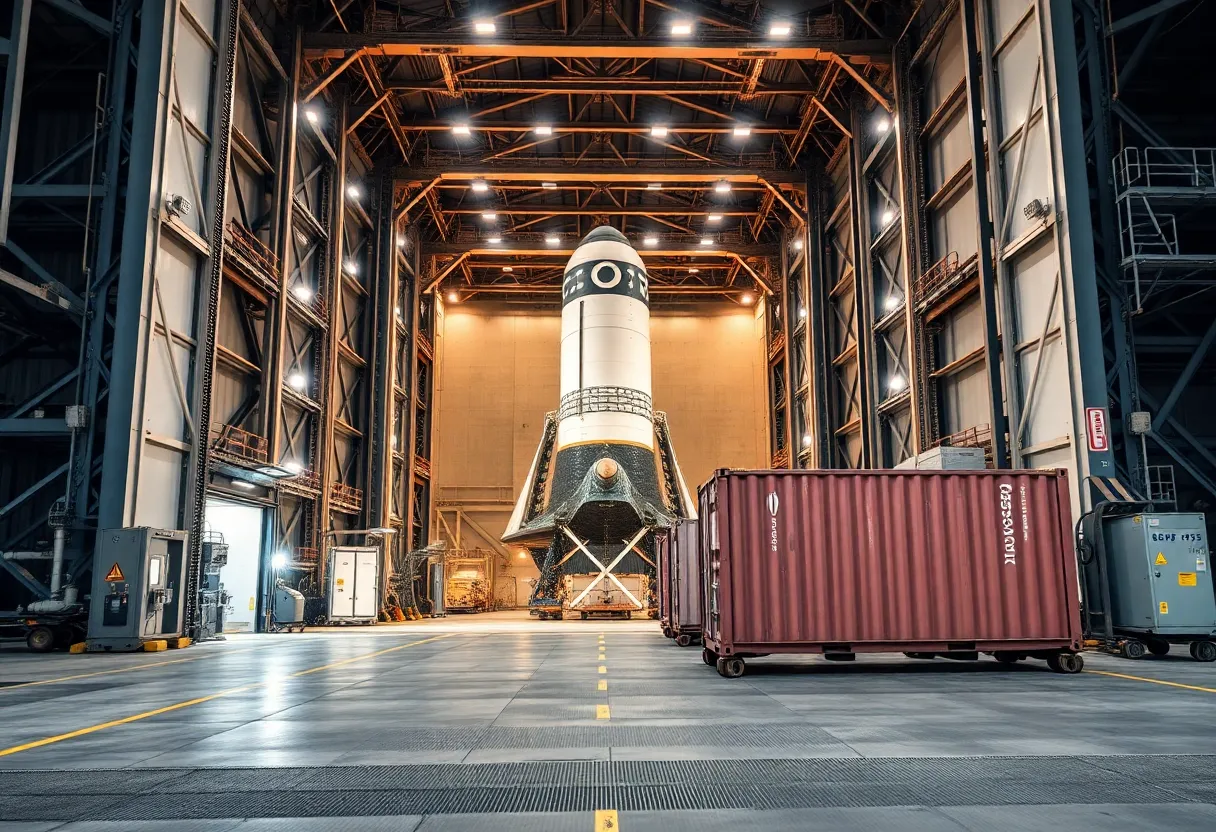
Blue Moon’s story aligns with a NASA comfort narrative: dedicated lander prototypes, cargo capacity that can precede crew, and a launcher (New Glenn) intended to close the loop between Earth orbit and translunar injection without relying on a patchwork of smallest-possible rockets. Critics point to schedule history; supporters point to the value of lander-focused engineering when every kilogram to the surface is negotiated.
What contracts fund here is often structure — load paths, tankage, engines, guidance — repeated until the agency believes the vehicle is real enough to bet lives on. Cargo precursors buy down risk for crew versions even when headlines only count human flights.
SpaceX’s lane: Starship iteration and sheer throw mass
Starship’s lunar role leans on enormous capacity: fewer excuses about leaving science instruments behind, more room for redundancy, and a development style that flies prototypes aggressively. The trade is complexity: refueling, thermal management, and landing solutions that must work in multiple environments.
Dollars show up as steel, Raptor iterations, launch site infrastructure, and a test cadence that is publicly visible — which paradoxically makes failures look louder even when they are part of the plan. For lunar logistics specifically, much of the funding story is proving the orbital depot steps that make a giant ship relevant to the Moon at all.
International partners and the hidden coupling
Lunar surface logistics is not a duopoly. Gateway logistics, ESA contributions, Canadian robotics, and emerging commercial entrants stitch into NASA’s schedule. A delay in one element becomes a scheduling constraint in another. When comparing two U.S. companies, remember the choreography: your favorite lander still has to play nice with comm relays, surface suits, and surface rendezvous concepts that are still maturing.
Politics, budgets, and why multi-vendor strategies persist
Congressional funding is not a physics equation. Maintaining more than one approach to lunar access is sometimes engineering prudence — avoiding a single point of failure — and sometimes political durability: spreading work across districts and ensuring a setback in one program does not zero out U.S. lunar capacity. That reality shows up as parallel contracts even when pundits demand a “pick a winner” narrative.
For readers, the practical takeaway is simple: duplication is expensive, but so is monopoly risk when lives and decades of international trust are on the line. The “waste” you perceive may be the premium on optionality.
Surface logistics after touchdown: the part fans skip
Landing is the movie scene; surface logistics is the sequel. Rovers need charging windows. Science instruments need placement and cable runs. Habitats need berthing and thermal regulation. Cargo manifests must survive vibration without turning screws into shrapnel. Contract dollars fund simulations of offloading, human factors studies for gloves in dust, and the mundane mechanical engineering of ramps and tie-downs.
When comparing vendors, ask whether their architecture assumes abundant mass margin for spares and workarounds, or tight mass budgets that punish late design changes. Both can work; they imply different operational cultures on the Moon.
How to read 2026 pronouncements without losing the plot
- Watch for milestone verbs — “completed,” “qualified,” “delivered,” versus “targeted” or “anticipated.”
- Separate demo from operations — A spectacular test is not the same as a sustainment contract.
- Track recurring cadence — Logistics wins when the second flight is boring.
Also notice who signs the press release. A vendor update is not the same as an agency baseline change. NASA’s integrated schedule is the constraint that matters for astronauts stepping onto regolith; corporate optimism moves stock narratives more than orbital mechanics. Read schedules as graphs with dependencies, not as dates printed on mugs.
Bottom line
Blue Origin versus SpaceX on lunar logistics is not a comic-book battle; it is two funding theories about how to buy down risk on the way back to the surface. One emphasizes dedicated lander stacks and measured scaling; the other emphasizes massive reusable stages and rapid iteration. Your tax dollars, in 2026, mostly buy tests, integration, and the unflashy proof that those stacks can become a schedule NASA can defend. The Moon was never going to be cheap. At least we can be precise about what we are purchasing on the path to getting there.
If you remember nothing else from a noisy news cycle, remember this: contracts fund milestones, not vibes. Watch the milestones — qualification tests, integrated demos, flight rates — and you will understand lunar logistics far better than any infographic that ranks logos like sports teams.