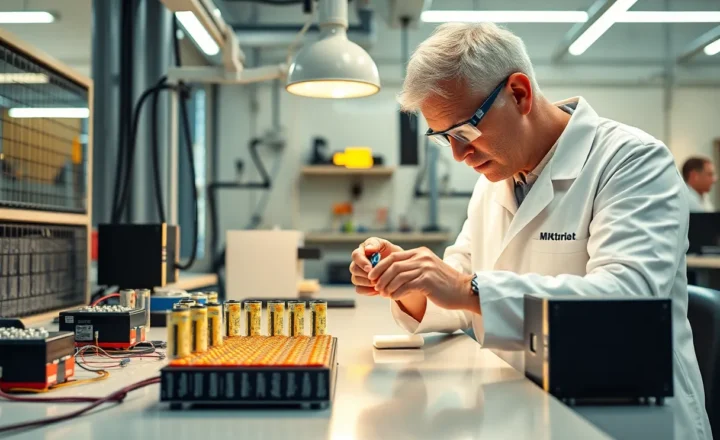
Why Solid-State Batteries Are Still Years Away From Your EV

Jordan Lee
March 1, 2026

Solid-state batteries are the holy grail of EV hype. Higher energy density, faster charging, no fire risk—they solve the problems that plague today’s lithium-ion packs. Toyota, Volkswagen, and a dozen startups have promised production cars by 2027 or 2028. The headlines write themselves. So why are most battery experts still cautious? The gap between lab results and mass production is bigger than the headlines suggest.
What Makes Solid-State Different
Today’s EV batteries use a liquid electrolyte—a flammable gel that conducts ions between the anode and cathode. Solid-state batteries replace that with a solid electrolyte: ceramics, polymers, or composites. No liquid means no leakage, no thermal runaway in the same way, and—in theory—higher energy density because you can use lithium metal anodes instead of graphite.
A lithium-metal anode can hold roughly 10× more charge per gram than graphite. That’s the dream: half the weight, double the range, charge in minutes instead of hours. The solid electrolyte is also supposed to enable faster charging because ions move more predictably through a solid than through a messy liquid. On paper, it’s a slam dunk.
The Manufacturing Problem
Lab cells work. Small batches work. The problem is scale. Solid electrolytes are brittle—ceramics crack under stress, and a battery pack undergoes thermal cycling, vibration, and mechanical load. Tiny cracks create pathways for dendrites—branch-like lithium growths—that can short the cell. In liquid electrolytes, additives and separator design mitigate dendrites. In solid-state, the electrolyte itself has to be perfect.
Manufacturing defect-free solid electrolytes at volume is hard. Ceramics need high temperature and pressure. Thin-film approaches don’t scale to EV-sized cells. Hybrid designs—solid electrolyte with a small amount of liquid—reduce the problem but also reduce the benefits. Every lab breakthrough has to survive the transition from hand-made cells to automated gigafactory production. Most don’t.
Cost is another hurdle. Lithium-ion production has had 30 years to optimize. Solid-state production is still in its infancy. Even if the chemistry works, the capex for new production lines and the learning curve for yield will keep early solid-state batteries expensive. Automakers won’t adopt them until the cost per kWh is competitive—and that timeline keeps slipping.
The Dendrite Problem Isn’t Solved
Dendrites are the ghost at the feast. When you charge a lithium-metal anode, lithium tends to deposit unevenly—in spikes and branches that can pierce the electrolyte and short the cell. Liquid electrolytes slow this down with additives and stable interfaces. Solid electrolytes were supposed to prevent it entirely—lithium can’t grow through a rigid solid, right?
Except it can. Cracks, grain boundaries, and interface instabilities create pathways. Researchers have made progress—better electrolytes, pressure management, interface engineering—but no one has demonstrated a commercially viable cell that survives thousands of cycles without dendrite-related failure. Lab results improve every year. Production-ready cells are still elusive.

Who’s Actually Close?
Toyota has been working on solid-state since the 2000s and has pushed production targets out repeatedly. They’ve shown prototype cells and announced pilot production, but volume EVs with solid-state packs are still a moving target. Volkswagen-backed QuantumScape has reported strong lab data and raised billions, but scaling to automotive volumes is unproven. Samsung, LG, and CATL are all investing—but none has announced a production timeline they’ve hit.
Some startups might get limited production running for niche applications—drones, aviation, high-end performance cars—before mainstream EVs. Lower volume means lower pressure on yield and cost. But “limited production” is not “your next family SUV.”
Lithium-Ion Isn’t Standing Still
While solid-state languishes in the valley of death, lithium-ion keeps improving. Silicon anodes, better cathodes, improved thermal management—each iteration squeezes more range and faster charging from existing chemistry. The gap solid-state was supposed to fill is narrowing. By the time solid-state reaches mass market, lithium-ion may have closed it further.
That doesn’t mean solid-state is pointless. The ceiling is higher—lithium-metal anodes and solid electrolytes can eventually deliver what liquid lithium-ion can’t. But the incentive to rush diminishes when incumbents keep getting better.
What to Expect
Optimistic view: first production EVs with solid-state packs in small volumes by 2027–2028, mainstream adoption by the early 2030s. Pessimistic view: repeated delays, niche adoption first, mass market a decade away. Realistic view: something in between—a few high-profile launches that prove the concept, followed by a slow ramp as manufacturing matures.
If you’re buying an EV in the next few years, assume lithium-ion. Solid-state will arrive when it’s ready—and the lab-to-road path is longer than the headlines suggest.