Portable Projectors in 2026: Good Enough for Real Work?

Rita Chen
February 26, 2026
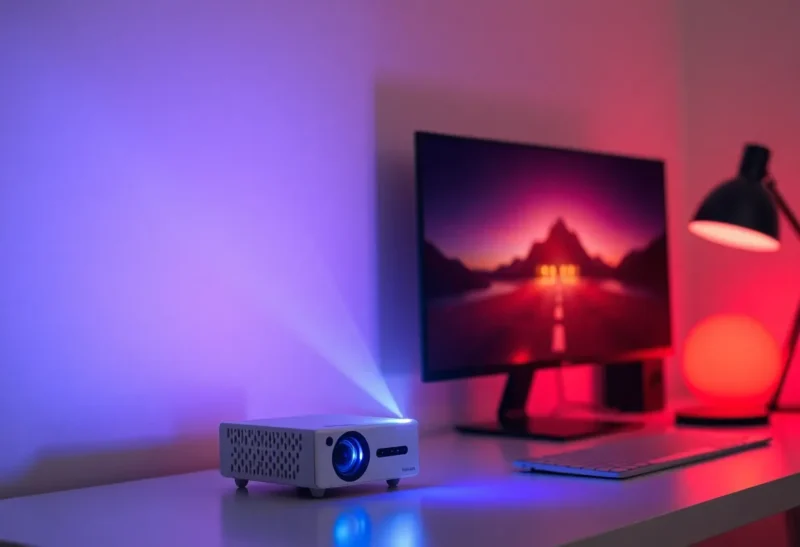
Portable projectors have been “almost there” for years: small enough to throw in a bag, bright enough for a dark room, but rarely good enough for a real presentation or a full day of work. In 2026, the gap is narrowing. The question is whether they’re finally good enough for real work—or still a compromise.
What Portable Projectors Do Well Now
Modern pocket and pico projectors have gotten brighter, sharper, and more reliable. LED and laser light sources last longer and hold their brightness better than the old lamp-based units. Resolution has crept up: 1080p is common in the mid-tier, and 4K options exist if you’re willing to pay and carry a bit more. Battery life on battery-powered models is often one to two hours—enough for a short pitch or a small meeting. USB-C power input means you can often run or charge from a laptop or power bank. For casual use—movie night in a hotel room, a quick demo in a coffee shop—portable projectors are genuinely usable. Auto keystone and auto focus have improved, so you spend less time fiddling with the image. Smart projectors with built-in streaming are an option for entertainment; for work, a dumb projector with good HDMI or USB-C is often the simpler choice.

Where They Still Fall Short
Brightness is the main limit. Even the best portable projectors top out at a few hundred to maybe a thousand lumens. In a lit room or next to a window, that’s not enough for a crisp, readable image. You need controlled lighting or a dark environment. For “real work”—presentations in a typical office, all-day use as a secondary display—that’s a dealbreaker for many. Fixed installations with 3,000+ lumens and proper screens still win for anything serious.
Throw distance and keystone correction help, but setup isn’t instant. You still need a flat surface, a wall or screen, and often a few minutes to align and focus. Built-in speakers are usually weak; you’ll want external audio for anything beyond voice. And while connectivity has improved (HDMI, USB-C, sometimes wireless casting), dealing with dongles and compatibility is still part of the experience. None of this is fatal for occasional use, but it adds friction when you’re under time pressure. Latency can also be an issue for interactive work: if you’re mirroring a screen and need to click or type in real time, some projectors introduce enough delay to feel sluggish. Check reviews for latency numbers if that matters for your workflow.
Portable Projector vs Portable Monitor
For many people, a portable 15–17 inch monitor is a better fit for “work on the go.” It’s brighter, sharper, and doesn’t depend on a wall or a dark room. You give up screen size—a projector can throw a 60–100 inch image—but you gain consistency and simplicity. Choose a projector when you need to share the image with a room (meetings, demos, teaching) or when you want a very large display for media in a controlled space. Choose a portable monitor when you need a reliable second screen for yourself in any environment. The two solve different problems; don’t assume a projector replaces a travel monitor.
What to Look For If You Buy One
Prioritize brightness (lumens), native resolution, and input options. ANSI lumens are the standard; marketing “lux” or “LED lumens” can be inflated. For use in anything but a dark room, aim for at least 300–500 ANSI lumens; 500–1000 is better for spaces with some ambient light. Native 1080p is a good target; avoid “supported” 1080p with a lower native resolution, which means the image is scaled and softer. USB-C with power delivery is convenient if you want one cable for video and power from a laptop. Battery life matters only if you’ll use it unplugged; otherwise, skip the battery and get more brightness or a lower price.
Who They’re Actually For
Portable projectors make sense if you often present in different locations, work from hotels or client sites, or want a big screen for media without a TV. They’re also useful for small teams that don’t have a dedicated meeting room: set up in a corner, dim the lights, and you have a shared display. For that use case, a decent portable projector in the $300–600 range can be a good investment. Below that, you’re trading a lot on brightness and reliability; above it, you’re often paying for features you won’t use on the go.

Good Enough for Real Work?
It depends how you define “real work.” If you need to run full-day workshops, present in bright rooms, or use the projector as a primary display, the answer is still no—get a proper installation or a large portable monitor. If you need to show slides or dashboards in varied, often dim environments, and you’re okay with a few setup minutes and some lighting constraints, then yes: portable projectors in 2026 are good enough. They’ve crossed from “toy” to “tool,” with the usual caveats. Just know the limits before you buy. The best use case is still “I need to show something big to a few people in a room I can dim.” For everything else, there’s usually a better tool—but for that, portable projectors have finally arrived.